Results by title
30 books match the query 'Ann Arbor'

A Catalogue of Greek Manuscripts at the University of Michigan, Ann Arbor, Volume 1
Nadezhda Kavrus-Hoffmann with the collaboration of Pablo Alvarez
University of Michigan Press, 2021
A Catalogue of Greek Manuscripts at the University of Michigan, Ann Arbor is a comprehensive, fully illustrated catalogue of the largest collection of Greek manuscripts in America, including 110 codices and fragments ranging from the fourth to the nineteenth century. The collection, held in the Special Collections Research Center of the University of Michigan Library, contains many manuscripts from Epirus and the Meteora monasteries built on high pinnacles of rocks in Thessaly. Nadezhda Kavrus-Hoffmann has based the manuscript descriptions on the latest developments in the fields of paleography and codicology, including the newest recommendations of the Institute for Research and History of Texts in Paris. The catalogue includes high-resolution plates of all the manuscripts, allowing researchers to compare the entries with other Greek manuscripts around the world. This catalogue contains a trove of fascinating information related to Byzantine culture that will be available for the first time to scholars working on various disciplines of the humanities such as Classical and Byzantine Studies, Art History, Medieval Studies, Theology, and History.
This is the first volume of a projected two-volume set. Volume 2, also by Nadezhda Kavrus-Hoffmann, will contain descriptions of remaining Greek manuscripts in the Library’s collection, starting with Mich. Ms. 59 and ending with Mich. Ms. 238, for a total of 53 manuscripts and 8 fragments. Both volumes will have the same format – catalogue entries for each manuscript together with extensive illustrations. The publication date for Volume 2 has not been established.

A Catalogue of Greek Manuscripts at the University of Michigan, Ann Arbor, Volume 2
Nadezhda Kavrus-Hoffmann with the collaboration of Pablo Alvarez and Julia Miller
University of Michigan Press, 2026
A Catalogue of Greek Manuscripts at the University of Michigan, Ann Arbor, Volume II unveils the rich diversity and enduring legacy of the Greek manuscript tradition preserved in one of North America's largest collections. Building on the acclaimed first volume, this second and concluding volume offers comprehensive illustrated descriptions of eighty-four manuscripts and fragments housed in the University of Michigan Library's Special Collections Research Center. The discovery of twenty-three previously unknown manuscripts and fragments significantly expands our understanding of Byzantine and post-Byzantine book culture, illuminating the remarkable continuity of Greek scholarly, liturgical, and artistic traditions from the ninth through the nineteenth centuries.
Each entry integrates codicological features, handwriting analysis, textual content, decoration, binding, provenance, and references to earlier scholarship as well as high-quality color plates to illustrate representative pages, script types, and illuminations. Among the exceptional highlights are a fragment of The Great Calculation According to the Indians by Maximos Planoudes, preserving portions of this rare mathematical treatise otherwise lost; an illuminated 1371 copy of The Heavenly Ladder by John Klimax, created by the renowned scribe Joasaph II of the Hodegon Monastery in Constantinople; and a newly identified manuscript containing rare patristic homilies linked to the sixteenth-century Choniates scriptorium in Venice.

A History of Ann Arbor
Jonathan Marwil
University of Michigan Press, 1991

A Setting For Excellence, Part II
The Story of the Planning and Development of the Ann Arbor Campus of the University of MichiganFrederick W. Mayer
University of Michigan Press, 2017
By tracing the development of the Ann Arbor campus from its early days to the present, within the context of the evolution of higher education in America, Mayer provides a strong argument for the importance of rigorous and enlightened campus planning as a critical element of the learning environment of the university. His comprehensive history of campus planning, illustrated with photos, maps, and diagrams from Michigan’s history, is an outstanding contribution to the university’s history as it approaches its bicentennial.
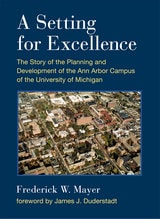
A Setting For Excellence
The Story of the Planning and Development of the Ann Arbor Campus of the University of MichiganFrederick W. Mayer
University of Michigan Press, 2015
By tracing the development of the Michigan campus from its early days to the present, within the context of the evolution of higher education in America, Mayer provides a strong argument for the importance of rigorous and enlightened campus planning as a critical element of the learning environment of the university. His comprehensive history of campus planning, illustrated with photos, maps, and diagrams from Michigan’s history, is an outstanding contribution to the university’s history as it approaches its bicentennial in 2017. Perhaps more important, Mayer’s book provides a valuable treatise on the evolution of campus planning as an architectural discipline.

A University for the 21st Century
James J. Duderstadt
University of Michigan Press, 2000

Ann Arbor Observed
Selections from Then and NowGrace Shackman
University of Michigan Press, 2010
Packed with photographs from Ann Arbor of yesteryear and the present day, Ann Arbor Observed compiles the best of Shackman’s articles in one book divided into eight sections: public buildings and institutions, the University of Michigan, transportation, industry, downtown Ann Arbor, recreation and culture, social fabric and communities, and architecture.
For long-time residents, Ann Arbor expatriates, University of Michigan alumni, and visitors alike, Ann Arbor Observed provides a rare glimpse of the bygone days of a town with a rich and varied history.
Grace Shackman is a history columnist for the Ann Arbor Observer, the Community Observer, and the Old West Side News, as well as a writer for University of Michigan publications. She is the author of two previous books: Ann Arbor in the 19th Century and Ann Arbor in the 20th Century.

Blues in Black and White
The Landmark Ann Arbor Blues FestivalsAs photographed by Stanley Livingston with Text and a History of the Ann Arbor Blues Festival by Michael Erlewine
University of Michigan Press, 2010
"This was really the first time that blues music, especially Chicago/urban blues, was showcased in this way. Sadly, the festivals were not recorded professionally. So Mr. Livingston's photos are the best record of the festivals."
---Michael Jewett, longtime weekday afternoon host of 89.1 Jazz and host of "Blues & Some Uthuh Stuff"
"The photos are works of art. It is great to see photos of musicians such as Buddy Guy and James Cotton looking so young and vibrant. And it is great to see photos of blues legends such as John Lee Hooker, Roosevelt Sykes, Howlin' Wolf, and Son House, who have long since passed away."
---Peter Madcat Ruth, Grammy-winning blues harmonica player
"If Woodstock was one of the Fifty Moments That Changed Rock 'n' Roll History, as honored in Rolling Stone magazine, then the Ann Arbor Blues Festival was the coronation for the blues roots that sired rock to begin with. . . . finally we have this amazing book of Stanley Livingston's priceless images, along with Michael Erlewine's detailed chronology."
---From the foreword by Jim O'Neal, Cofounder, Living Blues Magazine
In 1969 and 1970, the first Ann Arbor Blues Festivals brought together the greatest-ever selection of blues performers---an enormous blues party that seemed to feature every big name in the world of blues.
The Ann Arbor Blues Festival was just that: a festival and celebration of city blues. It helped to mark the discovery of modern blues music (and the musicians who made that music) by a much larger audience. The festival, however, was something more than just a white audience discovering black music.
Never before had such a far-reaching list of performers been assembled, including the grandfathers of southern country blues and the hottest electric bands from Chicago. These groundbreaking festivals were the seed that grew into the Ann Arbor Blues and Jazz Festival, which was continued annually for many years. To name just a few of the dozens of artists who performed at the festival: Luther Allison, John Lee Hooker, Howlin' Wolf, B.B. King, Muddy Waters, Otis Rush, Hound Dog Taylor, Big Mama Thorton, T-Bone Walker, Sippie Wallace, Junior Wells, and Mighty Joe Young.
Stanley Livingston, a professional photographer from Ann Arbor, captured these legendary performances onstage---as well as the goings-on backstage. Livingston's thousands of photographs from these festivals, previously unpublished and known only to a few, are among the finest candid blues shots ever taken. Together with editor and archivist Michael Erlewine's text accompaniments, these photographs, reproduced here as high-quality duotones, comprise a visual history and important keepsake for blues aficionados everywhere.
Stanley Livingston was an award-winning photographer living and working in Ann Arbor until he passed away in 2010, after the book was released.
Michael Erlewine, also from Ann Arbor, is a renowned archivist of popular culture and founder of the All-Music Guide (allmusic.com) and editor of a number of books on blues and jazz.
Cover photo of B.B. King by Stanley Livingston

Cinema Ann Arbor
How Campus Rebels Forged a Singular Film CultureFrank Uhle
University of Michigan Press, 2023
Featuring interviews with filmmaker Ken Burns, Oscar-nominated editor Jay Cassidy, producer John Sloss, and more, this masterpiece provides insights into how a Midwestern college town developed a robust underground art film community that inspired those across the country. Variety’s Owen Glieberman says, “Frank Uhle has captured the moment when cinema became, for a new generation, a kind of religion, with its own rituals and sacred texts and a spirit of exploratory mystery that has all but vanished from the culture.”
This is a must-have book for cinema and media aficionados, film archivists, and anyone interested in the cultural history of Ann Arbor.
This book was published in collaboration with Fifth Avenue Press at Ann Arbor District Library. Learn more about their publishing program here. You can also see their collection, including vintage flyers, photos, film schedules, here.

Conquering Heroines
How Women Fought Sex Bias at Michigan and Paved the Way for Title IXSara Fitzgerald
University of Michigan Press, 2020
Galvanized by their shared experiences with sex discrimination, the Ann Arbor women organized a group called FOCUS on Equal Employment for Women, led by activist Jean Ledwith King. Working with Bernice Sandler of the Women’s Equity Action League, they developed a strategy to unleash the power of another powerful institution—the federal government—to demand change at U-M and, they hoped, across the world of higher education. Prompted by a complaint filed by FOCUS, the U.S. Department of Health, Education, and Welfare soon documented egregious examples of discrimination in Michigan’s practices toward women and threatened to withhold millions of dollars in contracts unless the school adopted remedies. Among the hundreds of similar complaints filed against U.S. colleges in 1970–1971, the one brought by the Michigan women achieved the breakthrough that provided the historic template for settlements with other institutions.
Drawing on oral histories from archives as well as new interviews with living participants, Conquering Heroines chronicles this pivotal period in the histories of the University of Michigan and the women’s movement. An incredible story of grassroots activism and courageous women, the book highlights the kind of relentless effort that has helped make inclusivity an ongoing goal at U-M.
Defending Diversity
Affirmative Action at the University of MichiganPatricia Gurin, Jeffrey S. Lehman, and Earl Lewis, with Eric L. Dey, Gerald Gurin, and Sylvia Hurtado
University of Michigan Press, 2004
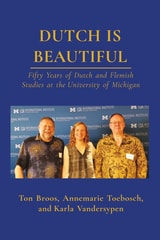
Dutch is Beautiful
Fifty Years of Dutch and Flemish Studies at the University of MichiganTon Broos, Annemarie Toebosch, and Karla Vandersypen
Michigan Publishing Services, 2019
Dutch is Beautiful tells the story of the fifty years of Dutch and Flemish Studies at the University of Michigan in Ann Arbor, Michigan, USA. It is an account of the efforts to promote Dutch and Flemish culture and language, as well as a description of how the teaching of Dutch language, literature, history and culture can be a tool to look at a world of diverse identities. It also offers a comprehensive overview of the beginnings of a successful program that included Dutch writers-in-residence, visiting Netherlands professors, cultural and educational events, arts, music, films, conferences and publications. Several alumni of the program look back at their college years with appreciation. Articles and essays on history, Anne Frank, and conversations on colonialism discuss critical and educational views on Dutch and Flemish Studies in past, present and future, when diversity, equity and inclusion are important goals and objectives, and public scholarship and academic activism will be a larger part of the curriculum. This book will inform, entertain, stimulate and impress everyone who is interested in the culture of the Low Countries. The title says it all!
Everybody In, Nobody Out
Inspiring Community at Michigan's University Musical SocietyKen Fischer with Robin Lea Pyle
University of Michigan Press, 2020
The approach not only deepened UMS’s engagement with the university and southeast Michigan communities, it led to exemplary partnerships with distinguished artists across the world. Under Fischer’s leadership, UMS hosted numerous breakthrough performances, including the Vienna Philharmonic’s final tour with Leonard Bernstein, appearances by then relatively unknown opera singer Cecilia Bartoli, a multiyear partnership with the Royal Shakespeare Company, and artists as diverse as Yo-Yo Ma, Jawole Willa Jo Zollar, Elizabeth Streb, and Nusrat Fateh Ali Khan.
Though peppered with colorful anecdotes of how these successes came to be, this book is neither a history of UMS nor a memoir of Fischer’s significant accomplishments with the organization. Rather it is a reflection on the power of the performing arts to engage and enrich communities—not by handing down cultural enrichment from on high, but by meeting communities where they live and helping them preserve cultural heritage, incubate talent, and find ways to make community voices heard.

Hillel at Michigan, 1926/27-1945
Struggles of Jewish Identity in a Pivotal EraAndrei S. Markovits and Kenneth Garner
Michigan Publishing Services, 2016
The study analyzes Hillel's challenges as a big-tent, catch-all institution trying to represent all Jewish students on campus regardless of their religious orientation, cultural preferences, and ideological predilections. It looks at Hillel's interactions with the then powerful Jewish fraternities and sororities that provided the main locus of Jewish life on campus at the time, as well as its relations with the University's leadership and many of its cultural and political constituencies. Most of these activities occurred at a time when anti-Semitism was rife in the United States, particularly in the larger Detroit area, home to Henry Ford and Father Charles Edward Coughlin.

In the Name of Editorial Freedom
125 Years at the Michigan DailyEdited by Stephanie Steinberg
University of Michigan Press, 2015
Search and browse the Bentley Historical Library's Michigan Daily Archive, https://digital.bentley.umich.edu/midaily. The free online archive contains stories from 23,000 issues published between 1891 and 2014.
--John U. Bacon, bestselling author of Three and Out: Rich Rodriguez and the Michigan Wolverines in the Crucible of College Football and Endzone: The Rise, Fall, and Return of Michigan Football
—Mary Sue Coleman, President Emerita at the University of Michigan
—James J. Duderstadt, President Emeritus at the University of Michigan
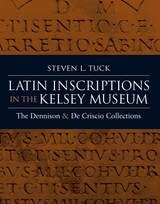
Latin Inscriptions in the Kelsey Museum
The Dennison and De Criscio CollectionsSteven L. Tuck
University of Michigan Press, 2006
The 400 entries in this volume include all of the Latin inscriptions on stone or metal in the Kelsey Museum of Archaeology at the University of Michigan; they represent the largest, and arguably the most important, collection of Latin inscriptions in the Western Hemisphere. The collection is notable not just for its size but for the fact that almost all the inscriptions were acquired by purchase for their scholarly and educational value to the members of the university community. Because of this, the collection is also an important testimony to a seminal phase in the development of the study of Classics at the University of Michigan. For the first time ever, this project makes the Latin inscriptions of the Kelsey available in one volume and has provided an opportunity to reexamine some texts that have not been edited in over a century. The commentaries for this edition have benefited from a wealth of recent scholarship resulting in some amended readings and reidentification of texts.
Steven L. Tuck is Assistant Professor of Classics at Miami University of Ohio.
The Kelsey Museum Studies series, edited by University of Michigan professors Elaine Gazda, Margaret Cool Root, and John Pedley, is designed to publish unusual material in the Museum's collections, together with reports of current and past archaeological expeditions sponsored by the University of Michigan.

Leaders in Plastic Surgery
The Dingman-Grabb Era 1946-1986Robert M. Oneal, MD, and Lauralee A. Lutz
Michigan Publishing Services, 2017
Medical Lives and Scientific Medicine at Michigan, 1891-1969
Joel D. Howell, Editor
University of Michigan Press, 1993

Ninety Years Crossing Lake Michigan
The History of the Ann Arbor Car FerriesGrant Brown, Jr.
University of Michigan Press, 2008
"A must buy for anyone interested in the Great Lakes."
---Frederick Stonehouse, maritime historian
In 1892, the Ann Arbor Car Ferries shook the transportation world by doing what was then deemed impossible---carrying loaded railroad cars by ship across the sixty-two miles of open water between Frankfort, Michigan and Kewaunee, Wisconsin. With passion, acuity, and remarkable detail, Grant Brown describes the nearly 100-year crossings---from their beginnings with James Ashley's bold new idea of car ferrying down to the last fight for survival until the Michigan Interstate Rail Company finally closed in 1982.
Crossing the lake with loaded freight cars was a treacherous task that presented daily obstacles. Knowledgeable people believed it was impossible to secure rail cars from tipping over and sinking the ship. Weather and ice presented two near-insurmountable hurdles, making car ferrying doubly difficult in the winter when nearly all shipping on the Great Lakes shut down. This vivid history gives voice to the ships and their crews as they battled the storms without modern navigational aids or adequate power.
This spirited account of the Ann Arbor car ferries draws on ships' logs from various museums, over 2,000 newspaper articles, annual reports from 1889 through 1976, and interviews with former employees. The result is a living history of the ships, the crews, and their adventures; of the men who built and ran the business; and of the enormous influence the vessels had on the communities they served.
Grant Brown, Jr., worked for S.D. Warren Company, a paper manufacturer, for 37 years. He raced sailboats on Crystal Lake in northern Michigan for ten years while growing up, continued in Boston and St. Louis, and has since returned to living and racing in Frankfort, Michigan. He spent eight years in the U.S. Coast Guard Reserve, where he learned navigation and shipboard procedure.
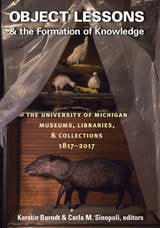
Object Lessons and the Formation of Knowledge
The University of Michigan Museums, Libraries, and Collections 1817–2017Kerstin Barndt and Carla M. Sinopoli, editors
University of Michigan Press, 2017
Papyri from Karanis
The Granary C123W. Graham Claytor and Arthur Verhoogt, editors
University of Michigan Press, 2018
The documents are presented with an introduction, transcription of the original Greek or Latin, translation, commentary, and images. A unique community prayer to the emperor and gods (827) is the volume’s most notable contribution. The other papyri are a mix of private and public documents (petitions, declarations, letters, lists, etc.) that date from between the first century BCE and the fourth century CE. The typological and chronological mix of texts shows that they do not form an undisturbed archive but were rather a dump of wastepaper and other household objects.
Michigan’s excavated papyri are here presented for the first time on the basis of their archaeological find spot rather than being organized according to content. The volume’s introduction provides a possible model for analyzing legacy data from the Karanis excavations stored at the University of Michigan. The book will be of interest to papyrologists, ancient historians, and archaeologists of Greco- Roman Egypt.

Paralyzing Summer
The True Story of the Ann Arbor V.A. Hospital Poisonings and DeathsZibby Oneal and S. Martin Lindenauer
University of Michigan Press, 2016
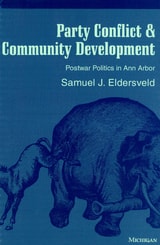
Party Conflict & Community Development
Postwar Politics in Ann ArborSamuel J. Eldersveld
University of Michigan Press, 1995
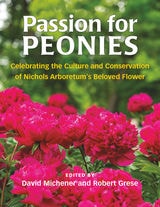
Passion for Peonies
Celebrating the Culture and Conservation of Nichols Arboretum's Beloved FlowerDavid Michener and Robert Grese, Editors
University of Michigan Press, 2020
Originally planted in 1922, the Nichols Arboretum Peony Garden now boasts North America’s largest public collection of heirloom herbaceous peonies. The Peony Garden has become a sacred space for the Ann Arbor community, a not-to-be-missed sensation when it erupts each season, as the Ann Arbor Observer once wrote, in “a riot of color, of crimson, rose and shell pink intermingled with fluffy pompoms of creamy white.” The rather short period of peak bloom—about two fleeting weeks each year—only seems to intensify the garden’s appeal, drawing thousands of visitors annually to this spectacular “living museum” on campus that showcases upwards of 10,000 blossoms.
Richly illustrated with hundreds of striking color photos, Passion for Peonies collects twenty short essays that celebrate the story of the Nichols Arboretum Peony Garden as well as the rich social history of peony gardening that it is an integral part of. Together these pieces comprise a love letter both to a magical public space at the University of Michigan and to the broader history and culture of peony gardening. The book will appeal to readers interested in the University of Michigan, the history of public gardens, and of course peonies!
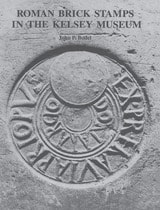
Roman Brick Stamps in the Kelsey Museum
John P. Bodel
University of Michigan Press, 1983

Shaping Nursing Science and Improving Health
The Michigan LegacyShaké Ketefian, editor
Michigan Publishing Services, 2016
The work covers selectively the development of nursing science over a period of some thirty years which was undertaken by nursing faculty and the School’s PhD Alumni. The account of the strategic development of a program of research across bio-behavioral phenomena, health promotion/risk reduction, women’s health and nursing and health care systems is instructive. Substantive contributions have been made across the selected areas; of note also is the impact of translational science on health outcomes of individuals and communities. The accounts of the purposeful development of health informatics in nursing and leadership as scholarship are also highly developed. The book is a valuable contribution to the literature on how nursing research at Michigan is helping transform the lives of patients, families and communities.

The Boundaries of Pluralism
The World of the University of Michigan’s Jewish Students from 1897 to 1945Andrei S. Markovits & Kenneth Garner
Michigan Publishing Services, 2020
Raoul Wallenberg Distinguished University Professor of History,
University of Michigan
Arthur F. Thurnau Professor, University of Michigan,
and Director, Bentley Historical Library

The Unlikely Saga of a Singer from Ann Arbor
The Autobiography of Willis C. Patterson, BassoWillis Patterson
Michigan Publishing Services, 2015
The book’s main character begins his life, similar to a diamond in the rough, and over time evolves into a rare gem at maturity. These pages will reveal how Willis Patterson of Ann Arbor, Michigan developed from somewhat of a lost child in the 1930s into a: sophisticated academician (Ph.D. in Higher Education Administration and Supervision from Wayne State University in Detroit, MI); a superior vocal performer; Voice Department Chair, Fulbright Scholar; esteemed Master Voice Teacher; Choral and Glee Club director extraordinaire; University Leader in the recruitment and retention of Minority students (Voice/Performing/Composition); an established Church Choir Director; and Associate Academic Dean of the School of Music at one of America’s finest universities, the University of Michigan.
This book is about a very humble man of significant stature. Although he was motivated and driven to become the best he could be in his quest for excellence—by kicking open the door of opportunity whenever it was presented (audition ready)—he never forgot his family members or hometown acquaintances.

Women at Michigan
The "Dangerous Experiment," 1870s to the PresentRuth Bordin
University of Michigan Press, 2001
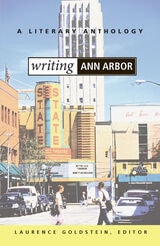
Writing Ann Arbor
A Literary AnthologyLaurence Goldstein, Editor
University of Michigan Press, 2005
The anthology is eclectic and engaging, with many wonderful surprises: an essay on the Underground Railroad in Ann Arbor; one on basketball legend Cazzie Russell; an essay by Arthur Miller; an excerpt from Joyce Carol Oates's All the Good People I've Left Behind; a selection from Tender at the Bone: Growing Up at the Table by food writer and Gourmet magazine editor Ruth Reichl; and much more.
This is more than a series of portraits of Ann Arbor and the University of Michigan; it is a miniature time capsule, a look into the shifting cultural currents of the last two centuries from some of the greatest thinkers and writers of those times.
Poet and literary scholar Laurence Goldstein is Professor of English at the University of Michigan and Editor of the Michigan Quarterly. He is the author of three books of poetry and several books of literary criticism, including The American Poet at the Movies.