Results by title
3 books match the query 'Antigone'
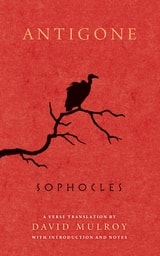
Antigone
Sophocles; A verse translation by David Mulroy, with introduction and notes
University of Wisconsin Press, 2013
David Mulroy’s translation of Antigone faithfully reproduces the literal meaning of Sophocles’ words while also reflecting his verbal pyrotechnics. Using fluid iambic pentameters for the spoken passages and rhyming stanzas for the songs, it is true to the letter and the spirit of the great Greek original.

Antigone
Sophocles
University of Chicago Press, 2013
Drawn from the authoritative third edition of the University of Chicago Press’s Complete Greek Tragedies series, this stand-alone edition of Elizabeth Wyckoff’s elegant rendition of Antigone reminds readers why it endures as one of the most widely read and admired of Sophocles’s plays. Though the story unfolds in the aftermath of Oedipus the King, Antigone was the first of the Theban Plays written by Sophocles.
Mark Griffith and Glenn W. Most’s introduction to the story of one woman’s brave resistance in the face of unfathomable loss provides essential information about the play’s first production, plot, and reception in antiquity.
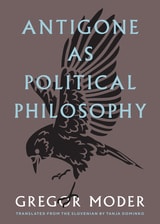
Antigone as Political Philosophy
Gregor Moder, Tanja Dominko
Northwestern University Press, 2026
Offering a new perspective on Sophocles’s Antigone as a model for reimagining humanity’s future—and its end
Why read Antigone today? The premise of this accessible, essayistic work is that humanity finds itself at a crossroads, where it must reinvent itself or perish—a condition similar to Antigone’s own. Rereading Antigone via Hegel’s engagement with the text can help us understand what it means for a human age to come to an end: that is, to think of our age as an episode whose collapse is also an engine of historical change.
Gregor Moder argues that the task of humanity today may not be to defend the minimal remnants of our civilization but to say farewell to it—to give it a proper burial. As Moder explicates, the central problem of this foundational tragedy lies in the positions of brother and sister, man and woman, representing human and divine law and the institutions of the state and the family. Through a fresh reading of both Sophocles’s play and Hegel’s productive reworking of the Greek myth, Moder’s analysis shows that sometimes the only way through deep social contradictions is in unraveling the framework that has constructed them.