Results by title
23 books match the query 'Valley'

Agricultural Intensification and Prehistoric Health in the Valley of Oaxaca, Mexico
Denise C. Hodges
University of Michigan Press, 1989

Corvallis Trails
Exploring the Heart of the ValleyMargie C. Powell
Oregon State University Press, 2006
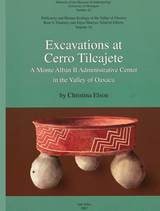
Excavations at Cerro Tilcajete
A Monte Albán II Administrative Center in the Valley of OaxacaChristina Elson
University of Michigan Press, 2007
Fabrica San Jose and Middle Formative Society in the Valley of Oaxaca
Robert D. Drennan
University of Michigan Press, 2019
Formative Mesoamerican Exchange Networks with Special Reference to the Valley of Oaxaca
Jane W. Pires-Ferreira
University of Michigan Press, 2019
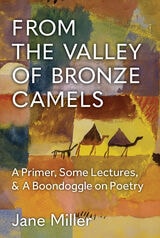
From the Valley of Bronze Camels
A Primer, Some Lectures, & A Boondoggle on PoetryJane Miller
University of Michigan Press, 2022
Jane Miller loves poetry. In these provocative and deeply insightful essays, she unpacks the work of giants like Adrienne Rich, Paul Celan, Marina Tsvetaeva, Osip Mandelstam, and Federico García Lorca alongside painters such as Caravaggio and Paul Klee, as well as ancient Chinese music and techniques of the contemporary poem. Miller explores the use of the question mark in the history of poetry and its function as a revelation of poetic voice. She considers the positive and negative aspects of surrealism on the contemporary poem, its anti-feminist origins in France, its contemporary usage, and the benefits of super-real images. Miller examines how identity politics might affect the imagination. She describes ancient Chinese musical instruments to show how their sounds resonate off/in American poems and on the aural integrity of the lyric poem. She interrogates the political implications of language and the degeneration and regeneration of words. Finally, in an essay about what she dares not say about poetry, she comes out against forms of surrealism, narrative, jargon, rhetoric, irony, and appropriation. This masterful work can be read as advice to a young writer, but it also invites us into the mind of a writer who has developed her craft through the course of a lifetime of writing, reading, and exploring the world, showing not only the ideas that influenced her—feminist, lesbian, and international works—but also how Miller has, in turn, influenced ideas.
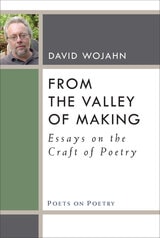
From the Valley of Making
Essays on the Craft of PoetryDavid Wojahn
University of Michigan Press, 2015
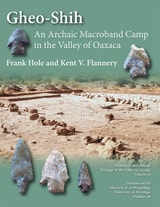
Gheo-Shih
An Archaic Macroband Camp in the Valley of OaxacaFrank Hole and Kent V. Flannery
University of Michigan Press, 2024
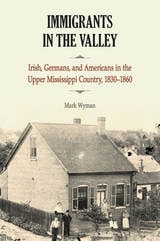
Immigrants in the Valley
Irish, Germans, and Americans in the Upper Mississippi Country, 1830-1860Mark Wyman
Southern Illinois University Press, 1984
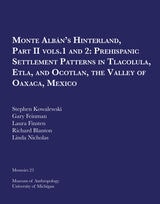
Monte Albán's Hinterland, Part II
Prehispanic Settlement Patterns in Tlacolula, Etla, and Ocotlan, the Valley of Oaxaca, Mexico, Vols. 1 and 2Stephen Kowalewski, Gary Feinman, Laura Finsten, Richard Blanton, and Linda Nicholas
University of Michigan Press, 1989
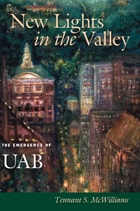
New Lights in the Valley
The Emergence of UABTennant S. McWilliams
University of Alabama Press, 2007
A scholarly narrative of UAB from its nascent beginnings through the mid 1990s.
While the economy and culture of the post—World War II South changed from an era of material capital (e.g., cotton and iron ore) to a period of social capital (intellectual development and networked approaches to social change), one of the most important components of urban life, the university, emerged as both a creator and a reflector of such modernization.
This is the case with Birmingham and its youthful institution of higher learning, the University of Alabama at Birmingham. From its early days as a struggling offshoot of the capstone campus in Tuscaloosa, UAB’s journey to its current status as a major university has been a bumpy but interesting one. Tennant McWilliams, a longtime UAB history professor, explores the whole range of historical considerations, including UAB’s similarities and connections to trans-Atlantic civic universities; the irony of the shift from Big Steel to Big Medicine in Birmingham; the visionary administrations of Joseph F. Volker and others; and the evolving decision to make non-medical life at UAB less of a commuter experience and more of a traditional campus experience.
McWilliams does not palliate the missteps and disputes that have, from time to time, impeded the institution’s progress. But he explains why, despite various hurdles and distractions, UAB has risen to be Alabama’s largest employer and can rightly boast that its complex of health care services, especially organ transplantation and neuroscience, as well as such fields as philosophy and psychology, are among the best in the nation.
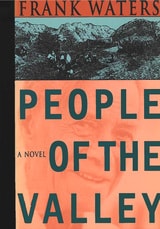
People Of The Valley
A NovelFrank Waters
Ohio University Press, 1941
One of Frank Waters’s most popular novels, People of the Valley takes place high in the Sangre de Cristo Mountains where an isolated Spanish-speaking people confront a threatening world of change.
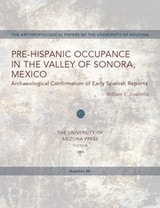
Pre-Hispanic Occupance in the Valley of Sonora, Mexico
Archaeological Confirmations of Early Spanish ReportsWilliam E. Doolittle
University of Arizona Press, 1988
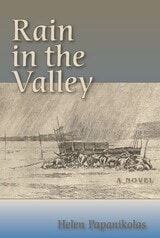
Rain in the Valley
A NovelHelen Papanikolas
Utah State University Press, 2005
Three generations of the Demas family face the ups and downs of the twentieth century after their fathers leave the coal mines that drew them from Greece to America, become wool growers and small businessmen, and Americanize their Demopoulos name. As the years pass, the family accumulates untidy lives and tragedies. Parents seek to keep their children tightly bound by old-country customs, to arrange marriages, and to foist their views of women’s inferiority on their daughters. Lia Papastamos in particular, child of a forced marriage between her Greek father and Amerikanidha mother, pulls away from the stifling burden of family tradition and interference, but she and her husband must contend with the decline that time, synthetics, and changing tastes bring to a once-thriving sheep business.
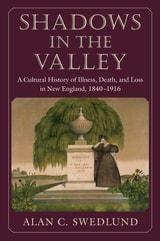
Shadows in the Valley
A Cultural History of Illness, Death, and Loss in New England, 1840-1916Alan Swedlund
University of Massachusetts Press, 2010
How does the experience of sickness, death, and loss change over time? We know that the incidence and virulence of particular diseases have varied from one period to another, as has their medical treatment. But what was it like for the individuals who suffered and died from those illnesses, for the health practitioners and institutions that attended to them, and for the families who buried and mourned them?
In Shadows in the Valley, Alan Swedlund addresses these questions by closely examining the history of mortality in several small communities in western Massachusetts from the mid-nineteenth to the early twentieth century—from just before the acceptance of the germ theory of disease through the early days of public health reform in the United States. This was a time when most Americans lived in rural areas or small towns rather than large cities. It was also a time when a wide range of healing practices was available to the American public, and when the modern form of Western medicine was striving for dominance and authority. As Swedlund shows, this juncture of competing practices and ideologies provides a rich opportunity for exploring the rise of modern medicine and its impact on the everyday lives of ordinary Americans.
To indicate how individuals in different stages of their lives were exposed to varying assaults on their health, the book is structured in a way that superimposes what the author calls “life-course time” onto chronological time. Thus the early chapters look at issues of infancy and childhood in the 1840s and 1850s and the last chapters at the problems of old age after 1900. The reader becomes familiar with specific individuals and families as they cope with the recurrent loss of children, struggle to understand the causes of new contagions, and seek to find meaning in untimely death. By using a broad time frame and a narrow geographical lens, Swedlund is able to engage with both the particularities and generalities of evolving medical knowledge and changing practice, and to highlight the differences in personal as well as collective responses to illness and loss.
Sixteenth Century Maiolica Pottery in the Valley of Mexico
Florence C. Lister and Robert H. Lister
University of Arizona Press, 1982
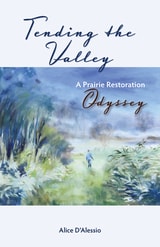
Tending the Valley
A Prairie Restoration OdysseyAlice D'Alessio
Wisconsin Historical Society Press, 2020
In Tending the Valley, Alice chronicles their efforts to return the land to its natural prairie state and to manage their oak and pine woods. Along the way they joined the land restoration movement, became involved in a number of stewardship groups, and discovered the depths of dedication and toil required to bring their dream to fruition. With hard-earned experience and the evocative language of a poet, D’Alessio shares her personal triumphs and setbacks as a prairie steward, along with a profound love for the land and respect for the natural history of the Driftless.
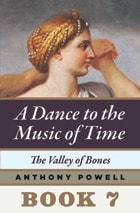
The Valley of Bones
Book 7 of A Dance to the Music of TimeAnthony Powell
University of Chicago Press, 1995
Anthony Powell’s universally acclaimed epic A Dance to the Music of Time offers a matchless panorama of twentieth-century London. Now, for the first time in decades, readers in the United States can read the books of Dance as they were originally published—as twelve individual novels—but with a twenty-first-century twist: they’re available only as e-books.
World War II has finally broken out, and The Valley of Bones (1964) finds Nick Jenkins learning the military arts. A stint at a training academy in Wales introduces him to the many unusual characters the army has thrown together, from the ambitious bank clerk-turned-martinet, Gwatkin, to the hopelessly slovenly yet endearing washout, Bithel. Even during wartime, however, domestic life proceeds, as a pregnant Isobel nears her term and her siblings’ romantic lives take unexpected turns—their affairs of the heart lent additional urgency by the ever-darkening shadow of war.
"Anthony Powell is the best living English novelist by far. His admirers are addicts, let us face it, held in thrall by a magician."--Chicago Tribune
"A book which creates a world and explores it in depth, which ponders changing relationships and values, which creates brilliantly living and diverse characters and then watches them grow and change in their milieu. . . . Powell's world is as large and as complex as Proust's."--Elizabeth Janeway, New York Times
"One of the most important works of fiction since the Second World War. . . . The novel looked, as it began, something like a comedy of manners; then, for a while, like a tragedy of manners; now like a vastly entertaining, deeply melancholy, yet somehow courageous statement about human experience."--Naomi Bliven, New Yorker
“The most brilliant and penetrating novelist we have.”--Kingsley Amis

The Valley of Shadows
SANGAMON SKETCHESFrancis Grierson
University of Illinois Press, 1990
undertones. In this her fourth collection she finds Ovid in Provincetown,
a right whale in Iowa, and Cleopatra in the afterworld. Nothing resides
in its proper place, except the place of exile. "Characteristic wit,
irony, and precision." —Publishers Weekly
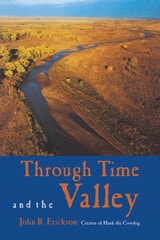
Through Time and the Valley
John R. Erickson
University of North Texas Press, 1995
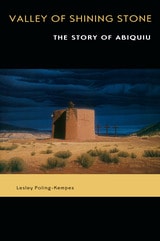
Valley of Shining Stone
The Story of AbiquiuLesley Poling-Kempes
University of Arizona Press, 1997
O'Keeffe saw the magic of sandstone cliffs and turquoise skies, but her life and death here are only part of the story. Reading almost like a novel, this book spills over with other legends buried deep in time, just as some of North America's oldest dinosaur bones lie hidden beneath the valley floor. Here are the stories of Pueblo Indians who have claimed this land for generations. Here, too, are Utes, Navajos, Jicarilla Apaches, Hispanos, and Anglos—many lives tangled together, yet also separate and distinct.
Underlying these stories is the saga of Ghost Ranch itself, a last living vestige of the Old West ideal of horses, cowboys, and wide-open spaces. Readers will meet a virtual Who's Who of visitors from "dude ranch" days, ranging from such luminaries as Willa Cather, Ansel Adams, and Charles Lindbergh to World War II scientist J. Robert Oppenheimer and his colleagues, who were working on the top-secret atomic bomb in nearby Los Alamos. Moving on through the twentieth century, the book describes struggles to preserve the valley's wild beauty in the face of land development and increased tourism.
Just as the Piedra Lumbre landscape has captivated countless wayfarers over hundreds of years, so its stories cast their own spell. Indispensable for travelers, pure pleasure for history buffs and general readers, these pages are a magic carpet to a magic land: Abiquiu, Ghost Ranch, the Valley of Shining Stone.
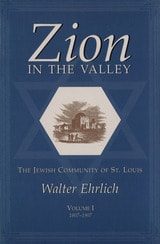
Zion in the Valley, Volume I
The Jewish Community of St. Louis, Volume I, 1807-1907Walter Ehrlich
University of Missouri Press, 1997
St. Louis contains one of the largest Jewish communities in the interior of the United States. Yet, despite the important contributions of St. Louis Jews to the city's cultural and economic growth and to national and international Jewry, no history of their accomplishments has heretofore been written.
In this masterful book, Walter Ehrlich shows how the St. Louis Jewish community grew in two separate yet intricately related milieux. One was the internal socioreligious community, which centered on relations of Jews with fellow Jews. The other was the broader secular environment, in which Jews individually and collectively interacted with the non-Jewish population, assuming significant roles in the political, economic, social, and religious developments of one of the country's most important urban centers.
Employing many previously unused primary materials--especially congregational archives, organizational and business records, contemporary newspapers, and vivid personal memoirs--Ehrlich presents a fascinating description of how individuals and groups contributed to the growth and development of a major American urban area. He clarifies significant aspects of social and economic structure, mobility, and philanthropy within the Jewish community and integrates them within the broader framework of American society. In the process, Ehrlich provides a unique perspective on St. Louis history, as well as on American urban, ethnic, and immigration history.
Zion in the Valley is an invaluable contribution to the field of Jewish studies. It will appeal to scholars and students of Jewish, urban, and ethnic history, as well as to members of the broader St. Louis community.
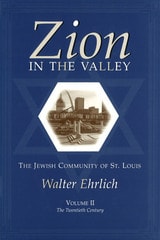
Zion in the Valley, Volume II
The Jewish Community of St. Louis, Volume II, The Twentieth CenturyWalter Ehrlich
University of Missouri Press, 2002