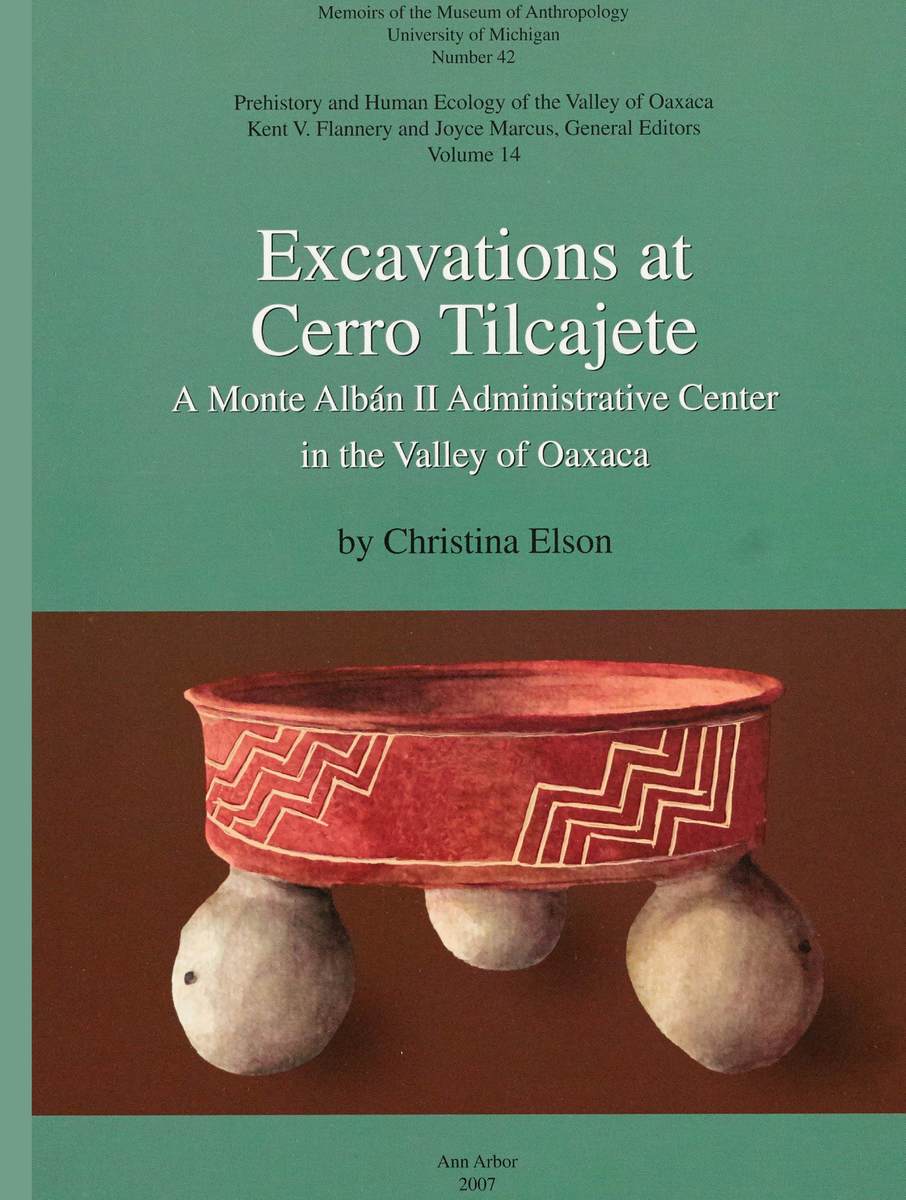
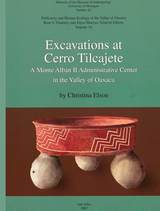
Excavations at Cerro Tilcajete: A Monte Albán II Administrative Center in the Valley of Oaxaca
by Christina Elson
University of Michigan Press, 2007
Paper: 978-0-915703-66-1 | eISBN: 978-1-951519-84-1 (standard)
Library of Congress Classification F1219.8.Z37E57 2007
Dewey Decimal Classification 972.7401
Paper: 978-0-915703-66-1 | eISBN: 978-1-951519-84-1 (standard)
Library of Congress Classification F1219.8.Z37E57 2007
Dewey Decimal Classification 972.7401
ABOUT THIS BOOK | TOC | REQUEST ACCESSIBLE FILE
ABOUT THIS BOOK
This volume, part of a series on the prehistory and human ecology of the Valley of Oaxaca, Mexico, focuses on Cerro Tilcajete, a secondary administrative center below Monte Albán, the capital of the prehispanic Zapotec state.
TABLE OF CONTENTS
Contents
List of Tables, 000
List of Illustrations, 000
Introduction to Volume 14,000
Acknowledgments, 000
CHAPTER 1. INTRODUCTION TO ELITES AT SECONDARY CENTERS IN THE
ZAPOTEC STATE
An Overview of Cerro Tilcajete and the Early Zapotec State
Anthropological Approaches to Defining Zapotec Elites
Zapotec Elites As Members of Socioeconomic Groups
Zapotec Elites as Administrators
Zapotec Elites, Power Sharing, and Conflict
Summary
CHAPTER 2. ELITE BEHAVIOR IN THE EARLY ZAPOTEC STATE
Zapotec Polities in the Sixteenth Century
Zapotec Nobles
Zapotec Policy Makers
Zapotec Priests
Zapotec Warriors
Zapotec Merchants
Summary
CHAPTER 3. THE OAXACA VALLEY IN THE TERMINAL FORMATIVE PERIOD
(100 B.C.-A.D. 200)
Archaeological Indicators of Elite Behavior
The Regional Picture
The Settlement Hierarchy
I-Shaped Ballcourts
Pottery Production Network
Monte Alb¿n
The North Platform Governmental Palace
The Main Plaza
The Mound of the Carved Stone
The Northeast Zone
Zone East of Building P
The El Pitahayo Mounds
Mounds and Terraces on the North Slope
Summary
San Jos¿ Mogote
Dainz¿
Regions Outside the Valley
The Cuicatl¿n Ca¿ada
Ejutla
Summary
CHAPTER 4. CERRO TILCAJETE IN MONTE ALBçN II
Surface Data
Site Layout and Occupational History
Surface Ceramics as Possible Clues to Status
Other Materials from the Surface
Summary
Excavation Data
Temples and Civic-Ceremonial Buildings
Structure 2
Mound E
Residential Excavations
Structure 1
Structure 3
Structure 4
Pottery Types Believed to Reflect Status
Ceramic Types and Forms Found in Residences
Ceramic Types and Forms Found in Middens
Subsistence Activities
Household Ritual
Figurines and Urns
Incense Burners
Mortuary Ritual
Obsidian
Shell
Summary
CHAPTER 5. CERRO TILCAJETE AND THE DECLINE OF THE ZAPOTEC STATE
Monte Alb¿n
The Oaxaca Valley in the Classic Period
The Chronology of the Late Classic and Epiclassic
Jalieza
Cerro Tilcajete
The Adoratory and Mound F at Cerro Tilcajete
The North Mound Complex
Structure 5 Ceramics
Summary
CHAPTER 6. CONCLUSIONS
Appendix A: Ceramic Terms, Analysis, and Illustrations
Appendix B: Inventory of Human Remains From Surface Collections and Features in
Structures, by William Duncan, 000
Appendix C: The Shell Assemblage from Cerro Tilcajete, by Gary M. Feinman and
Linda M. Nicholas, 000
Appendix D: Resumen en Espa¿ol
References Cited
Tables
3.1	Settlement hierarchy and population ranges for Monte Alb¿n Late I and Monte
Alb¿n II sites.
4.1	Mounds and plaza dimensions at Cerro Tilcajete.
4.2	Surface data by collection unit.
4.3	Surface data by collection unit (non-vessels).
4.4	Surface ceramic categories by zone.
4.5	Ceramics coded in Test Pit 1, Mound E.
4.6	Descriptive data from Structure 4 burials.
4.7	Ceramics in residential structures by paste, diagnostic form, and type.
4.8	Ceramics in residential structures by form.
4.9	Minimum number of vessels in Feature 1, Structure 3.
4.10	Minimum number of vessels in Feature 6, Structure 4.
4.11	Minimum number of vessels in Feature 2, Structure 4.
4.12	Ceramics by weight and number in Feature 2, Structure 4.
4.13	Figurines in residential structures.
4.14	Obsidian in Structures 1-4.
5.1	Paste and weight of sherds in Feature 1, Mound E.
5.2	Diagnostic sherds in Feature 1, Mound E by type.
A.1 Data on G.12 motifs and rim forms from residential structures.
A.2 Diagnostic elements of G.29 vessels in residential structures.
A.3 Diagnostic aspects of orange-paste ceramics.
A.4 Bowl and vase rim forms coded for cream-paste vessels.
A.5 Motifs on C.11 and C.12 vessels.
A.6 The frequency of cream paste types of all decorated cream vessels coded.
A.7 	Shell found in surface collections.
A.8 	Shell in excavations by excavation area and genus.
A.9 	Shell in excavations by excavation area and ornament class.
A.10 	Shell in excavations by object and genus.
A.11 	Shell in excavations by ornament type and genus.
Illustrations
Frontpiece. Monte Alb¿n as viewed from Cerro Tilcajete's Main Plaza.
1.1 Mexico, showing the location of the Oaxaca Valley.
1.2 The Oaxaca Valley showing places mentioned in the text.
1.3 Cerro Tilcajete from an adjoining hilltop to the south.
2.1	Formative Period depiction of Cociyo.
2.2	Plan of Yagul's ceremonial core.
3.1	Plan of Cerro Tilcajete showing mound groups and the ceremonial core.
3.2	The Monte Alb¿n II Settlement Hierarchy in the Oaxaca Valley.
3.3	The I-shaped ballcourt at Monte Alb¿n.
3.4	Cream paste bowl with incised lightning designs and bulbous supports.
3.5	Orange paste bowl with red-painted designs found at Cerro Tilcajete.
3.6	Plan of Monte Alb¿n's ceremonial core.
3.7	Plan of the Pitahayo mound group at Monte Alb¿n.
3.8	A detailed view of the North Mound Platform at Monte Alb¿n.
3.9	Three ceramic statues from Tomb 113, a Monte Alb¿n II tomb at Monte Alb¿n.
3.10	An urn from the antechamber of Tomb 104 at Monte Alb¿n.
3.11	Plan of Tomb 95 and 96 in the Pitahayo mound group.
3.12	Plan of Tomb 77 and 78 in the Pitahayo mound group.
3.13	Map of San Jos¿ Mogote.
3.14	Map of Dainz¿.
4.1	The relationship between El Palenque, Cerro Tilcajete, and Jalieza.
4.2	Plan of Cerro Tilcajete showing surface collection and terraces.
4.3	Map showing the frequency of cream paste ceramics across the surface of Cerro
Tilcajete.
4.4	Plan of Structure 2, Mound B.
4.5	Profile of the east retaining wall of Mound B.
4.6	Profile of the west plaza-facing wall of Mound B.
4.7	Plan of Monte Alb¿n II structures on Mound E.
4.8	Plan of Structure 1, Mound A.
4.9	Plan of the south wall of Structure 1.
4.10	Photo of the south wall of Structure 1 showing plastered adobes.
4.11	Photo of the southeast corner of Structure 1 showing plastered adobes.
4.12	Modeled gray paste ceramic ornament showing a deceased individual.
4.13	Plan of Structure 3, Area C.
4.14	North profile of Structure 3, Area C.
4.15	West profile of Structure 3, Area C.
4.16	West profile of Feature 1, Structure 3, also east profile of Structure 3.
4.17	Plan of Feature 1, Structure 3, Area C.
4.18	Plan of Structure 4.
4.19	Photo of Burial 2, Structure 4.
4.20	Gray paste turkey rattle, Burial 1, Structure 4.
4.21	Orange paste figurine of a person with an elaborate headdress.
4.22	Orange paste whistle of a man with an elaborate headdress and walking stick.
4.23	Photo of Burial 4, Structure 4.
4.24	Gray paste figure, Burial 4, Structure 4.
4.25	Caf¿ paste bowl with an incised step-fret motif, Burial 4, Structure 4.
4.26	Photo of Feature 2, Structure 4, a storage room.
4.27	Photo of Feature 4, Structure 4, a hearth.
4.28	Fragments from stuccoed and painted vessels.
4.29	Rim forms for vases with lids.
4.30	Rim forms for serving wares.
4.31	Rim forms for utilitarian wares.
4.32	Figurines in residential excavations.
4.33	Incense burner fragments in residential structures.
5.1 The Tomb 105 residence at Monte Alb¿n.
5.2	The Oaxaca Valley showing major Classic Epiclassic sites.
5.3	Photo of the Early Classic Jalieza site
5.4	Photo of the Late Classic-Epiclassic Jalieza site.
5.5	The Plaza I Adoratory platform.
5.6	Bifacially flaked chert knife found on the Adoratory, Plaza I.
5.7	The post A.D. 500 layout of Plaza I.
5.8	Photo of Structure 5, Mound E.
5.9	Plan of Structure 5, Mound E.
5.10	The tomb in Mound F, Plaza I.
5.11	Stylized G.35 vessels forms found in Feature 1, Mound E.
A.1 G.12 bowl bases.
A.2 G.12 rim decoration.
A.3 G.21 rim forms.
A.4 G.12 bowl base motifs.
A.5 G.12 rim motifs
A.6 G.15, G.16, G.25, and G.26 vessels forms.
A.7 G.34 vessels.
A.8 G.29 vessels.
A.9 A.9 vessels.
A.10 A.11 vessels.
A.11 K.17 vessels with incised motifs.
A.12 Incised motifs on K.17, C.11, and C.12 vessels.
A.13 Photo of C.11 sherds.
A.14 C.7 and C.11 vessels
A.15 C.12 and C.20 vessels.
An Introduction to Volume 14 of the Series
by Kent V. Flannery and Joyce Marcus
This volume; the fourteenth in our series of monographs on the prehistory and
human ecology of the Valley of Oaxaca; deals with Cerro Tilcajete, a secondary
administrative center below Monte Alb¿n, the capital of the prehispanic Zapotec state.
To put Christina Elson's excavations at this secondary center into perspective, let
us review what we have recently learned about Monte Alb¿n and its relationships with
other sites in the Valley of Oaxaca. To be sure, our knowledge abof Monte Alb¿n's
relations with areas outside the Valley of Oaxaca has also expanded during the last
decade, and interested readers will want to consult those contributions as well (e.g.,
Balkansky 1998, 2002; Feinman and Nicholas 1990, 1993; Spencer 1998, 2006; Spencer
and Redmond 1997, 2001a).
The Valley of Oaxaca has been the scene of extensive archaeological fieldwork
throughout the twentieth century and into the twenty-first. Impressive early excavations
were conducted at the city of Monte Alb¿n, situated on the top of a mountain 400 meters
above the valley floor (e.g., Caso 1932, 1933, 1935, 1938, 1942; Bernal 1946, 1949;
Acosta 1958-1959, 1965, 1974). The excavation team of Alfonso Caso, Ignacio Bernal,
and Jorge Acosta worked there throughout the 1930s and 1940s, expanding on the
pioneering work of Leopoldo Batres (1902) at the beginning of the twentieth century.
These excavations laid the foundation for all the work that has followed. We owe
a major debt to Caso, Bernal, and Acosta (1967) because their deep stratigraphic
excavations established a well-defined ceramic chronology of five periods; Monte
Alb¿n I, II, IIIa, IIIb/IV, and V; which allowed subsequent generations of archaeologists
to focus on questions of social and political change.
Three of the major questions were; How did Monte Alb¿n gain control over the
Valley of Oaxaca? When did each part of the Valley of Oaxaca come under the sway of
the capital? Did Monte Alb¿n establish new centers, or take over extant centers, to
administer the various regions of the valley?
Current evidence suggests that Monte Alb¿n was founded mainly by the former
inhabitants of San Jos¿ Mogote and its satellite communities in the northern (Etla)
subvalley (Marcus and Flannery 1996). It is no surprise, therefore, that when it came time
for Monte Alb¿n to establish a regional administrative center for the Etla subvalley
during Monte Alb¿n II, it chose to put that center atop the earlier site of San Jos¿ Mogote
(Flannery and Marcus 1983:111-13; Marcus 1999; Marcus and Flannery 2004).
Comparable Period II centers are known from other subvalleys, but until recently their
history was not known in the detail of San Jos¿ Mogote.
The Oaxaca Settlement Pattern Project (Blanton et al. 1982; Kowalewski et al.
1989) identified San Mart¿n Tilcajete in the southern (Zimatl¿n-Ocotl¿n) subvalley as the
second largest pre-Monte Alb¿n site in the valley (San Jos¿ Mogote being the largest). In
1993, Charles Spencer and Elsa Redmond began intensive surface pickup and mapping at
three related archaeological sites near San Mart¿n Tilcajete; SMT-11a, SMT-11b, and
SMT-23. In subsequent seasons, Spencer and Redmond excavated extensively at two of
these three sites, SMT-11a ("El Mogote") and SMT-11b ("El Palenque") (Spencer and
Redmond 2001b, 2003, 2004a, 2004b, 2004c, 2005, 2006). Christina Elson took on the
task of excavating the third site, SMT-23 or "Cerro Tilcajete" (Elson 2003).
Spencer and Redmond's excavations indicated that the El Mogote site (SMT-11a)
had not participated in the founding of Monte Alb¿n, and instead had behaved like a
political rival. Instead of losing population during Early Monte Alb¿n I (= Period Ia), as
San Jos¿ Mogote had, El Mogote had doubled its size to 52.8 hectares, and created a
ceremonial plaza oriented 25¡ east of true north, providing a defiant contrast to the true
north-south orientation of Monte Alb¿n's main plaza. At the end of Period Ia, El
Mogote's main plaza was abandoned in a conflagration, almost certainly as the result of a
raid by Monte Alb¿n (see Beckmann et al. 2002; Redmond and Spencer 2006; Spencer in
press a, in press b; Spencer and Redmond 2001b, 2003, 2004a-c, 2005, 2006).
Spencer and Redmond's research has further documented the Tilcajete polity's
resistance to Monte Alb¿n's attempt to take over its region. During Late Monte Alb¿n I
(= Period Ic), El Mogote's population moved uphill to a more defensible location at the
El Palenque site (SMT-11b) and built a new ceremonial plaza with the same orientation
as El Mogote's. It also added defensive walls. Throughout Period Ic, Monte Alb¿n seems
to have denied El Palenque full access to the luxury pottery and imported obsidian that it
made available to other communities that were its allies.
The rivalry between Monte Alb¿n and the Tilcajete polity continued for centuries
until a final attack by Monte Alb¿n, during the first century B.C., left the palace and major
temples at El Palenque destroyed by fire (Spencer 1999, 2003; Spencer and Redmond
2001b). This time, Tilcajete did not recover. Victorious Monte Alb¿n then turned to a
mountain overlooking the burned El Palenque site and created an administrative center
for the Ocotl¿n region.
This new Monte Alb¿n II mountaintop administrative center, Cerro Tilcajete
(SMT-23), is the subject of this Memoir. Elson excavated there for three seasons (1999-
2001) and showed that, in contrast to San Jos¿ Mogote (Marcus and Flannery 1996),
Cerro Tilcajete was a newly created regional center rather than a reoccupied earlier site.
One goal of Elson's excavations was to document the nature of Cerro Tilcajete's
ties to Monte Alb¿n, especially the links between the elite families at the capital and
those at Cerro Tilcajete. By Period II, the site of Monte Alb¿n had become the capital of
a fully developed state and had begun to solidify its core region, investing in the
administration of the area within one to two days' travel of the capital (Marcus 1992;
Spencer 1998).
Elson's work moves us away from our usual top-down, capital-centric Monte
Alb¿n focus, and in so doing, gives us new insights into secondary administrative centers
in a pristine state. For more than 100 years, archaeologists have speculated about Monte
Alb¿n's impact on the rest of its valley (Bernal 1967, 1989; Bernal and Oliveros 1988;
Marcus and Flannery 1996; Marcus 1983:113-15; Paddock 1966, 1983), and with this
study some of their questions are answered. We can now see that Monte Alb¿n brought
different subvalleys under its control gradually, using a variety of strategies. We believe
that the future excavation of second-tier centers in other parts of the valley would
continue to open up new avenues for understanding first-generation states.
Bibliography
Acosta, Jorge R.
1958-59	Exploraciones arqueol¿gicas en Monte Alb¿n, XVIII temporada.
Revista Mexicana de Estudios Antropol¿gicos 15:7-50.
1965	Preclassic and classic architecture of Oaxaca. In Handbook of Middle
American Indians, vol. 3, edited by Robert Wauchope and Gordon R. Willey,
pp. 814-36. Austin: University of Texas Press.
1974	Informe de la XIV temporada de exploraciones en la zona arqueol¿gica de
Monte Alb¿n, 1945-1946. Cultura y Sociedad 1(2):69-82.
Balkansky, Andrew K.
1998	Urbanism and early state formation in the Huamelulpan Valley of southern
Mexico. Latin American Antiquity 9:37-67.
2002	The Sola Valley and the Monte Alb¿n State: A study of Zapotec Imperial
Expansion. Memoirs, no. 36. Museum of Anthropology, University of
Michigan. Ann Arbor.
Batres, Leopoldo
1902	Exploraciones en Monte Alb¿n. M¿xico: Inspecci¿n y Conservaci¿n de la
Rep¿blica Mexicana, Calle Gante.
Beckmann, Jennifer, Charles S. Spencer, and Elsa M. Redmond
2002	Early State Development at San Mart¿n Tilcajete. New York: American
Museum of Natural History. http://anthro.amnh.org.
Bernal, Ignacio
1946	La cer¿mica precl¿sica de Monte Alb¿n. Master's thesis, Escuela Nacional de
Antropolog¿a e Historia, M¿xico.
1949	La cer¿mica de Monte Alb¿n IIIa. Doctoral dissertation, Universidad Nacional
Aut¿noma de M¿xico, M¿xico.
1967	Excavaciones en Dainz¿. Bolet¿n del Instituto Nacional de Antropolog¿a e
Historia 27, pp. 7-13. M¿xico.
1989	Official Guide. Oaxaca Valley. Instituto Nacional de Antropolog¿a e Historia,
M¿xico: Salvat.
Bernal, Ignacio, and Arturo Oliveros
1988	Excavaciones Arqueol¿gicas en Dainz¿, Oaxaca. M¿xico: Instituto Nacional
de Antropolog¿a e Historia.
Blanton, Richard E., Stephen A. Kowalewski, Gary M. Feinman, and Jill Appel
1982	Monte Alb¿n's Hinterland, Part I: Prehispanic Settlement Patterns of the
Central and Southern Parts of the Valley of Oaxaca, Mexico. Memoirs, no. 15.
Museum of Anthropology, University of Michigan. Ann Arbor.
Caso, Alfonso
1932	Las exploraciones en Monte Alb¿n, temporada 1931-1932. Instituto
Panamericano de Geograf¿a e Historia, Publicaci¿n 7. M¿xico.
1933	Las tumbas de Monte Alb¿n. Anales del Museo Nacional de Arqueolog¿a,
Historia y Etnograf¿a, Tomo VIII, pp. 641-47. M¿xico.
1935	Las exploraciones en Monte Alb¿n, temporada 1934-1935. Instituto
Panamericano de Geograf¿a e Historia, Publicaci¿n 18. M¿xico.
1938	Las exploraciones en Oaxaca, quinta y sexta temporadas, 1936-1937. Instituto
Panamericano de Geograf¿a e Historia, Publicaci¿n 34. M¿xico.
1942	Resumen del informe de las exploraciones en Oaxaca, durante la 7» y la 8»
temporadas 1937-1938 y 1938-1939. Vigesimoseptimo Congreso Internacional
de Americanistas, Actas de la Primera Sesi¿n, Celebrada en La Ciudad de
M¿xico en 1939, tomo 2, pp. 159-87. M¿xico: Secretaria de Educaci¿n
P¿blica, Instituto Nacional de Antropolog¿a e Historia.

Caso, Alfonso, Ignacio Bernal, and Jorge R. Acosta
1967	La Cer¿mica de Monte Alb¿n. Memorias del Instituto Nacional de
Antropolog¿a e Historia, no. 13. M¿xico, D.F.
Elson, Christina M.
2003	Cerro Tilcajete: un centro secundario del estado zapoteco temprano (100 a.C.-
200 d.C.). Arqueolog¿a 31:5-24.
Feinman, Gary M., and Linda M. Nicholas
1990	At the margins of the Monte Alb¿n state: settlement patterns in the Ejutla
Valley, Oaxaca, Mexico. Latin American Antiquity 1:216-46.
1993	Shell ornament production in Ejutla: implications for highland-coastal
interaction in ancient Oaxaca. Ancient Mesoamerica 4:103-19.
Flannery, Kent V., and Joyce Marcus
1983	San Jos¿ Mogote in Monte Alb¿n II: a secondary administrative center. In The
Cloud People: Divergent Evolution of the Zapotec and Mixtec Civilizations,
edited by Kent V. Flannery and Joyce Marcus, pp. 111-13. New York:
Academic Press.
Kowalewski, Stephen A., Gary M. Feinman, Laura Finsten, Richard E. Blanton, and
Linda M. Nicholas
1989	Monte Alb¿n's Hinterland, Part II: Prehispanic Settlement Patterns in
Tlacolula, Etla, and Ocotl¿n, the Valley of Oaxaca. Memoirs, no. 23. Museum
of Anthropology, University of Michigan. Ann Arbor.
Marcus, Joyce
1983	Monte Alb¿n II in the Macuilxochitl area. In The Cloud People: Divergent
Evolution of the Zapotec and Mixtec Civilizations, edited by Kent V. Flannery
and Joyce Marcus, pp. 113-15. New York: Academic Press.
1992	Dynamic cycles of Mesoamerican states. National Geographic Research and
Exploration 8:392-411.
1999	Early architecture in the Valley of Oaxaca: 1350 B.C.-A.D. 500. In
Mesoamerican Architecture as a Cultural Symbol, edited by Jeff Karl Kowalski, pp.
58-75. Oxford: Oxford University Press.
Marcus, Joyce, and Kent V. Flannery
1996	Zapotec Civilization: How Urban Society Evolved in Mexico's Oaxaca Valley.
New York and London: Thames and Hudson.
2004	The coevolution of ritual and society: new 14C dates from ancient Mexico.
Proceedings of the National Academy of Sciences 101:18257-61.
Paddock, John
1966	Ancient Oaxaca. Stanford, CA: Stanford University Press.
1983	Monte Alb¿n II in the Yagul-Caballito Blanco area. In The Cloud People:
Divergent Evolution of the Zapotec and Mixtec Civilizations, edited by Kent V.
Flannery and Joyce Marcus, pp. 115-17. New York: Academic Press.
Redmond, Elsa M., and Charles S. Spencer
2006	 From raiding to conquest: warfare strategies and early state development in
Oaxaca, Mexico. In The Archaeology of Warfare: Prehistories of Raiding and
Conquest, edited by Elizabeth N. Arkush and Mark W. Allen, pp. 336-93.
Gainesville: University of Florida Press.
Spencer, Charles S.
1998	A mathematical model of primary state formation. Cultural Dynamics 10:5-20.
1999	Palatial digs. Natural History 108(2):94-95.
2003	War and early state formation in Oaxaca, Mexico. Proceedings of the National
Academy of Sciences 100(20):11185-87.
2006	Modeling (and measuring) expansionism and resistance: state formation in
ancient Oaxaca, Mexico. In History and Mathematics: Historical Dynamics
and Development of Complex Societies, edited by Peter Turchin, Leonid
Grinin, Andrey Korotayev, and Victor C. de Munck, pp. 170-92. Moscow:
Russian State University for the Humanities.
In press a	Territorial expansion and primary state formation in Oaxaca, Mexico. In
Latin American Indigenous Warfare and Ritual Violence, edited by Richard
Chacon and Ruben Mendoza. Tucson: University of Arizona Press.
In press b	Testing the morphogenesist model of primary state formation: the Zapotec
case. In Macroevolution in Human Prehistory, edited by Anna Prentiss, Ian
Kuijt, and James C. Chatters. Salt Lake City: University of Utah Press.
Spencer, Charles S., and Elsa M. Redmond
1997	Archaeology of the Ca¿ada de Cuicatl¿n, Oaxaca. American Museum of
Natural History, Anthropological Papers 80. New York.
2001a	The chronology of conquest: implications of new radiocarbon analyses from
the Ca¿ada de Cuicatl¿n, Oaxaca. Latin American Antiquity 12:182-202.
2001b	 Multilevel selection and political evolution in the Valley of Oaxaca, 500-100
B.C. Journal of Anthropological Archaeology 20:195-229.
2003	Militarism, resistance, and early state development in Oaxaca, Mexico. Social
Evolution and History 2(1):25-70.
2004a	Conquest warfare, strategies of resistance, and the rise of the Zapotec early
state. In The Early State: Its Alternatives and Analogues, edited by Leonid E.
Grinin, Robert L. Carneiro, Dmitri M. Bondarenko, Nikolai N. Kradin, and
Andrey V. Korotayev, pp. 220-61. Moscow: Uchitel Publishing House.
2004b	Primary state formation in Mesoamerica. Annual Review of Anthropology
33:173-99.
2004c	A Late Monte Alb¿n I phase (300-100 B.C.) palace in the Valley of Oaxaca.
Latin American Antiquity 15:441-55.
2005	Institutional development in Late Formative Oaxaca: the view from San Mart¿n
Tilcajete. In New Perspectives on Formative Mesoamerican Cultures, edited
by Terry G. Powis, pp. 171-82. British Archaeological Reports, International
Series 1377. Oxford, UK: Archaeopress.
2006	Resistance strategies and early state formation in Oaxaca, Mexico. In
Intermediate Elites in Precolumbian States and Empires, edited by Christina
Elson and R. Alan Covey, pp. 21-43. Tucson: University of Arizona Press.
Acknowledgments
My excavations at Cerro Tilcajete began in 1999. Several years
earlier, in 1994, Charles Spencer and Elsa Redmond had mapped the site and
made intensive surface collections. I am indebted to them not only for
encouraging me to work at Cerro Tilcajete, but also for graciously providing
me with their site map and surface collections to analyze. In all, I excavated
for three seasons and conducted two seasons of analysis. Although the
analysis continues, this Memoir seeks to provide the most important results
of my research thus far, in terms of the site's chronology, architecture, and
material remains.
The National Science Foundation, the Foundation for the
Advancement of Mesoamerican Research, Inc., the University of Michigan,
and the American Museum of Natural History funded the project. In Oaxaca,
I thank the National Institute of Anthropology, its director Eduardo L¿pez
Calzada, and its representatives Marcus Winter and Cira L¿pez Mart¿nez for
assistance. At Cerro Tilcajete, Luca Casparis and Michelle Crossier expertly
directed some excavation areas. Many skilled workmen from the
municipality of San Mart¿n Tilcajete climbed more than 100 m to the site
each day and worked carefully to uncover the structures and features.
Since completing work at Cerro Tilcajete, Luca Casparis and I have
gone on to work at Jalieza, the successor to the Tilcajete site. In Luca I am
lucky to have a great co-director with whom I can plan to work for the many
years it will take to sort out the long-term processes affecting Ocotl¿n after
100 B.C.
Heartfelt acknowledgments must go to the many people who helped
me get to, and get through, graduate school. I consider myself lucky to have
had a series of committed professors, including Gabriela Uru¿uela, Patricia
Plunket, William Parry, Gregory Johnson, Jeffrey Parsons, Robert Whallon,
John O'Shea, Conrad Kottak, and David Frye. Graduate school was made
less of an ordeal by studying with an amazing cohort made up of Kamyar
Abdi, Alan Covey, Patrick Livingood, and Jason Sherman. Alan Covey
worked with me at Cerro Tilcajete, helped me code thousands of sherds, and
listened patiently and supportively to a million little complaints all while
completing his own dissertation work in Peru. Alan and I defended our
dissertations the same day and I am as proud of his work and
accomplishments as he is of mine. While being a young academic can be
hard, having four truly outstanding advisors; Charles Spencer, Elsa
Redmond, Kent Flannery, and Joyce Marcus; who time and time again
offered enthusiastic support and encouragement made the work more
worthwhile.
The realm of moral support belongs to my family; James, Sue,
Elizabeth, and Scott Elson; who think archaeology and archaeologists are
pretty odd but are firm believers in doing what one likes. Finally, I want to
thank my husband Kevin, who has kept me grounded and my priorities in
order while somehow managing to get me to focus all my efforts on writing
this monograph.
REQUEST ACCESSIBLE FILE
If you are a student who cannot use this book in printed form, BiblioVault may be able to supply you with an electronic file for alternative access.
Please have the accessibility coordinator at your school fill out this form.
It can take 2-3 weeks for requests to be filled.
See other books on: Elite (Social sciences) | Kings and rulers | Power (Social sciences) | Social archaeology | Valley
See other titles from University of Michigan Press
Nearby on shelf for Latin America. Spanish America / Mexico / Antiquities. Indians:
|








9780870819438
9780816540013


