Results by title
5 books match the query 'Antiquarians'
Antiquarianism and Intellectual Life in Europe and China, 1500-1800
Peter N. Miller and François Louis, editors
University of Michigan Press, 2012
This book is a project in comparative history, but along two distinct axes, one historical and the other historiographical. Its purpose is to constructively juxtapose the early modern European and Chinese approaches to historical study that have been called "antiquarian." As an exercise in historical recovery, the essays in this volume amass new information about the range of antiquarian-type scholarship on the past, on nature, and on peoples undertaken at either end of the Eurasian landmass between 1500 and 1800. As a historiographical project, the book challenges the received---and often very much under conceptualized---use of the term "antiquarian" in both European and Chinese contexts. Readers will not only learn more about the range of European and Chinese scholarship on the past---and especially the material past---but they will also be able to integrate some of the historiographical observations and corrections into new ways of conceiving of the history of historical scholarship in Europe since the Renaissance, and to reflect on the impact of these European terms on Chinese approaches to the Chinese past. This comparison is a two-way street, with the European tradition clarified by knowledge of Chinese practices, and Chinese approaches better understood when placed alongside the European ones.
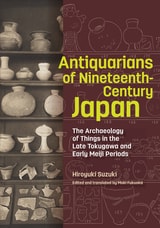
Antiquarians of Nineteenth-Century Japan
The Archaeology of Things in the Late Tokugawa and Early Meiji PeriodsHiroyuki Suzuki
J. Paul Getty Trust, The, 2022
Originally published in Japanese, Antiquarians of Nineteenth-Century Japan looks at the approach toward object-based research across the late Tokugawa and early Meiji periods, which were typically kept separate, and elucidates the intellectual continuities between these eras. Focusing on the top-down effects of the professionalizing of academia in the political landscape of Meiji Japan, which had advanced by attacking earlier modes of scholarship by antiquarians, Suzuki shows how those outside the government responded, retracted, or challenged new public rules and values. He explores the changing process of evaluating objects from the past in tandem with the attitudes and practices of antiquarians during the period of Japan’s rapid modernization. He shows their roots in the intellectual sphere of the late Tokugawa period while also detailing how they adapted to the new era. Suzuki also demonstrates that Japan’s antiquarians had much in common with those from Europe and the United States.
Art historian Maki Fukuoka provides an introduction to the English translation that highlights the significance of Suzuki’s methodological and intellectual analyses and shows how his ideas will appeal to specialists and nonspecialists alike.
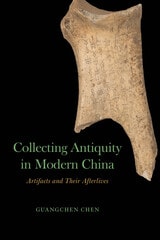
Collecting Antiquity in Modern China
Artifacts and Their AfterlivesGuangchen Chen
University of Chicago Press, 2026
In this book, Guangchen Chen argues that discerning collectors used antiquities to upend dominant discourses on history and cultural memory in twentieth-century China. Examining four categories of ancient artifacts—“carving” (oracle bones), “rubbing” (imprints of inscriptions and books), “brushing” (calligraphy), and “weaving” (textiles and costumes)—Chen explains how their modern (re)emergences changed our understanding of the relationship between tradition and modernity, textuality and materiality, and the very meaning of “Chineseness.”
Chen considers intellectuals such as Wang Yirong, Liu E, Luo Zhenyu, Wang Guowei, and Chen Mengjia, who played a pivotal role in the oracle bones’ modern reception. He also looks to major literary figures including Lu Xun, whose engagements with textual remnants of the past inspired his critique of Chinese culture; Guo Moruo, whose work on the calligraphic masterpiece Lantingxu contributed to the cultural-political climate that sparked the Cultural Revolution; Shi Zhecun, whose interest in inscriptions on ancient stelae helped him to hold fast to intellectual integrity in the face of political pressure; and Shen Congwen, whose obsession with ancient textiles saved him from committing suicide after his writing fell out of favor. These antiquarians used their collections as a strategy to synchronize historical time and to challenge two dominant yet contrasting ideologies in modern China: a regressive idealization of antiquity and an unquestioning trust in linear progress. During this turbulent period, long-lost artifacts came to function as omens, warnings, and revelations from another time, generating new meanings that were uniquely relevant to the present.
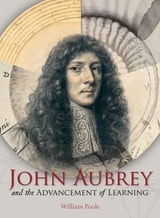
John Aubrey and the Advancement of Learning
William Poole
Bodleian Library Publishing, 2010
John Aubrey (1626–97) was one of the best-connected scholars and antiquaries in the great decades of the British scientific revolution. He is remembered as a pioneer historian and the father of English life-writing, whose Brief Lives remains a lasting portrait of a generation of eminent thinkers and nobles. But Aubrey’s intellectual interests were much broader. He was one of the first Fellows of the Royal Society, and he was acquainted with leading scientists of the generation of Robert Hooke and Isaac Newton. Aubrey championed Hooke’s geological theories, radical for the time, that proposed the organic origin of fossils. In addition, Aubrey was a keen mathematician and an early donor to the Ashmolean Museum of Art and Archaeology and the Bodleian Library. Extensively illustrated, John Aubrey and the Advancement of Learning presents all of Aubrey’s varied interests and pursuits in their intellectual milieu. Published to celebrate the 350th anniversary of the Royal Society, this is the first accessible and illustrated guide to Aubrey’s many diverse achievements as a biographer, natural philosopher and scientist, and antiquary.
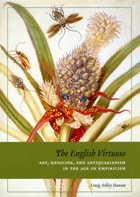
The English Virtuoso
Art, Medicine, and Antiquarianism in the Age of EmpiricismCraig Ashley Hanson
University of Chicago Press, 2009
At the heart of this profoundly interdisciplinary study lies the Royal Society of London for the Improvement of Natural Knowledge, which from its founding in 1660 served as the major professional organization for London’s leading physicians, many of them prominent virtuosi. Craig Ashley Hanson reveals that a vital art audience emerged from the Royal Society—whose members assembled many of the period’s most important nonaristocratic collections—a century before most accounts date the establishment of an institutional base for the arts in England. Unearthing the fascinating stories of an impressive cast of characters, Hanson establishes a new foundation for understanding both the relationship between British art and science and the artistic accomplishments of the late eighteenth and nineteenth centuries.