Results by title
11 books match the query 'Antiquities, Roman'
Cosa V
An Intermittent Town, Excavations 1991-1997Elizabeth Fentress
University of Michigan Press, 2003
Cosa and the Colonial Landscape of Republican Italy (Third and Second Centuries BCE)
Andrea U. De Giorgi, Editor
University of Michigan Press, 2019
This important new volume examines archaeological evidence of Roman colonization of the Middle Republican period. Themes of land use, ethnic accommodation and displacement, colonial identity, and administrative schemes are also highlighted. In delving deeply into the uniqueness of select colonial contexts, these essays invite a novel discussion on the phenomenon of colonialism in the political landscape of Rome’s early expansion. Roman urbanism of the Middle Republican period brought to the Italian peninsula fundamental changes, an important example of which, highlighted by a wealth of studies, is the ebullience of a dense network of colonies, as well as a mix of senatorial tactics and individual initiatives that underpinned their foundation. Whether Latin, Roman, or Maritimae, colonies created a new mesh of communities and imposed a new topography; more subtly, they signified the mechanisms of the rising hegemony. This book brings to the fore the diversity, agendas, and overall impact of a “settlement device” that changed the Italian landscape and introduced a new idea of Roman town.
Ireland and the Classical World
By Philip Freeman
University of Texas Press, 2000
On the boundary of what the ancient Greeks and Romans considered the habitable world, Ireland was a land of myth and mystery in classical times. Classical authors frequently portrayed its people as savages—even as cannibals and devotees of incest—and evinced occasional uncertainty as to the island's shape, size, and actual location. Unlike neighboring Britain, Ireland never knew Roman occupation, yet literary and archaeological evidence prove that Iuverna was more than simply terra incognita in classical antiquity.
In this book, Philip Freeman explores the relations between ancient Ireland and the classical world through a comprehensive survey of all Greek and Latin literary sources that mention Ireland. He analyzes passages (given in both the original language and English) from over thirty authors, including Julius Caesar, Strabo, Tacitus, Ptolemy, and St. Jerome. To amplify the literary sources, he also briefly reviews the archaeological and linguistic evidence for contact between Ireland and the Mediterranean world.
Freeman's analysis of all these sources reveals that Ireland was known to the Greeks and Romans for hundreds of years and that Mediterranean goods and even travelers found their way to Ireland, while the Irish at least occasionally visited, traded, and raided in Roman lands. Everyone interested in ancient Irish history or Classics, whether scholar or enthusiast, will learn much from this pioneering book.
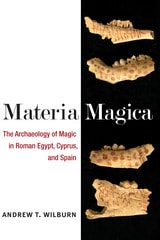
Materia Magica
The Archaeology of Magic in Roman Egypt, Cyprus, and SpainAndrew T. Wilburn
University of Michigan Press, 2015
This exciting new study draws on objects excavated or discovered in the late nineteenth or early twentieth century at three Mediterranean sites. Through the three case studies, Materia Magica identifies specific forms of magic that may be otherwise unknown. It isolates the practitioners of magic and examines whether magic could be used as a form of countercultural resistance. Andrew T. Wilburn discovers magic in the objects of ancient daily life, suggesting that individuals frequently turned to magic, particularly in crises. Local forms of magic may have differed, and Wilburn proposes that the only way we can find small-town sorcerers is through careful examination of the archaeological evidence.
Studying the remains of spells enacted by practitioners, Wilburn's work unites the analysis of the words written on artifacts and the physical form of these objects. He situates these items within their contexts, to study how and why they were used. Materia Magica approaches magic as a material endeavor, in which spoken spells, ritual actions, and physical objects all played vital roles in the performance of a rite.
Materia Magica develops a new method for identifying and interpreting the material remains of magical practice by assessing artifacts within their archaeological contexts. Wilburn suggests that excavations undertaken in recent centuries can yield important lessons about the past, and he articulates the ways in which we can approach problematic data.
Mountain and Plain
From the Lycian Coast to the Phrygian Plateau in the Late Roman and Early Byzantine PeriodMartin Harrison
University of Michigan Press, 2001
The present study is the fruit of years of excavation and research by the author. The manuscript was largely sketched out when Martin Harrison unexpectedly passed away, and the volume has been finished and prepared for press by his long-time assistant Wendy Young, with further guidance from friends and colleagues with whom he had discussed the project.
The resulting volume explores Martin Harrison's belief that the coastal cities of Lycia declined after the fifth century C.E., and that smaller settlements (monasteries, villages, and towns) appeared in the mountains and further inland. In addition he considered that there was a demographic shift of masons and sculptors from the cities to serve these new settlements. This beautifully illustrated study provides convincing evidence from architecture, sculpture, and inscriptional sources to support this theory. It also contains a description of Amorium in Phrygia, as revealed in survey and excavation seasons from 1987 until the author's untimely death half a dozen years later. The volume includes a preface by Stephen Hill and an appendix by Michael Ballance and Charlotte Roueché on three special inscriptions from Ovacik.
The volume will be of interest to historians of the Near East and classical antiquity, to archaeologists, and to students of architectural history.
Martin Harrison was Professor of Archaeology, University of Oxford. Wendy Young was Research Assistant to the author until his death.
Mummy Portraits of Roman Egypt, Volume 2
Emerging Research from the APPEAR ProjectMarie Svoboda
J. Paul Getty Trust, The, 2026
Nearly a thousand funerary portraits from Roman Egypt, once interred with mummified remains, survive in museums around the world. These fascinating paintings offer the unparalleled opportunity for viewers to come face-to-face with people who lived and died some two thousand years ago.
The international collaboration known as APPEAR (Ancient Panel Paintings: Examination, Analysis, and Research) was launched in 2013 to promote the study of these objects and gather research findings in a shared database. This second volume of Mummy Portraits of Roman Egypt compiles seventeen scholarly papers from the APPEAR conference hosted in October 2022 at the Allard Pierson Museum, Amsterdam. Conservators, scientists, and curators presented new research on topics such as technical imaging; nondestructive analytical techniques; provenance and collecting; treatment histories; connoisseurship and forgeries; comparisons of works across institutions; and scientific studies of woods, pigments, coatings, binders, and supports. This volume will be a valuable resource to conservators, scientists, curators, and collectors.
The free online edition of this open-access publication is available at getty.edu/publications/mummy-portraits-2/ and includes zoomable illustrations and graphs. Also available are free PDF and EPUB downloads of the book.
Mummy Portraits of Roman Egypt
Emerging Research from the APPEAR ProjectMarie Svoboda
J. Paul Getty Trust, The, 2020
Once interred with mummified remains, nearly a thousand funerary portraits from Roman Egypt survive today in museums around the world, bringing viewers face-to-face with people who lived two thousand years ago. Until recently, few of these paintings had undergone in-depth study to determine by whom they were made and how.
An international collaboration known as APPEAR (Ancient Panel Paintings: Examination, Analysis, and Research) was launched in 2013 to promote the study of these objects and to gather scientific and historical findings into a shared database. The first phase of the project was marked with a two-day conference at the Getty Villa. Conservators, scientists, and curators presented new research on topics such as provenance and collecting, comparisons of works across institutions, and scientific studies of pigments, binders, and supports. The papers and posters from the conference are collected in this publication, which offers the most up-to-date information available about these fascinating remnants of the ancient world.
The free online edition of this open-access publication is available at www.getty.edu/publications/mummyportraits/ and includes zoomable illustrations and graphs. Also available are free PDF, EPUB, and Kindle/MOBI downloads of the book.
The Collection of Antiquities of the American Academy in Rome
Larissa Bonfante and Helen Nagy, editors
University of Michigan Press, 2016
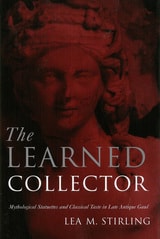
The Learned Collector
Mythological Statuettes and Classical Taste in Late Antique GaulLea M. Stirling
University of Michigan Press, 2005
The majority of statues in late antique homes were heirlooms and antiques. Mythological statuary, which would be interpreted in varying degrees of complexity, favored themes reflecting aristocratic pastimes such as dining and hunting. The Learned Collector investigates the manufacture of these distinctive statuettes in the later fourth century, the reasons for their popularity, and their modes of display in Gaul and the empire.
Although the destruction of ancient artwork looms large in the common view of late antiquity, statuary of mythological figures continued to be displayed and manufactured into the early fifth century. Stirling surveys the sculptural decor of late antique villas across the empire to reveal the universal and regional trends in the late antique confluence of literary education, mythological references, aristocratic mores, and classicizing taste. Deftly combining art historical, archaeological, and literary evidence, this book will be important to classicists and art historians alike. Stirling's accessible writing style makes this an important work for scholars, students, and anyone with an interest in Roman statues of this era.
Lea M. Stirling is Associate Professor of Classics at the University of Manitoba and holds a Canada Research Council Chair in Roman Archaeology. She co-directs excavations at the ancient city of Leptiminus, Tunisia.
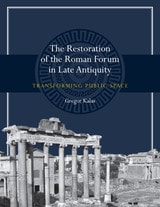
The Restoration of the Roman Forum in Late Antiquity
Transforming Public SpaceBy Gregor Kalas
University of Texas Press, 2015
In The Restoration of the Roman Forum in Late Antiquity, Gregor Kalas examines architectural conservation during late antiquity period at Rome’s most important civic center: the Roman Forum. During the fourth and fifth centuries CE—when emperors shifted their residences to alternate capitals and Christian practices overtook traditional beliefs—elite citizens targeted restoration campaigns so as to infuse these initiatives with political meaning. Since construction of new buildings was a right reserved for the emperor, Rome’s upper echelon funded the upkeep of buildings together with sculptural displays to gain public status. Restorers linked themselves to the past through the fragmentary reuse of building materials and, as Kalas explores, proclaimed their importance through prominently inscribed statues and monuments, whose placement within the existing cityscape allowed patrons and honorees to connect themselves to the celebrated history of Rome.
Building on art historical studies of spolia and exploring the Forum over an extended period of time, Kalas demonstrates the mutability of civic environments. The Restoration of the Roman Forum in Late Antiquity maps the evolution of the Forum away from singular projects composed of new materials toward an accretive and holistic design sensibility. Overturning notions of late antiquity as one of decline, Kalas demonstrates how perpetual reuse and restoration drew on Rome’s venerable past to proclaim a bright future.
The Roman Army in Jordan
David Kennedy
Council for British Research in the Levant, 2004