71 books match the query 'Antiquities & Archaeology' and 5 start with a
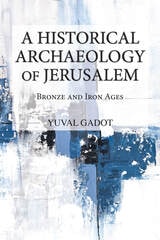
cover of A Historical Archaeology of Jerusalem: Bronze and Iron Ages

A Historical Archaeology of Jerusalem

Bronze and Iron Ages

Yuval Gadot

SBL Press, 2026

In the first book to examine Jerusalem’s archaeological remains in detail since Kathleen M. Kenyon’s Digging Up Jerusalem (1974), Yuval Gadot reexamines the results of more than one hundred years of excavations and incorporates findings from recent research based on the most up-to-date scientific methods. The book covers six pivotal periods of Jerusalem’s development and correlates those with historical texts, including those from the Hebrew Bible, for the purpose of portraying a nuanced and detailed reconstruction of Jerusalem during the Bronze and Iron Ages. More than one hundred color illustrations and maps supplement Gadot’s analysis of the archaeological data and reconstruction of Jerusalem’s history. This volume presents the most complete picture of Jerusalem’s history for scholars and students interested in the city’s role as a royal seat and a religious center.
[more]
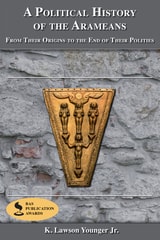
cover of A Political History of the Arameans: From Their Origins to the End of Their Polities

A Political History of the Arameans

From Their Origins to the End of Their Polities

K. Lawson Younger Jr.

SBL Press, 2016

An up-to-date analysis of the history of the ancient Near East and the Arameans

K. Lawson Younger Jr. presents a political history of the Arameans from their earliest origins to the demise of their independent entities. The book investigates their tribal structures, the development of their polities, and their interactions with other groups in the ancient Near East. Younger utilizes all of the available sources to develop a comprehensive picture of this complex, yet highly important, people whose influence and presence spanned the Fertile Cresent.

Features:

  • The best, recent understanding of tribal political structures, aspects of mobile pastoralism, and models of migration
  • A regional rather than a monolithic approach to the rise of Aramean polities
  • Thorough integration of the complex relationships and interactions of the Arameans with the Luwians, the Assyrians, the Israelites, and others
[more]
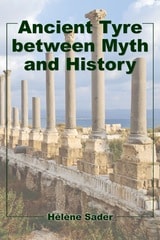
cover of Ancient Tyre between Myth and History

Ancient Tyre between Myth and History

Hélène Sader

SBL Press, 2026
Hélène Sader gathers and synthesizes the archaeological and textual evidence from excavations conducted during the past fifty years at Tyre and its far-flung settlements. By incorporating the results obtained from western Tyrian sites rich in metals, Sader confirms that Tyre and its colonies, which stretched to the Atlantic coast of Spain, held incredible wealth. In addition to her analysis of the material remains, soundings, and surveys, Sader includes a thorough discussion of the main Tyrian gods and the practice of cremation introduced at the beginning of the Iron Age. More than seventy-five images and maps illuminate the development of Tyre and its cultural heritage. The result is a more complex picture of the history of Tyre than that known from its description in the Hebrew Bible, ancient Near Eastern sources, and classical histories. Tyre emerges from the shadows of myth as the main protagonist of the Phoenician maritime expansion.
[more]
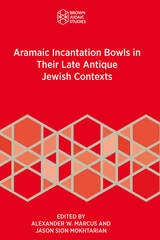
cover of Aramaic Incantation Bowls in Their Late Antique Jewish Contexts

Aramaic Incantation Bowls in Their Late Antique Jewish Contexts

Alexander W. Marcus

SBL Press, 2025
Outside of the Babylonian Talmud, the Aramaic incantation bowls inscribed with elaborate magical texts are the only major extant written corpus produced by Jews during the late Sasanian and early Islamic periods (ca. 500–700 CE). Contributors Siam Bhayro, Anne Burberry, Shira Eliassian, James Nathan Ford, Tal Ilan, Reuven Kiperwasser, Dan Levene, Alexander W. Marcus, Jason Sion Mokhtarian, Ortal-Paz Saar, Harriet Walker, and Daniel J. Waller approach the amulets through a variety of methodological approaches, including social history, gender studies, linguistics, and digital humanities. The volume includes an up-to-date survey, introductory essay, map of known excavation sites, and bibliographical resources for the vast and diffuse corpus of Aramaic incantation bowls that served a number of purposes, including warding off evil spirits and diseases, overturning curses from human adversaries, and achieving success in court cases, childbirth, or livelihood. The fascinating artifacts presented here transform our understanding of Jewish culture, interreligious interactions, and the varieties of Jewish identity and religion that existed during this formative era.
[more]
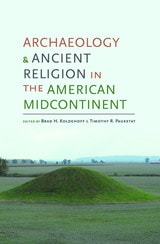
cover of Archaeology and Ancient Religion in the American Midcontinent

Archaeology and Ancient Religion in the American Midcontinent

Edited by Brad H. Koldehoff and Timothy R. Pauketat

University of Alabama Press, 2019

Analyses of big datasets signal important directions for the archaeology of religion in the Archaic to Mississippian Native North America

Across North America, huge data accumulations derived from decades of cultural resource management studies, combined with old museum collections, provide archaeologists with unparalleled opportunities to explore new questions about the lives of ancient native peoples. For many years the topics of technology, economy, and political organization have received the most research attention, while ritual, religion, and symbolic expression have largely been ignored. This was often the case because researchers considered such topics beyond reach of their methods and data.

In Archaeology and Ancient Religion in the American Midcontinent, editors Brad H. Koldehoff and Timothy R. Pauketat and their contributors demonstrate that this notion is outdated through their analyses of a series of large datasets from the midcontinent, ranging from tiny charred seeds to the cosmic alignments of mounds, they consider new questions about the religious practices and lives of native peoples. At the core of this volume are case studies that explore religious practices from the Cahokia area and surrounding Illinois uplands. Additional chapters explore these topics using data collected from sites and landscapes scattered along the Mississippi and Ohio River valleys.

This innovative work facilitates a greater appreciation for, and understanding of, ancient native religious practices, especially their seamless connections to everyday life and livelihood. The contributors do not advocate for a reduced emphasis on technology, economy, and political organization; rather, they recommend expanding the scope of such studies to include considerations of how religious practices shaped the locations of sites, the character of artifacts, and the content and arrangement of sites and features. They also highlight analytical approaches that are applicable to archaeological datasets from across the Americas and beyond.
[more]