Results by title

9 books match the query 'Hole'
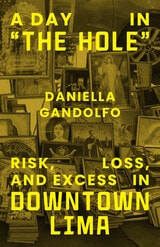
cover of A Day in "The Hole": Risk, Loss, and Excess in Downtown Lima

A Day in "The Hole"

Risk, Loss, and Excess in Downtown Lima

Daniella Gandolfo

University of Chicago Press, 2025

A single day in a semilegal market in Lima, Peru, reveals a social world that defies conventional economic logic.

In the heart of Lima’s historic center, the markets of El Hueco (“The Hole”) and sprawling Mesa Redonda pulse with life, with thousands of vendors selling everything from knockoff electronics to religious icons. In A Day in “The Hole,” anthropologist Daniella Gandolfo immerses readers in a single, tumultuous day—the thirty-fourth anniversary of a vendors’ cooperative—while examining the dynamics that sustain these marketplaces.
 
Through a blend of cinematic storytelling and incisive anthropological insight, Gandolfo reveals a world with its own unique codes. She inspects how vendors embrace expenditure over profit and instability over order, and moving through the sights and sounds of El Hueco and Mesa Redonda, she finds a dissident economy that is as much about survival as it is about spectacle. Gandolfo redefines how we think about urban economies and the unexpected ways these defiant communities thrive in this textured portrait of Lima’s markets and the people who animate them.
[more]
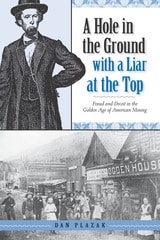
cover of A Hole in the Ground with a Liar at the Top: Fraud and Deceit in the Golden Age of American Mining

A Hole in the Ground with a Liar at the Top

Fraud and Deceit in the Golden Age of American Mining

Dan Plazak

University of Utah Press, 2006

Coal, silver, gold. There is something about the allure of hidden treasure that puts a glint in people’s eyes. By gathering such familiar stories as that of Nevada’s infamous Comstock Lode with a succession of lesser-known scandals, Dan Plazak provides an entertaining and informative volume that delightfully investigates the history of mining frauds in the United States from the Civil War to World War I.
[more]
cover of A Hole in the Heavens

A Hole in the Heavens

Dyan Elliott

Arizona Center for Medieval and Renaissance Studies, 2017

What if Satan were to disguise himself as an angel of light? What if he even appeared as Christ? Schoolmen in late medieval Paris were obsessed with that question--and A Hole in the Heavens explores the alarming consequences of this obsession. It soon becomes impossible to tell the difference between saints and impostors, conversion and demonic possession, heresy and the true faith. Even the wisest and holiest may be deceived. A struggling student, a pair of prostitutes, and a beautiful priest's daughter are among those caught up in the chaos. Based on meticulous research, Dyan Elliott's first novel is an absorbing and ultimately chilling exercise in the discernment of spirits.
[more]
cover of A Hole in the Language

A Hole in the Language

Marly Swick

University of Iowa Press, 1990

These stories are delicate seismographic meditations on disaster and its aftershocks. The characters are survivors, digging their way out of the past, shaken but hopeful. Despite all their tragic losses, there is a pervasive sense of humor, hope, and forgiveness: abandonment leads ultimately to reunion, grief to solace. This is contemporary America—a jigsaw puzzle of fragmented families constantly picking up the pieces and fitting themselves together in new ways to form unforgettable pictures.


[more]
cover of Fire in the Hole

Fire in the Hole

Sybil Downing

University Press of Colorado, 1996
The award-winning Fire in the Hole is the tale of a young widowed lawyer swept up in the violence of the famous Colorado coal strike of 1913-1914 known to history as the Ludlow Massacre. Opposed by the coal companies, the union, Wall Street, and the federal government, Alex hatches a scheme involving the president to overturn martial law and settle the strike. A gripping tale of a woman who dares to go beyond the conventions of the day to find freedom and justice amid a power struggle so terrifying it would wrench the nation's conscience for decades.
[more]
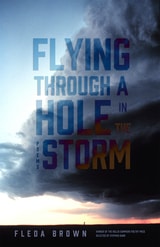
cover of Flying through a Hole in the Storm: Poems

Flying through a Hole in the Storm

Poems

Fleda Brown

Ohio University Press, 2021
A keenly observant collection of poems on disaster, aging, and apocalypse
 
Golda Meir once said, “Old age is like a plane flying through a storm. Once you're aboard, there’s nothing you can do.” The poems in Fleda Brown’s brave collection, her thirteenth, take readers on a journey through the fury of this storm. There are plenty of tragedies to weather here, both personal and universal: the death of a father, a child’s terminal cancer, the extinction of bees, and environmental degradation. 
 
Brown’s poems are wise, honest, and deeply observant meditations on contemporary science, physics, family, politics, and aging. With tributes to visionary artists, including Frida Kahlo, Pablo Picasso, and Grandma Moses, as well as to life’s terrors, sadnesses, and joys, these works are beautiful dispatches from a renowned poet who sees the shadows lengthening and imagines what they might look like from the other side.
[more]
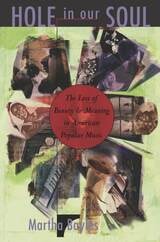
cover of Hole in Our Soul: The Loss of Beauty and Meaning in American Popular Music

Hole in Our Soul

The Loss of Beauty and Meaning in American Popular Music

Martha Bayles

University of Chicago Press, 1996

From Queen Latifa to Count Basie, Madonna to Monk, Hole in Our Soul: The Loss of Beauty and Meaning in American Popular Music traces popular music back to its roots in jazz, blues, country, and gospel through the rise in rock 'n' roll and the emergence of heavy metal, punk, and rap. Yet despite the vigor and balance of these musical origins, Martha Bayles argues, something has gone seriously wrong, both with the sound of popular music and the sensibility it expresses.

Bayles defends the tough, affirmative spirit of Afro-American music against the strain of artistic modernism she calls 'perverse.' She describes how perverse modernism was grafted onto popular music in the late 1960s, and argues that the result has been a cult of brutality and obscenity that is profoundly anti-musical.

Unlike other recent critics of popular music, Bayles does not blame the problem on commerce. She argues that culture shapes the market and not the other way around. Finding censorship of popular music "both a practical and a constitutional impossibility," Bayles insists that "an informed shift in public tastes may be our only hope of reversing the current malignant mood."
[more]
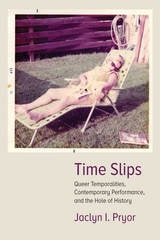
cover of Time Slips: Queer Temporalities, Contemporary Performance, and the Hole of History

Time Slips

Queer Temporalities, Contemporary Performance, and the Hole of History

Jaclyn I. Pryor

Northwestern University Press, 2017

This bold book investigates how performance can transform the way people perceive trauma and memory, time and history. Jaclyn I. Pryor introduces the concept of "time slips," moments in which past, present, and future coincide, moments that challenge American narratives of racial and sexual citizenship.
 
Framing performance as a site of resistance, Pryor analyzes their own work and that of four other queer artists—Ann Carlson, Mary Ellen Strom, Peggy Shaw, and Lisa Kron—between 2001 and 2016. Pryor illuminates how each artist deploys performance as a tool to render history visible, trauma recognizable, and transformation possible by laying bare the histories and ongoing systems of violence woven deep into our society. Pryor also includes a case study that examines the challenges of teaching queer time and queer performance within the academy in what Pryor calls a post-9/11 “homeland” security state.
 
Masterfully synthesizing a wealth of research and experiences, Time Slips will interest scholars and readers in the fields of theater and performance studies, queer studies, and American studies.
[more]
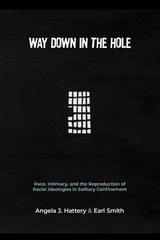
cover of Way Down in the Hole: Race, Intimacy, and the Reproduction of Racial Ideologies in Solitary Confinement

Way Down in the Hole

Race, Intimacy, and the Reproduction of Racial Ideologies in Solitary Confinement

Angela J. Hattery

Rutgers University Press, 2023

Based on ethnographic observations and interviews with prisoners, correctional officers, and civilian staff conducted in solitary confinement units, Way Down in the Hole explores the myriad ways in which daily, intimate interactions between those locked up twenty-four hours a day and the correctional officers charged with their care, custody, and control produce and reproduce hegemonic racial ideologies. Smith and Hattery explore the outcome of building prisons in rural, economically depressed communities, staffing them with white people who live in and around these communities, filling them with Black and brown bodies from urban areas and then designing the structure of solitary confinement units such that the most private, intimate daily bodily functions take place in very public ways. Under these conditions, it shouldn’t be surprising, but is rarely considered, that such daily interactions produce and reproduce white racial resentment among many correctional officers and fuel the racialized tensions that prisoners often describe as the worst forms of dehumanization. Way Down in the Hole concludes with recommendations for reducing the use of solitary confinement, reforming its use in a limited context, and most importantly, creating an environment in which prisoners and staff co-exist in ways that recognize their individual humanity and reduce rather than reproduce racial antagonisms and racial resentment.

Way Down the Hole Video 1 (https://youtu.be/UuAB63fhge0)
Way Down the Hole Video 2 (https://youtu.be/TwEuw1cTrcQ)
Way Down the Hole Video 3 (https://youtu.be/bOcBv_UnHIs​)
Way Down the Hole Video 4 (https://youtu.be/cx_l1S8D77c)
[more]