Results by title
8 books match the query 'Apostles'
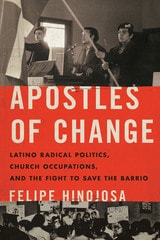
Apostles of Change
Latino Radical Politics, Church Occupations, and the Fight to Save the BarrioBy Felipe Hinojosa
University of Texas Press, 2021
2021 Finalist Raul Yzaguirre Best Political/Current Affairs Book, International Latino Book Awards
Winner of the Texas Association of Chicanos in Higher Education Inaugural Book Award
Unraveling the intertwined histories of Latino radicalism and religion in urban America, this book examines how Latino activists transformed churches into staging grounds for protest against urban renewal and displacement.
In the late 1960s, the American city found itself in steep decline. An urban crisis fueled by federal policy wreaked destruction and displacement on poor and working-class families. The urban drama included religious institutions, themselves undergoing fundamental change, that debated whether to stay in the city or move to the suburbs. Against the backdrop of the Black and Brown Power movements, which challenged economic inequality and white supremacy, young Latino radicals began occupying churches and disrupting services to compel church communities to join their protests against urban renewal, poverty, police brutality, and racism.
Apostles of Change tells the story of these occupations and establishes their context within the urban crisis; relates the tensions they created; and articulates the activists' bold, new vision for the church and the world. Through case studies from Chicago, Los Angeles, New York City, and Houston, Felipe Hinojosa reveals how Latino freedom movements frequently crossed boundaries between faith and politics and argues that understanding the history of these radical politics is essential to understanding the dynamic changes in Latino religious groups from the late 1960s to the early 1980s.
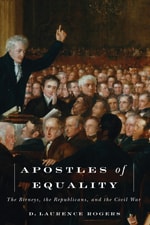
Apostles of Equality
The Birneys, the Republicans, and the Civil WarD. Laurence Rogers
Michigan State University Press, 2011
The first biographical account of the life of James Gillespie Birney in more than fifty years, this fabulously insightful history illuminates and elevates an all-but-forgotten figure whose political career contributed mightily to the American political fabric. Birney was a southern-born politician at the heart of the antislavery movement, with two southern-born sons who were major generals involved in key Union Army activities, including the leadership of the black troops. The interaction of the Birneys with historical figures (Abraham Lincoln, Harriet Beecher Stowe, and Henry Clay) highlights the significance of the family’s activities in politics and war. D. Laurence Rogers offers a unique historiography of the abolition movement, the Civil War, and Reconstruction through the experiences of one family navigating momentous developments from the founding of the Republic until the late 19th century.
Brigham Young, the Quorum of the Twelve, and the Latter-Day Saint Investigation of the Mountain Meadows Massacre
Arrington Lecture No. TwelveThomas G. Alexander
Utah State University Press, 2007
In this 12th volume of the Arrington Lecture Series, Thomas Alexander (Lemuel Redd Professor of Western American History, Emeritus, at Brigham Young University), asserts that Brigham Young and the LDS Church’s governing Quorum of Twelve made timely and diligent efforts to investigate the massacre and encouraged legal proceedings but were hindered by federal territorial officials and lied to by massacre participant John D. Lee, preventing Young from learning the full truth for many years.
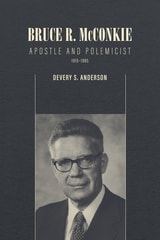
Bruce R. McConkie
Apostle and Polemicist, 1915–1985Anderson, Devery S.
Signature Books, 2024
Although he served as an apostle in the Church of Jesus Christ of Latter-day Saints for only twelve and a half years, Bruce R. McConkie’s twenty-six years’ service in the First Council of Seventy had already made him a household name within the church. Called to full-time church service at age thirty-one, McConkie quickly gained a reputation as a theologian and doctrinal teacher. He became a prolific writer, and his controversial book, Mormon Doctrine, remained a bestseller for decades. His writing style, dogmatic approach, and quickness to reprimand others he believed in error made him many enemies, while others endeared themselves to him because of those very traits.
McConkie the man was far more complex than the serious and focused general authority most church members saw and heard at the pulpit. Those who knew him best experienced his profound sense of humor. His passion for jogging, rock hounding, and jewelry making occupied much of his free time. Those who witnessed his final address delivered days before his death felt compassion toward him, no matter how they had always viewed him as a writer, speaker, or leader. Truly, to understand Bruce R. McConkie one must look closely at the entire picture.
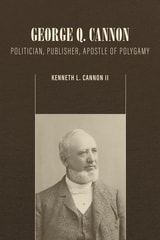
George Q. Cannon
Politician, Publisher, Apostle of PolygamyKenneth L. Cannon II
Signature Books, 2023
Lost Apostles
Forgotten Members of Mormonism's Original Quorum of the TwelveWilliam Shepard
Signature Books, 2013
Of the twelve men selected, nine would eventually be pruned from the vineyard themselves, to varying degrees. Seven were excommunicated, one of whom was reinstated to his position in the Twelve. Of the other six, the subjects of this book, none returned to the apostleship and four never came back to the Church at all. Those who left faded into obscurity except for when they are occasionally still mentioned in sermons as cautionary tales. But two of them made their marks in other areas of society, John Boynton becoming a successful dentist, a popular lecturer, geologist, and inventor with dozens of important patents to his name, while Lyman Johnson became a prominent attorney and business owner. Even though Luke Johnson, Thomas B. Marsh, William McLellin, and William Smith became religious wanderers and tried unsuccessfully to adjust to life outside of the Church, their experiences were interesting and comprise valuable case studies in belief and disaffection.
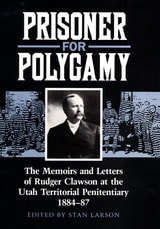
Prisoner for Polygamy
The Memoirs and Letters of Rudger Clawson at the Utah Territorial Penitentiary, 1884-87Edited by Stan Larson
University of Illinois Press, 1993
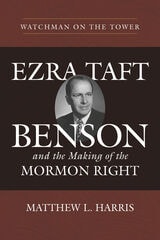
Watchman on the Tower
Ezra Taft Benson and the Making of the Mormon RightMatthew L. Harris
University of Utah Press, 2020