Results by title

20 books match the query 'Arab Americans'

cover of Anti-Arab Racism in the USA: Where It Comes From and What It Means For Politics Today

Anti-Arab Racism in the USA

Where It Comes From and What It Means For Politics Today

Steven Salaita

Pluto Press, 2006

"A sobering analysis of anti-Arab racism, from neo-conservative to liberal, rooted in America's settler colonial past and seeping into every corner of our lives. Steven Salaita takes the reader into the crisis of Arab-American communities in the wake of 9/11. Written with passion, this lucid account of the dangers of American imperialism paints a dark picture of the agenda of the Bush administration not only in the Arab world but also for people of color at home."
Miriam Cooke, Professor, Duke University

"An impassioned and deeply compelling look at the origins, evolution, manifestations and implications of anti-Arab racism today. ... A tour-de-force."
Lisa Suhair Majaj, co-editor, Etel Adnan: Critical Reflections on the Arab-American Writer and Artist and Intersections: Gender, Nation, and Community in Arab Women¹s Novels

"Salaita dives head-first into the heart of racism in America and uses his personal experiences to help readers understand the mechanics of racism as it applies to Arabs, Muslims and people who look Middle Eastern in the post-Sept. 11 world."
Ray Hanania, journalist and filmmaker, author of I¹m Glad I Look Like a Terrorist: Growing up Arab in America and Arabs of Chicagoland

"A highly recommended read, not only for students of Middle East history, but for the average American who wants to know how we have become so intimately and yet so bitterly entwined with the people of the Middle East. ... Salaita has thoughtfully articulated a very regretful era of unabashed racism in American history."
Ramzy Baroud, editor, Palestine Chronicle and author of Searching Jenin

Today is a difficult time to be both Arab and American. Since 9/11 there has been a lot of criticism of America¹s involvement in the middle east. Yet there has been little analysis of how America treats citizens of Arab or middle eastern origin within its own borders.

Steven Salaita explores the reality of Anti-Arab racism in America. He blends personal narrative, theory and polemics to show how this deep-rooted racism affects everything from legislation to cultural life, shining a light on the consequences of Anti-Arab racism both at home and abroad.

Uniquely, the book shows how ingrained racist attitudes can be found within the progressive movements on the political left, as well as the right. Salaita argues that, under the guise of patriotism, Anti-Arab racism fuels support for policies such as the Patriot Act.

Salaita breaks down the façade of Anti-Arab racism with an insightful analysis, arguing for the urgency of a commitment to openness and inclusion in today¹s political climate.


Steven Salaita is Assistant Professor of English at the University of Wisconsin -Whitewater. He writes frequently about Arab America and the Arab World.
[more]
cover of Arab American Public History

Arab American Public History

Edited by Edward E. Curtis IV

Temple University Press, 2026

How have public history projects celebrated Arab American life and culture and countered anti-Arab bias and discrimination? The editor and contributors to Arab American Public History show how this vibrant community creates their own narratives through writing, blogging, curating, collaborating, and broadcasting. They also consider how the larger social and political contexts affect their work and offer self-reflection.

Arab American Public History is an invitation to engage more deeply with Arab American communities. Chapters examine Arab Americans’ origins, ethnic identities, and efforts to belong in America through case studies of the community’s food cultures, genealogy research, cultural production, and neighborhood enclaves.   

The first formal study of Arab American public history, this exciting volume charts various ways Arab Americans have interpreted their past as a source of defiant humanity, cultural enfranchisement, social solidarity, and political power.

Contributors: Reem Awad-Rashmawi, Chloe Bordewich, Richard M. Breaux, Maria F. Curtis, Lydia Harrington, Randa A. Kayyali, Matthew Jaber Stiffler, Rebecca K. Shrum, and the editor

In the series History and the Public
[more]
cover of Arab Americans in Michigan

Arab Americans in Michigan

Rosina J. Hassoun

Michigan State University Press, 2003

The state of Michigan hosts one of the largest and most diverse Arab American populations in the United States. As the third largest ethnic population in the state, Arab Americans are an economically important and politically influential group. It also reflects the diversity of national origins, religions, education levels, socioeconomic levels, and degrees of acculturation. Despite their considerable presence, Arab Americans have always been a misunderstood ethnic population in Michigan, even before September 11, 2001 imposed a cloud of suspicion, fear, and uncertainty over their ethnic enclaves and the larger community. In Arab Americans in Michigan Rosina J. Hassoun outlines the origins, culture, religions, and values of a people whose influence has often exceeded their visibility in the state.

[more]
cover of Arab-American Faces and Voices: The Origins of an Immigrant Community

Arab-American Faces and Voices

The Origins of an Immigrant Community

By Elizabeth Boosahda

University of Texas Press, 2003

As Arab Americans seek to claim their communal identity and rightful place in American society at a time of heightened tension between the United States and the Middle East, an understanding look back at more than one hundred years of the Arab-American community is especially timely. In this book, Elizabeth Boosahda, a third-generation Arab American, draws on over two hundred personal interviews, as well as photographs and historical documents that are contemporaneous with the first generation of Arab Americans (Syrians, Lebanese, Palestinians), both Christians and Muslims, who immigrated to the Americas between 1880 and 1915, and their descendants.

Boosahda focuses on the Arab-American community in Worcester, Massachusetts, a major northeastern center for Arab immigration, and Worcester's links to and similarities with Arab-American communities throughout North and South America. Using the voices of Arab immigrants and their families, she explores their entire experience, from emigration at the turn of the twentieth century to the present-day lives of their descendants. This rich documentation sheds light on many aspects of Arab-American life, including the Arab entrepreneurial motivation and success, family life, education, religious and community organizations, and the role of women in initiating immigration and the economic success they achieved.
[more]
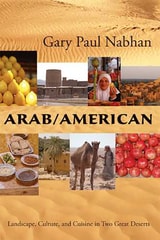
cover of Arab/American: Landscape, Culture, and Cuisine in Two Great Deserts

Arab/American

Landscape, Culture, and Cuisine in Two Great Deserts

Gary Paul Nabhan

University of Arizona Press, 2008
The landscapes, cultures, and cuisines of deserts in the Middle East and North America have commonalities that have seldom been explored by scientists—and have hardly been celebrated by society at large. Sonoran Desert ecologist Gary Nabhan grew up around Arab grandparents, aunts, uncles, and cousins in a family that has been emigrating to the United States and Mexico from Lebanon for more than a century, and he himself frequently travels to the deserts of the Middle East. In an era when some Arabs and Americans have markedly distanced themselves from one another, Nabhan has been prompted to explore their common ground, historically, ecologically, linguistically, and gastronomically. Arab/American is not merely an exploration of his own multicultural roots but also a revelation of the deep cultural linkages between the inhabitants of two of the world’s great desert regions. Here, in beautifully crafted essays, Nabhan explores how these seemingly disparate cultures are bound to each other in ways we would never imagine. With an extraordinary ear for language and a truly adventurous palate, Nabhan uncovers surprising convergences between the landscape ecology, ethnogeography, agriculture, and cuisines of the Middle East and the binational Desert Southwest. There are the words and expressions that have moved slowly westward from Syria to Spain and to the New World to become incorporated—faintly but recognizably—into the language of the people of the U.S.–Mexico borderlands. And there are the flavors—piquant mixtures of herbs and spices—that have crept silently across the globe and into our kitchens without our knowing where they came from or how they got here. And there is much, much more. We also learn of others whose work historically spanned these deserts, from Hadji Ali (“Hi Jolly”), the first Moslem Arab to bring camels to America, to Robert Forbes, an Arizonan who explored the desert oases of the Sahara. These men crossed not only oceans but political and cultural barriers as well. We are, we recognize, builders of walls and borders, but with all the talk of “homeland” today, Nabhan reminds us that, quite often, borders are simply lines drawn in the sand.
[more]
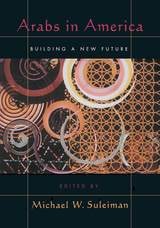
cover of Arabs in America: Building a New Future

Arabs in America

Building a New Future

edited by Michael W. Suleiman

Temple University Press, 1999

For many North Americans, Arab Americans are invisible, recalled only when words like "terrorism" or "anti-American sentiments" arise. However, people of Arab descent have been contributing to U. S. an d  Canadian culture since the 1870s in fields as diverse as literature, science, politics, medicine, and commerce -- witness surgeon Michael DeBakey, former Oregon governor Victor Atiyeh, consumer advocate Ralph Nader, and Canadian M.P. Mac Harb. Yet while Arab American contributions to our society are significant and Arab Americans surpass the U.S. average in both education and economics, they still struggle for recognition and acceptance.

In this volume, editor Michael Suleiman brings together 21 prominent scholars from a wide range of perspectives -- including anthropology, economics, history, law, literature and culture, political science, and sociology -- to take a close look at the status of Arabs in North America. Topics range from the career of Arab American singer, dancer, and storyteller Wadeeha Atiyeh to a historical examination of Arab Americans and Zionism. The contributors discuss in Detroit, a group of well-educated Jordanian men, and the Shi'a Muslims -- to illustrate the range of Arab emigre experience. More broadly, they examine Arab American identity, political activism, and attempts by Arab immigrants to achieve respect and recognition in their new homes. They address both the  present situation for Arab Americans and prospects for their future.

Arabs in America will engage anyone interested in Arab American studies, ethnic studies, and American studies.
[more]
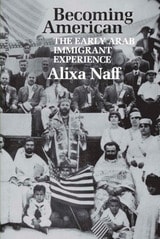
cover of Becoming American: The Early Arab Immigrant Experience

Becoming American

The Early Arab Immigrant Experience

Alixa Naff

Southern Illinois University Press, 1993

A unique study in American immigra­tion and assimilation history that also provides a special view of one of the smaller ethnic groups in American society.

Naff focuses on the pre-World War I pio­neering generation of Arabic-speaking immigrants, the generation that set the patterns for settlement and assimilation. Unlike many immigrants who were drawn to the United States by dreams of industrial jobs or to escape religious or economic persecution, most of these ar­tisans and owners of small, disconnected plots of land came to America to engage in the enterprise of peddling. Most planned to stay two or three years and re­turn to their homelands.

[more]
cover of Between the Middle East and the Americas: The Cultural Politics of Diaspora

Between the Middle East and the Americas

The Cultural Politics of Diaspora

Edited by Evelyn Alsultany and Ella Shohat

University of Michigan Press, 2013

Between the Middle East and the Americas: The Cultural Politics of Diaspora traces the production and circulation of discourses about "the Middle East" across various cultural sites, against the historical backdrop of cross-Atlantic Mahjar flows. The book highlights the fraught and ambivalent situation of Arabs/Muslims in the Americas, where they are at once celebrated and demonized, integrated and marginalized, simultaneously invisible and spectacularly visible. The essays cover such themes as Arab hip-hop's transnational imaginary; gender/sexuality and the Muslim digital diaspora; patriotic drama and the media's War on Terror; the global negotiation of the Prophet Mohammad cartoons controversy; the Latin American paradoxes of Turcophobia/Turcophilia; the ambiguities of the bellydancing fad; French and American commodification of Rumi spirituality; the reception of Iranian memoirs as cultural domestication; and the politics of translation of Turkish novels into English. Taken together, the essays analyze the hegemonic discourses that position "the Middle East" as a consumable exoticized object, while also developing complex understandings of self-representation in literature, cinema/TV, music, performance, visual culture, and digital spaces. Charting the shifting significations of differing and overlapping forms of Orientalism, the volume addresses Middle Eastern diasporic practices from a transnational perspective that brings postcolonial cultural studies methods to bear on Arab American studies, Middle Eastern studies, and Latin American studies. Between the Middle East and the Americas disentangles the conventional separation of regions, moving beyond the binarist notion of "here" and "there" to imaginatively reveal the thorough interconnectedness of cultural geographies.
[more]
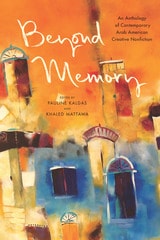
cover of Beyond Memory: An Anthology of Contemporary Arab American Creative Nonfiction

Beyond Memory

An Anthology of Contemporary Arab American Creative Nonfiction

Pauline Kaldas

University of Arkansas Press, 2020
This anthology brings together the voices of both new and established Arab American writers in a compilation of creative nonfiction that reveals the stories of the Arab diaspora in styles that range from the traditional to the experimental. Writers from Egypt, Lebanon, Libya, Palestine, and Syria explore issues related to politics, family, culture, and racism. Coming from different belief systems and cultures and including first- and second-generation immigrants as well as those whose identities encompass more than a single culture, these writers tell stories that speak to the complexity of the Arab American experience.
[more]
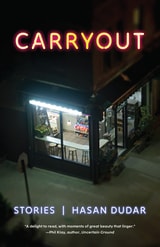
cover of Carryout

Carryout

Hasan Dudar

University of Iowa Press, 2026

A Poets & Writers First Fiction 2026 Debut Selection

In the late 1970s, Ziad Idilbi, a Palestinian refugee from Lebanon, marries Salma, a Lebanese refugee escaping the war in Beirut. Resolving to start over for the very last time, the couple opens a corner store in Toledo, Ohio, across from the General Motors factory, where Toledo’s Arab community intermingles with the working class. Over the decades, whether it’s bigotry (pre- and post-9/11), financial ruin, or terminal illness, the Idilbis find themselves on life’s outskirts, attempting to build something new.

Achingly poignant and slyly funny, the linked stories in Carryout follow the Idilbis and their children as they teeter on the brink of catastrophe. Walid, the youngest child of Ziad and Salma, navigates the heartbreaks of youth as well as the colorful characters who haunt his parents’ corner store. As he grows up into a writer, Walid’s gaze fixes on his father and the long shadow of displacement and occupation. Mustafa, the eldest son, is forever trying to outrun the disasters that seem to seek him out, while Nawal, the only daughter, is dumped by a friend and hatches a scheme to win her back. Unsure whether to run toward each other or away from each other, the characters in Dudar’s exquisite debut suffer the absurdities and indignities of life in America with wry obstinance and striking wisdom.
[more]
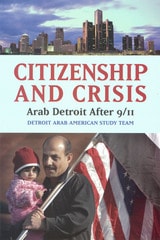
cover of Citizenship and Crisis: Arab Detroit After 9/11

Citizenship and Crisis

Arab Detroit After 9/11

Russell Sage Foundation, 2009

Is citizenship simply a legal status or does it describe a sense of belonging to a national community? For Arab Americans, these questions took on new urgency after 9/11, as the cultural prejudices that have often marginalized their community came to a head. Citizenship and Crisis reveals that, despite an ever-shifting definition of citizenship and the ease with which it can be questioned in times of national crisis, the Arab communities of metropolitan Detroit continue to thrive. A groundbreaking study of social life, religious practice, cultural values, and political views among Detroit Arabs after 9/11, Citizenship and Crisis argues that contemporary Arab American citizenship and identity have been shaped by the chronic tension between social inclusion and exclusion that has been central to this population's experience in America. According to the landmark Detroit Arab American Study, which surveyed more than 1,000 Arab Americans and is the focus of this book, Arabs express pride in being American at rates higher than the general population. In nine wide-ranging essays, the authors of Citizenship and Crisis argue that the 9/11 backlash did not substantially transform the Arab community in Detroit, nor did it alter the identities that prevail there. The city's Arabs are now receiving more mainstream institutional, educational, and political support than ever before, but they remain a constituency defined as essentially foreign. The authors explore the role of religion in cultural integration and identity formation, showing that Arab Muslims feel more alienated from the mainstream than Arab Christians do. Arab Americans adhere more strongly to traditional values than do other Detroit residents, regardless of religion. Active participants in the religious and cultural life of the Arab American community attain higher levels of education and income, yet assimilation to the American mainstream remains important for achieving enduring social and political gains. The contradictions and dangers of being Arab and American are keenly felt in Detroit, but even when Arab Americans oppose U.S. policies, they express more confidence in U.S. institutions than do non-Arabs in the general population. The Arabs of greater Detroit, whether native-born, naturalized, or permanent residents, are part of a political and historical landscape that limits how, when, and to what extent they can call themselves American. When analyzed against this complex backdrop, the results of The Detroit Arab American Study demonstrate that the pervasive notion in American society that Arabs are not like "us" is simply inaccurate. Citizenship and Crisis makes a rigorous and impassioned argument for putting to rest this exhausted cultural and political stereotype.
[more]
cover of Development of Arab-American Identity

Development of Arab-American Identity

Ernest McCarus, Editor

University of Michigan Press, 1994
By the early twenty-first century, the United States will experience a demographic change as those groups previously thought of as minorities become the majority. Arab-Americans, a fast growning group from Asia and northern Africa, are among those who will soon form part of this new majority. The Development of Arab-American Identity offers an account of the Arab-American experience from the early immigration to the present day.What do Arab-Americans think of traditional American values? How do they perceive their treatment as new immigrants? Have they been seriously alienated from the dominant culture? The Development of Arab-American Identity offers an account of the Arab-American experience from the early immigration to the present day. After the historical background has been set, the essays in this book deal with the struggle for religious, political, cultural, and social identity, all of which involve coping with unconscious and conscious stereotyping and marginalization of Arabs and Arab-Americans.
[more]
cover of Dinarzad's Children: An Anthology of Contemporary Arab American Fiction

Dinarzad's Children

An Anthology of Contemporary Arab American Fiction

Pauline Kaldas

University of Arkansas Press, 2009
The first edition of Dinarzad’s Children was a groundbreaking and popular anthology that brought to light the growing body of short fiction being written by Arab Americans. This expanded edition includes sixteen new stories —thirty in all—and new voices and is now organized into sections that invite readers to enter the stories from a variety of directions. Here are stories that reveal the initial adjustments of immigrants, the challenges of forming relationships, the political nuances of being Arab American, the vision directed towards homeland, and the ongoing search for balance and identity. The contributors are D. H. Melhem, Mohja Khaf, Rabih Alameddine, Rawi Hage, Laila Halaby, Patricia Sarrafian Ward, Alia Yunis, Diana Abu Jaber, Susan Muaddi Darraj, Samia Serageldin, Alia Yunis, Joseph Geha, May Monsoor Munn, Frances Khirallah Nobel, Nabeel Abraham, Yussef El Guindi, Hedy Habra, Randa Jarrar, Zahie El Kouri, Amal Masri, Sahar Mustafah, Evelyn Shakir, David Williams, Pauline Kaldas, and Khaled Mattawa.
[more]
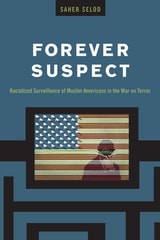
cover of Forever Suspect: Racialized Surveillance of Muslim Americans in the War on Terror

Forever Suspect

Racialized Surveillance of Muslim Americans in the War on Terror

Selod, Saher

Rutgers University Press, 2018
The declaration of a “War on Terror” in the aftermath of the September 11, 2001 terrorist attacks brought sweeping changes to the American criminal justice and national security systems, as well as a massive shift in the American public opinion of both individual Muslims and the Islamic religion generally. Since that time, sociologist Saher Selod argues, Muslim Americans have experienced higher levels of racism in their everyday lives. In Forever Suspect, Selod shows how a specific American religious identity has acquired racial meanings, resulting in the hyper surveillance of Muslim citizens. Drawing on forty-eight in-depth interviews with South Asian and Arab Muslim Americans, she investigates how Muslim Americans are subjected to racialized surveillance in both an institutional context by the state and a social context by their neighbors and co-workers. Forever Suspect underscores how this newly racialized religious identity changes the social location of Arabs and South Asians on the racial hierarchy further away from whiteness and compromises their status as American citizens.
[more]
cover of Homeland Insecurity: The Arab American and Muslim American Experience After 9/11

Homeland Insecurity

The Arab American and Muslim American Experience After 9/11

Louis A. Cainkar

Russell Sage Foundation, 2009
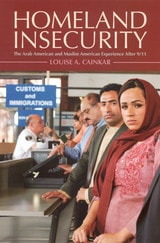
In the aftermath of 9/11, many Arab and Muslim Americans came under intense scrutiny by federal and local authorities, as well as their own neighbors, on the chance that they might know, support, or actually be terrorists. As Louise Cainkar observes, even U.S.-born Arabs and Muslims were portrayed as outsiders, an image that was amplified in the months after the attacks. She argues that 9/11 did not create anti-Arab and anti-Muslim suspicion; rather, their socially constructed images and social and political exclusion long before these attacks created an environment in which misunderstanding and hostility could thrive and the government could defend its use of profiling. Combining analysis and ethnography, Homeland Insecurity provides an intimate view of what it means to be an Arab or a Muslim in a country set on edge by the worst terrorist attack in its history. Focusing on the metropolitan Chicago area, Cainkar conducted more than a hundred research interviews and five in-depth oral histories. In this, the most comprehensive ethnographic study of the post-9/11 period for American Arabs and Muslims, native-born and immigrant Palestinians, Egyptians, Lebanese, Iraqis, Yemenis, Sudanese, Jordanians, and others speak candidly about their lives as well as their experiences with government, public mistrust, discrimination, and harassment after 9/11. The book reveals that Arab Muslims were more likely to be attacked in certain spatial contexts than others and that Muslim women wearing the hijab were more vulnerable to assault than men, as their head scarves were interpreted by some as a rejection of American culture. Even as the 9/11 Commission never found any evidence that members of Arab- or Muslim-American communities were involved in the attacks, respondents discuss their feelings of insecurity—a heightened sense of physical vulnerability and exclusion from the guarantees of citizenship afforded other Americans. Yet the vast majority of those interviewed for Homeland Insecurity report feeling optimistic about the future of Arab and Muslim life in the United States. Most of the respondents talked about their increased interest in the teachings of Islam, whether to counter anti-Muslim slurs or to better educate themselves. Governmental and popular hostility proved to be a springboard for heightened social and civic engagement. Immigrant organizations, religious leaders, civil rights advocates, community organizers, and others defended Arabs and Muslims and built networks with their organizations. Local roundtables between Arab and Muslim leaders, law enforcement, and homeland security agencies developed better understanding of Arab and Muslim communities. These post-9/11 changes have given way to stronger ties and greater inclusion in American social and political life. Will the United States extend its values of freedom and inclusion beyond the politics of "us" and "them" stirred up after 9/11? The answer is still not clear. Homeland Insecurity is keenly observed and adds Arab and Muslim American voices to this still-unfolding period in American history.
[more]
cover of Into Each Room We Enter without Knowing

Into Each Room We Enter without Knowing

Charif Shanahan

Southern Illinois University Press, 2017

Finalist, Lambda Literary Award for Gay Poetry
Finalist, Publishing Triangle's Thom Gunn Award

In this affecting poetry debut, Charif Shanahan explores what it means to be fully human in our wounded and divided world. In poised yet unrelenting lyric poems, Shanahan—queer and mixed-race—confronts the challenges of a complex cultural inheritance, informed by colonialism and his mother’s immigration to the United States from Morocco, navigating racial constructs, sexuality, family, and the globe in search of “who we are to each other . . . who we are to ourselves.”

With poems that weave from Marrakesh to Zürich to London, through history to the present day, this book is, on its surface, an uncompromising exploration of identity in personal and collective terms. Yet the collection is, most deeply, about intimacy and love, the inevitability of human separation and the challenge of human connection. Urging us to reexamine our own place in the broader human tapestry, Into Each Room We Enter without Knowing announces the arrival of a powerful and necessary new voice.
[more]
cover of One Hundred Hungers

One Hundred Hungers

Lauren Camp

Tupelo Press, 2016
In her Dorset Prize-winning new collection, Lauren Camp explores the lives of a first-generation Arab-American girl and her Jewish-Iraqi parent. One Hundred Hungers tells overlapping stories of food and ritual, immigration and adaptation, evoking her father's boyhood in Baghdad in the 1940s at a time when tensions began to emerge along ethnic and religious lines. She also draws upon memories of Sabbath dinners in her grandparents' new home in America to reveal how family culture persists.
[more]
cover of Scapegoats of September 11th: Hate Crimes & State Crimes in the War on Terror

Scapegoats of September 11th

Hate Crimes & State Crimes in the War on Terror

Welch, Michael

Rutgers University Press, 2006

From its largest cities to deep within its heartland, from its heavily trafficked airways to its meandering country byways, America has become a nation racked by anxiety about terrorism and national security. In response to the fears prompted by the tragedy of September 11th, the country has changed in countless ways. Airline security has tightened, mail service is closely examined, and restrictions on civil liberties are more readily imposed by the government and accepted by a wary public.

The altered American landscape, however, includes more than security measures and ID cards. The country's desperate quest for security is visible in many less obvious, yet more insidious ways. In Scapegoats of September 11th, criminologist Michael Welch argues that the "war on terror" is a political charade that delivers illusory comfort, stokes fear, and produces scapegoats used as emotional relief. Regrettably, much of the outrage that resulted from 9/11 has been targeted at those not involved in the attacks on the Pentagon or the Twin Towers. As this book explains, those people have become the scapegoats of September 11th. Welch takes on the uneasy task of sorting out the various manifestations of displaced aggression, most notably the hate crimes and state crimes that have become embarrassing hallmarks both at home and abroad.

Drawing on topics such as ethnic profiling, the Abu Ghraib scandal, Guantanamo Bay, and the controversial Patriot Act, Welch looks at the significance of knowledge, language, and emotion in a post-9/11 world. In the face of popular and political cheerleading in the war on terror, this book presents a careful and sober assessment, reminding us that sound counterterrorism policies must rise above, rather than participate in, the propagation of bigotry and victimization.
[more]
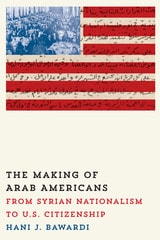
cover of The Making of Arab Americans: From Syrian Nationalism to U.S. Citizenship

The Making of Arab Americans

From Syrian Nationalism to U.S. Citizenship

By Hani J. Bawardi

University of Texas Press, 2014
While conventional wisdom points to the Arab-Israeli War of 1967 as the gateway for the founding of the first Arab American national political organization, such advocacy in fact began with the Syrian nationalist movement, which emerged from immigration trends at the turn of the last century. Bringing this long-neglected history to life, The Making of Arab Americans overturns the notion of an Arab population that was too diverse to share common goals. Tracing the forgotten histories of the Free Syria Society, the New Syria Party, the Arab National League, and the Institute of Arab American Affairs, the book restores a timely aspect of our understanding of an area (then called Syria) that comprises modern-day Syria, Lebanon, Jordan, Israel, and Palestine. Hani Bawardi examines the numerous Arab American political advocacy organizations that thrived before World War I, showing how they influenced Syrian and Arab nationalism. He further offers an in-depth analysis exploring how World War II helped introduce a new Arab American identity as priorities shifted and the quest for assimilation intensified. In addition, the book enriches our understanding of the years leading to the Cold War by tracing both the Arab National League’s transition to the Institute of Arab American Affairs and new campaigns to enhance mutual understanding between the United States and the Middle East. Illustrated with a wealth of previously unpublished photographs and manuscripts, The Making of Arab Americans provides crucial insight for contemporary dialogues.
[more]
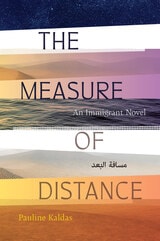
cover of The Measure of Distance: An Immigrant Novel

The Measure of Distance

An Immigrant Novel

Pauline Kaldas

University of Arkansas Press, 2023

They went to Cairo, leaving behind the adobe houses built along the edge of the Nile and the villagers who all knew each other and who had lived on this land for more centuries than their names could count. Behind them, they left the imprint of their footsteps for others who might follow.
 
This family saga begins when Salim, the eldest of three brothers, moves to Cairo at the start of the twentieth century with dreams of opening his own bakery. His decision to leave his ancestral village of Kom Ombo despite his parents’ objections reverberates across generations, kicking off a series of migrations that shape the lives of his family and their descendants throughout the decades that follow. These migrations only intensify after the revolution of 1952—with Misha, Salim’s eldest grandchild, being the first to flee to “Amreeka,” his annual phone calls home becoming briefer and briefer with each passing year.
 
Culminating with the 2011 protests in Tahrir Square, Pauline Kaldas’s The Measure of Distance is a detailed portrait of immigration against the backdrop of an Egypt in constant flux and an America that is always falling short of the fantasy. Alternating between tales of those who migrate and those who stay, this expansive novel follows its characters as they determine the course of their lives, often choosing one uncertainty over another as they migrate to new lands or plant their roots more firmly in their homeland.
 
[more]