Results by title
12 books match the query 'Arabic language'
Advanced Standard Arabic through Authentic Texts and Audiovisual Materials
Part One, Textual MaterialsRaji M. Rammuny
University of Michigan Press, 1994
Advanced Standard Arabic through Authentic Texts and Audiovisual Materials
Part Two, Audiovisual MaterialsRaji M. Rammuny
University of Michigan Press, 1994
Arabic Computational Linguistics
Edited by Ali Farghaly
CSLI, 2010
This comprehensive volume explores new Arabic machine translation systems, innovations in speech recognition and mention detection, tree banks, and linguistic corpora. Arabic Computational Linguistics will be an indispensable reference for language researchers and practitioners alike.
Arabic Sounds and Letters
A Beginning Programmed Course. Textbook and ManualRaji M. Rammuny
University of Michigan Press, 2006
The textbook includes twenty lessons aimed at introducing Arabic sounds and writing system in a programmed method of instruction, supported by images and audio tapes*. The Manual consists of two parts. Part One includes a suggested methodology to guide teachers and students and Part Two contains basic communication needs in both Arabic script and transliteration to create a climate of enjoyable learning while students are acquiring the sounds and letters.
Raji M. Rammuny is Professor of Arabic Studies, Department of Near Eastern Studies, University of Michigan. He is the author of numerous books, including Advanced Standard Arabic through Authentic Texts and Audiovisual Materials, Parts 1 and 2, also published by the University of Michigan Press.
*The CD accompanying Arabic Sounds and Letters can be obtained from the UM Language Resource Center. Contact them by email at flacs@umich.edu or by phone at 734-764-3521.
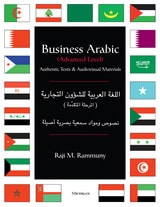
Business Arabic, Advanced Level
Authentic Texts and Audiovisual MaterialsRaji M. Rammuny
University of Michigan Press, 2000
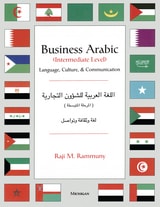
Business Arabic, Intermediate Level
Language, Culture and CommunicationRaji M. Rammuny
University of Michigan Press, 2000
The volume expects students to have control of basic vocabulary and grammatical structures that are typically covered in the first two years of Arabic instruction. Grammatical notes are given for review purposes, where necessary.
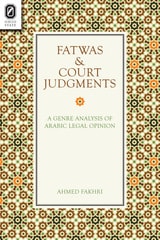
Fatwas and Court Judgments
A Genre Analysis of Arabic Legal OpinionAhmed Fakhri
The Ohio State University Press, 2014
The differences between the two genres stem from elements of their socio-cultural context, such as the role relations of the participants and the characteristics of the institutions to which the genres belong. Moving beyond these contexts, Fatwas and Court Judgments reveals generic practices that have broad implications for understanding various aspects of wider Arab culture, including the tension between modern secular ideologies and traditional religious beliefs, the male-dominated access to discourse, and the prevalence of utilitarian attitudes exhibited in “fatwa shopping.”
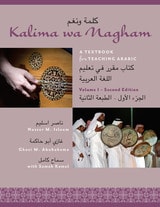
Kalima wa Nagham
A Textbook for Teaching Arabic, Volume 1By Nasser M. Isleem and Ghazi M. Abuhakema
University of Texas Press, 2020
Presenting a new Teaching Arabic as a Foreign Language (TAFL) curriculum that can be used in secondary and postsecondary educational settings, Kalima wa Nagham (Volume I) is a textbook that uniquely and simultaneously introduces Modern Standard Arabic (MSA) and salient aspects of Educated Spoken Arabic (ESA) to beginning language students. Students who fully utilize this book should be able to develop the different language skills: listening, speaking, reading, writing, and expressing deep cultural knowledge.
Written by Arabic language teaching practitioners and experienced educators who are certified language testers, Volume I of Kalima wa Nagham employs a threaded story that introduces language concepts along with music to enhance vocabulary retention and recall. At the core of the textbook are dialogues that present students and teachers with examples of Arabic grammatical concepts and important cultural aspects, as well as related vocabulary. These are supplemented by drills and activities that can be used in a classroom setting or pursued individually. Dialogues, pronunciation and listening drills, and charts to accompany the lessons are available on the UT Press website. This volume is student-centered in content and methodology, which will enable learners to meet and exceed linguistic and cultural proficiency expectations.
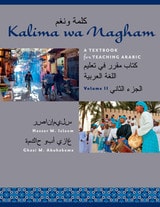
Kalima wa Nagham
A Textbook for Teaching Arabic, Volume 2By Nasser M. Isleem and Ghazi M. Abuhakema
University of Texas Press, 2016
Presenting a new Teaching Arabic as a Foreign Language (TAFL) curriculum that can be used in secondary and postsecondary educational settings, Kalima wa Nagham, Volume 2, is a textbook that uniquely and simultaneously introduces Modern Standard Arabic (MSA) and salient aspects of Educated Spoken Arabic (ESA) to level two language students. Students who fully utilize this book should be able to develop important language skills: listening, speaking, reading, writing, and expressing deep cultural knowledge.
Written by Arabic language teaching practitioners and experienced educators who are certified language testers, Kalima wa Nagham employs a threaded story that introduces language concepts along with music to enhance vocabulary retention and recall. At the core of the textbook are dialogues that present students and teachers with examples of Arabic grammatical concepts and important cultural aspects, as well as related vocabulary. These are supplemented by drills and activities that can be used in a classroom setting or pursued individually. Volume 2 incorporates media language to help students understand news reports and other media texts as well as original cartoons that demonstrate the meaning and significance of idiomatic expressions in a refreshing way. Dialogues and pronunciation and listening drills to accompany the lessons are available on the University of Texas Press website. This volume is student-centered in content and methodology, which will enable learners to meet and exceed linguistic and cultural proficiency expectations.
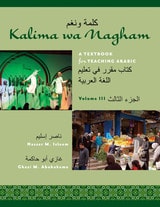
Kalima wa Nagham
A Textbook for Teaching Arabic, Volume 3By Nasser M. Isleem and Ghazi M. Abuhakema
University of Texas Press, 2020
Presenting a new Teaching Arabic as a Foreign Language (TAFL) curriculum that can be used in secondary and postsecondary educational settings, Kalima wa Nagham, volume 3, is a textbook that uniquely and simultaneously introduces Modern Standard Arabic (MSA) and salient aspects of Educated Spoken Arabic (ESA) to students whose proficiency level is at least intermediate high according to ACTFL’s rating scale. Students who fully use this book should be able to develop important language skills—listening, speaking, reading, writing, and expressing deep cultural knowledge—and reach the advanced high proficiency level by the end of the book.
Written by Arabic language teaching practitioners and experienced educators who are certified language testers, Kalima wa Nagham employs a threaded story that introduces language concepts along with music to enhance vocabulary retention and recall. At the core of the textbook are written and oral texts that present students and teachers with examples of Arabic grammatical concepts and important cultural aspects, as well as related vocabulary. These are supplemented by drills and activities that can be used in a classroom setting or pursued individually. Dialogues and pronunciation and listening drills that accompany the lessons are available on the University of Texas Press website. This volume is student-centered in content and methodology, which will enable learners to meet and exceed linguistic and cultural proficiency expectations.
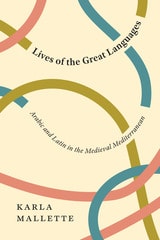
Lives of the Great Languages
Arabic and Latin in the Medieval MediterraneanKarla Mallette
University of Chicago Press, 2021
In this ambitious book, Karla Mallette studies the nature and behaviors of the medieval cosmopolitan languages of learning—classical Arabic and medieval Latin—as they crossed the Mediterranean. Through anecdotes of relationships among writers, compilers, translators, commentators, and copyists, Mallette tells a complex story about the transmission of knowledge in the period before the emergence of a national language system in the late Middle Ages and early modernity.
Mallette shows how the elite languages of learning and culture were only tenuously related to the languages of everyday life. These languages took years of study to master, marking the passage from intellectual childhood to maturity. In a coda to the book, Mallette speculates on the afterlife of cosmopolitan languages in the twenty-first century, the perils of monolingualism, and the ethics of language choice. The book offers insight for anyone interested in rethinking linguistic and literary tradition, the transmission of ideas, and cultural expression in an increasingly multilingual world.

The Arabic Language
Its Role in HistoryAnwar G. Chejne
University of Minnesota Press, 1969
The Arabic Language was first published in 1969. Minnesota Archive Editions uses digital technology to make long-unavailable books once again accessible, and are published unaltered from the original University of Minnesota Press editions.
Arabic, with its rich literary heritage, is one of the major languages of the world. It is spoken by about one hundred million people inhabiting a wide and important area of the Middle East. Yet the language and its significant role in history are little known in the English-speaking countries except among specialists. This book will, it is hoped, help to introduce the language and demonstrate its importance to a wider audience.
Professor Philip K. Hitti of Princeton University writes in the foreword: "Until recently Arabic studies in this country had been limited to the graduate level and confined to a few universities. Since World War II they have inched their way to the undergraduate curriculum of a small number of universities. But they are still top-heavy and anemic. They will so remain unless they send their roots deeper down into high schools and enlist the interest of a widening circle of nonspecialists.
"Hence the value of this work by Professor Chejne. It is a commendable attempt to introduce the Arabic language, with its features and problems, to students and nonspecialists, to tell the story of its dramatic evolution from a tribal dialect to one of the few carriers of world culture, to indicate its unique relation to the religion of Islam and its role in the development of modern Arab nationalism. The book, written in a language intelligible to the layman, sums up what is already known and presents the contribution of the author."