Results by title
3 books match the query 'Armed Conflict'
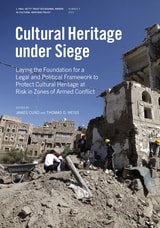
Cultural Heritage Under Siege
Laying the Foundation for a Legal and Political Framework to Protect Cultural Heritage at Risk in Zones of Armed ConflictJames Cuno
J. Paul Getty Trust, The, 2020
The fourth volume of the J. Paul Getty Trust Occasional Papers in Cultural Heritage Policy series is the result of a multi-day discussion on the issue of cultural heritage under siege. It features an edited collection of papers and discussions by nineteen scholars and practitioners of different specialties in the field of cultural heritage. This paper, along with the other Occasional Papers, is free and downloadable online.
[more]
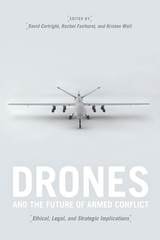
Drones and the Future of Armed Conflict
Ethical, Legal, and Strategic ImplicationsEdited by David Cortright, Rachel Fairhurst, and Kristen Wall
University of Chicago Press, 2015
During the past decade, armed drones have entered the American military arsenal as a core tactic for countering terrorism. When coupled with access to reliable information, they make it possible to deploy lethal force accurately across borders while keeping one’s own soldiers out of harm’s way. The potential to direct force with great precision also offers the possibility of reducing harm to civilians. At the same time, because drones eliminate some of the traditional constraints on the use of force—like the need to gain political support for full mobilization—they lower the threshold for launching military strikes. The development of drone use capacity across dozens of countries increases the need for global standards on the use of these weapons to assure that their deployment is strategically wise and ethically and legally sound.
Presenting a robust conversation among leading scholars in the areas of international legal standards, counterterrorism strategy, humanitarian law, and the ethics of force, Drones and the Future of Armed Conflict takes account of current American drone campaigns and the developing legal, ethical, and strategic implications of this new way of warfare. Among the contributions to this volume are a thorough examination of the American government’s legal justifications for the targeting of enemies using drones, an analysis of American drone campaigns’ notable successes and failures, and a discussion of the linked issues of human rights, freedom of information, and government accountability.
Presenting a robust conversation among leading scholars in the areas of international legal standards, counterterrorism strategy, humanitarian law, and the ethics of force, Drones and the Future of Armed Conflict takes account of current American drone campaigns and the developing legal, ethical, and strategic implications of this new way of warfare. Among the contributions to this volume are a thorough examination of the American government’s legal justifications for the targeting of enemies using drones, an analysis of American drone campaigns’ notable successes and failures, and a discussion of the linked issues of human rights, freedom of information, and government accountability.
[more]
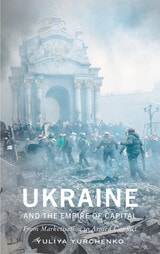
Ukraine and the Empire of Capital
From Marketisation to Armed ConflictYuliya Yurchenko
Pluto Press, 2017
Since 1991, nominally independent Ukraine has been in turmoil, with the Orange Revolution and the Maidan protests marking its most critical moments. Now, its borders are threatened and the civil unrest and armed conflict continue to destabilise the country. In order to understand these dramatic events, Yuliya Yurchenko looks to the country’s post-Soviet past in this ambitious analysis of contemporary Ukrainian political economy.
Providing distinctive and unexplored reflections on the origins of the conflict, Yurchenko unpacks the four central myths that underlie Ukraine's post-Soviet reality: the myth of transition, the myth of democracy, the myth of two Ukraines, and the myth of 'the other'. In doing so, she sheds light on the current intensification of class rivalries in Ukraine, the kleptocracy, resource wars and analyses existing and potential dangers of the rightwing shift in Ukraine's polity, stressing a historic opportunity for change.
Critiquing the concept of Ukraine as ‘transition space’, she provides a sweeping analysis which includes the wider neoliberal restructuring of global political economy since the 1970s, with particular focus on Ukraine's relations with the US, the EU and Russia. This is a book for those wanting to understand the current conflict as a dangerous product of neoliberalism, of the empire of capital.
[more]