Results by title

7 books match the query 'Art, Italian'
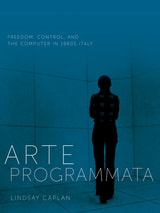
cover of Arte Programmata: Freedom, Control, and the Computer in 1960s Italy

Arte Programmata

Freedom, Control, and the Computer in 1960s Italy

Lindsay Caplan

University of Minnesota Press, 2022

Tracing the evolution of the Italian avant-garde’s pioneering experiments with art and technology and their subversion of freedom and control

In postwar Italy, a group of visionary artists used emergent computer technologies as both tools of artistic production and a means to reconceptualize the dynamic interrelation between individual freedom and collectivity. Working contrary to assumptions that the rigid, structural nature of programming limits subjectivity, this book traces the multifaceted practices of these groundbreaking artists and their conviction that technology could provide the conditions for a liberated social life.

Situating their developments within the context of the Cold War and the ensuing crisis among the Italian left, Arte Programmata describes how Italy’s distinctive political climate fueled the group’s engagement with computers, cybernetics, and information theory. Creating a broad range of immersive environments, kinetic sculptures, domestic home goods, and other multimedia art and design works, artists such as Bruno Munari, Enzo Mari, and others looked to the conceptual frameworks provided by this new technology to envision a way out of the ideological impasses of the age.

Showcasing the ingenuity of Italy’s earliest computer-based art, this study highlights its distinguishing characteristics while also exploring concurrent developments across the globe. Centered on the relationships between art, technology, and politics, Arte Programmata considers an important antecedent to the digital age. 
[more]
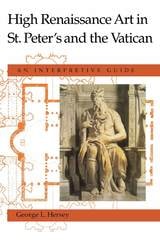
cover of High Renaissance Art in St. Peter's and the Vatican: An Interpretive Guide

High Renaissance Art in St. Peter's and the Vatican

An Interpretive Guide

George L. Hersey

University of Chicago Press, 1993

Michelangelo, Raphael, Bramante—together these artists created some of the most glorious treasures of the Vatican, viewed daily by thousands of tourists. But how many visitors understand the way these artworks reflect the passions, dreams, and struggles of the popes who commissioned them? For anyone making an artistic pilgrimage to the High Renaissance splendors of the Vatican, George L. Hersey's book is the ideal guide.

Before starting the tour of individual works, Hersey describes how the treacherously shifting political and religious alliances of sixteenth-century Italy, France, and Spain played themselves out in the Eternal City. He offers vivid accounts of the lives and personalities of four popes, each a great patron of art and architecture: Julius II, Leo X, Clement VII, and Paul III. He also tells of the complicated rebuilding and expanding of St. Peter's, a project in which Bramante, Raphael, and Michelangelo all took part.

Having set the historical scene, Hersey then explores the Vatican's magnificent Renaissance art and architecture. In separate chapters, organized spatially, he leads the reader through the Cortile del Belvedere and Vatican Museums, with their impressive holdings of statuary and paintings; the richly decorated Stanze and Logge of Raphael; and Michelangelo's Last Judgment and newly cleaned Sistine Chapel ceiling. A fascinating final chapter entitled "The Tragedy of the Tomb" recounts the vicissitudes of Michelangelo's projected funeral monument to Julius II.

Hersey is never content to simply identify the subject of a painting or sculpture. He gives us the story behind the works, telling us what their particular themes signified at the time for the artist, the papacy, and the Church. He also indicates how the art was received by contemporaries and viewed by later generations.

Generously illustrated and complete with a useful chronology, High Renaissance Art in St. Peter's and the Vatican is a valuable reference for any traveler to Rome or lover of Italian art who has yearned for a single-volume work more informative and stimulating than ordinary guidebooks. At the same time, Hersey's many anecdotes and intriguing comparisons with works outside the Vatican will provide new insights even for specialists.
[more]
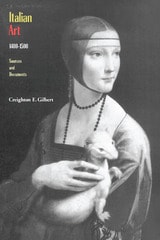
cover of Italian Art 1400-1500: Sources and Documents

Italian Art 1400-1500

Sources and Documents

Creighton Gilbert

Northwestern University Press, 1980
Creighton E. Gilbert captures the spirit of the early Renaissance in this remarkable collection of primary texts by and about artists of the fifteenth century. Italian Art makes a valuable contribution not only to the field of art history, but also to social and intellectual history. Almost all aspects of the life of the period—war, fashion, travel, communication—are documented. Revealing significant aspects of the practice of art, the process of patronage, and the way of life and social position of early Renaissance artists, Italian Art brings this fascinating period to life for students and scholars.
[more]
cover of Italian Art 1500–1600: Sources and Documents

Italian Art 1500–1600

Sources and Documents

Robert Klein and Henri Zerner

Northwestern University Press, 1966
Italian Art, 1500–1600 provides a unique view of the development of the literature on art in Italy during the Cinquecento. The selections bring out the close relationship between art theories and the actuality of art and chart a trend from a humanistic orientation to a more technical and professorial one. The documents and commentary reveal the effects that humanistic circles, the courts, and the Church—during the Renaissance and the Counter-Reformation—had on the way people wrote and thought about art.
[more]
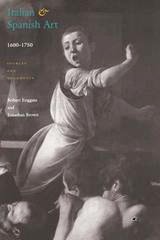
cover of Italian and Spanish Art 1600-1750: Sources and Documents

Italian and Spanish Art 1600-1750

Sources and Documents

Robert Enggass

Northwestern University Press, 1993
The Baroque period was crucial for the development of art theory and the advancement of the artistic academy. This collection of primary sources brings this important period to life with significant documents and texts. It conveniently assembles major texts, which are otherwise available only in scattered publications. The lives of leading artists--Caravaggio, El Greco, among others---are discussed by their contemporaries, while Bellori, Galileo, Pascoli, and others write on art theory and practice. The documents provide fascinating glimpses of the period's artistic self-image.
[more]
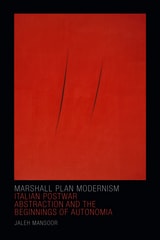
cover of Marshall Plan Modernism: Italian Postwar Abstraction and the Beginnings of Autonomia

Marshall Plan Modernism

Italian Postwar Abstraction and the Beginnings of Autonomia

Jaleh Mansoor

Duke University Press, 2016
Focusing on artwork by Lucio Fontana, Alberto Burri, and Piero Manzoni, Jaleh Mansoor demonstrates and reveals how abstract painting, especially the monochrome, broke with fascist-associated futurism and functioned as an index of social transition in postwar Italy. Mansoor refuses to read the singularly striking formal and procedural violence of Fontana's slit canvasses, Burri's burnt and exploded plastics, and Manzoni's "achromes" as metaphors of traumatic memories of World War II. Rather, she locates the motivation for this violence in the history of the medium of painting and in the economic history of postwar Italy. Reconfiguring the relationship between politics and aesthetics, Mansoor illuminates how the monochrome's reemergence reflected Fontana, Burri, and Manzoni's aesthetic and political critique of the Marshall Plan's economic warfare and growing American hegemony. It also anticipated the struggles in Italy's factories, classrooms, and streets that gave rise to Autonomia in the 1960s. Marshall Plan Modernism refigures our understanding of modernist painting as a project about labor and the geopolitics of postwar reconstruction during the Italian Miracle.
[more]
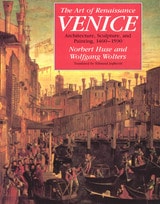
cover of The Art of Renaissance Venice: Architecture, Sculpture, and Painting, 1460-1590

The Art of Renaissance Venice

Architecture, Sculpture, and Painting, 1460-1590

Norbert Huse and Wolfgang Wolters

University of Chicago Press, 1990

In the first contemporary single-volume survey of the three arts of Venice—painting, sculpture, and architecture—Norbert Huse and Wolfgang Wolters offer an important counterbalance to the traditional orientation toward painting as the city's preeminent art by focusing on architecture as the essential Venetian art. They begin their study in 1460, when Venice was one of the key powers of Italy, and end with the death of Tintoretto in 1594, a period of waning international power. In the process, they define the distinctly Venetian terms by which the city and its culture should be understood. With over three hundred illustrations and an exhaustive bibliography, this volume makes an impressive contribution to art historical scholarship.

"The historical aspect of this book is splendid, but where it excels is in its fearless and thought-provoking critical judgements. . . . it will lead both beginners and experts to new joys."—David Ekserdjian, Times Literary Supplement

[more]