Results by title
6 books match the query 'Art and music'
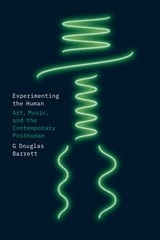
Experimenting the Human
Art, Music, and the Contemporary PosthumanG Douglas Barrett
University of Chicago Press, 2023
An engaging argument about what experimental music can tell us about being human.
In Experimenting the Human, G Douglas Barrett argues that experimental music speaks to the contemporary posthuman, a condition in which science and technology decenter human agency amid the uneven temporality of postwar global capitalism. Time moves forward for some during this period, while it seems to stand still or even move backward for others. Some say we’re already posthuman, while others endure the extended consequences of never having been considered fully human in the first place. Experimental music reflects on this state, Barrett contends, through its interdisciplinary involvements in postwar science, technology, and art movements.
Rather than pursuing the human's beyond, experimental music addresses the social and technological conditions that support such a pursuit. Barrett locates this tendency of experimentalism throughout its historical entanglements with cybernetics, and in his intimate analysis of Alvin Lucier’s neurofeedback music, Pamela Z’s BodySynth performances, Nam June Paik’s musical robotics, Pauline Oliveros’s experiments with radio astronomy, and work by Laetitia Sonami, Yasunao Tone, and Jerry Hunt. Through a unique meeting of music studies, media theory, and art history, Experimenting the Human provides fresh insights into what it means to be human.
[more]
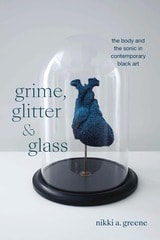
Grime, Glitter, and Glass
The Body and the Sonic in Contemporary Black ArtNikki A. Greene
Duke University Press, 2024
In Grime, Glitter, and Glass, Nikki A. Greene examines how contemporary Black visual artists use sonic elements to refigure the formal and philosophical developments of Black art and culture. Focusing on the multimedia art of Renée Stout, Radcliffe Bailey, and María Magdalena Campos-Pons, Greene traces the intersection of the visual’s sonic possibilities with the Black body’s physical, representational, and metaphorical use in art. She employs her concept of “visual aesthetic musicality” to interpret Black visual art by examining the musical genres of jazz and rap, along with the often-overlooked innovations of funk and rumba, within art historiography. From Bailey’s use of multilayered surfaces of glitter, mud, and recycled materials to meditate on Sun Ra’s Afrofuturism to Stout’s life-size cast of her own body that recalls funk musician Betty Davis to Campos-Pons’s performative and sculptural references to sugar that resonate with the legacy of Celia Cruz, Greene outlines how these artists use mediums such as molded glass sculptures, viscous wet plaster, and dazzling mannequin heads to enhance the manifestations of Black identity. By foregrounding the sonic elements of their work, Greene demonstrates that these artists use sound to make themselves legible, recognizable, and audible.
[more]
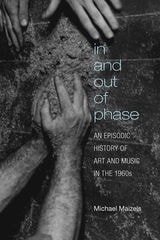
In and Out of Phase
An Episodic History of Art and Music in the 1960sMichael Maizels
University of Michigan Press, 2020
Experimental artists and musicians thrived in New York, Los Angeles, and other creative hotspots in the 1960s, and those who would become major figures in the visual arts often worked closely with those who became the most recognized composers and performers of late-twentieth-century music. Yet, surprisingly little attention has been given to these connections, especially considering that such collaborations helped to shape subsequent histories of both fields.
In and Out of Phase is the first sustained look at the creative interactions between artists and musicians of this era, looking at four pairs of creators who used process-oriented ideas and techniques in their music and art: Dan Flavin and La Monte Young; Sol LeWitt and Milton Babbitt; Richard Serra and Steve Reich; and Bruce Nauman and Meredith Monk. Maizels uncovers not just the social and intellectual connections between these two groups of creators, but illuminates how the focus on repetitive actions, pattern and process, and an emphasis on “surface” created mutual influence—and stylistic change—between music and art during this period. The book’s concluding chapter briefly addresses the enduring influence of the innovations of the 1960s on more recent works.
In and Out of Phase is the first sustained look at the creative interactions between artists and musicians of this era, looking at four pairs of creators who used process-oriented ideas and techniques in their music and art: Dan Flavin and La Monte Young; Sol LeWitt and Milton Babbitt; Richard Serra and Steve Reich; and Bruce Nauman and Meredith Monk. Maizels uncovers not just the social and intellectual connections between these two groups of creators, but illuminates how the focus on repetitive actions, pattern and process, and an emphasis on “surface” created mutual influence—and stylistic change—between music and art during this period. The book’s concluding chapter briefly addresses the enduring influence of the innovations of the 1960s on more recent works.
[more]
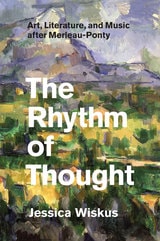
The Rhythm of Thought
Art, Literature, and Music after Merleau-PontyJessica Wiskus
University of Chicago Press, 2013
Between present and past, visible and invisible, and sensation and idea, there is resonance—so philosopher Maurice Merleau-Ponty argued and so Jessica Wiskus explores in The Rhythm of Thought. Holding the poetry of Stéphane Mallarmé, the paintings of Paul Cézanne, the prose of Marcel Proust, and the music of Claude Debussy under Merleau-Ponty’s phenomenological light, she offers innovative interpretations of some of these artists’ masterworks, in turn articulating a new perspective on Merleau-Ponty’s philosophy.
More than merely recovering Merleau-Ponty’s thought, Wiskus thinks according to it. First examining these artists in relation to noncoincidence—as silence in poetry, depth in painting, memory in literature, and rhythm in music—she moves through an array of their artworks toward some of Merleau-Ponty’s most exciting themes: our bodily relationship to the world and the dynamic process of expression. She closes with an examination of synesthesia as an intertwining of internal and external realms and a call, finally, for philosophical inquiry as a mode of artistic expression. Structured like a piece of music itself, The Rhythm of Thought offers new contexts in which to approach art, philosophy, and the resonance between them.
[more]

The Temple of Fame and Friendship
Portraits, Music, and History in the C. P. E. Bach CircleAnnette Richards
University of Chicago Press, 2020
This book examines the renowned portrait collection assembled by C. P. E. Bach, J. S. Bach’s second son.
One of the most celebrated German composers of the eighteenth century, C. P. E. Bach spent decades assembling an extensive portrait collection of some four hundred music-related items—from oil paintings to engraved prints. The collection was dispersed after Bach’s death in 1788, but with Annette Richards’s painstaking reconstruction, the portraits once again present a vivid panorama of music history and culture, reanimating the sensibility and humor of Bach’s time. Far more than a mere multitude of faces, Richards argues, the collection was a major part of the composer’s work that sought to establish music as an object of aesthetic, philosophical, and historical study.
The Temple of Fame and Friendship brings C. P. E. Bach’s collection to life, giving readers a sense of what it was like for visitors to tour the portrait gallery and experience music in rooms thick with the faces of friends, colleagues, and forebears. She uses the collection to analyze the “portraitive” aspect of Bach’s music, engaging with the influential theories of Swiss physiognomist Johann Caspar Lavater. She also explores the collection as a mode of cultivating and preserving friendship, connecting this to the culture of remembrance that resonates in Bach’s domestic music. Richards shows how the new music historiography of the late eighteenth century, rich in anecdote, memoir, and verbal portrait, was deeply indebted to portrait collecting and its negotiation between presence and detachment, fact and feeling.
[more]
Untwisting the Serpent
Modernism in Music, Literature, and Other ArtsDaniel Albright
University of Chicago Press, 2000
From its dissonant musics to its surrealist spectacles (the urinal is a violin!), Modernist art often seems to give more frustration than pleasure to its audience. In Untwisting the Serpent, Daniel Albright shows that this perception arises partly because we usually consider each art form in isolation, even though many of the most important artistic experiments of the Modernists were collaborations involving several media—Igor Stravinsky's The Rite of Spring is a ballet, Gertrude Stein's Four Saints in Three Acts is an opera, and Pablo Picasso turned his cubist paintings into costumes for Parade.
Focusing on collaborations with a musical component, Albright views these works as either figures of dissonance that try to retain the distinctness of their various media (e.g. Guillaume Apollinaire's Les Mamelles de Tirésias) or figures of consonance that try to lose themselves in some total effect (e.g. Arnold Schoenberg's Erwartung). In so doing he offers a fresh picture of Modernism, and provides a compelling model for the analysis of all artistic collaborations.
Untwisting the Serpent is the recipient of the 2001 Susanne M. Glasscock Humanities Book Prize for Interdisciplinary Scholarship of the Center for Humanities Research at Texas A&M University.
[more]