Results by title
23 books match the query 'Art and state'

African Royal Court Art
Michèle Coquet
University of Chicago Press, 1998
More than ornamentation, royal objects embodied the strength and status of African rulers. The gold-plated stools of the Ashanti, the delicately carved ivory bracelets of the Edo-these objects were meant not simply to adorn but to affirm and enhance the power and prestige of the wearer. Unlike the abstract style frequently seen in African ritual art, realism became manifest in courtly arts. Realism directly linked the symbolic value of the object-a portrait or relief-with the physical person of the king. The contours of the monarch's face, his political and military exploits rendered on palace walls, became visual histories, the work of art in essence corroborating the ruler's sovereign might.
Richly illustrated and wonderfully detailed, Coquet's influential volume offers both a splendid visual presentation and an authoritative analysis of African royal arts.
"[This] beautiful and exciting book emphasizes the skillful court art of the Benin, Dahomey, and the Kongo. A very interesting and unusual approach to the art of the continent that has been too easily situated 'outside of history.'"—Le Figaro
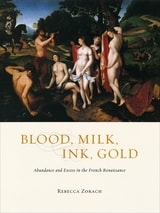
Blood, Milk, Ink, Gold
Abundance and Excess in the French RenaissanceRebecca Zorach
University of Chicago Press, 2005
Throughout the book, abundance and excess flow in liquids-blood, milk, ink, and gold-that highlight the materiality of objects and the human body, and explore the value (and values) accorded to them. The arts of the lavish royal court at Fontainebleau and in urban centers are here explored in a vibrant tableau that illuminates our own contemporary relationship to excess and desire.
From marvelous works by Francois Clouet to oversexed ornamental prints to Benvenuto Cellini's golden saltcellar fashioned for Francis I, Blood, Milk, Ink, Gold covers an astounding range of subjects with precision and panache, producing the most lucid, well-rounded portrait of the cultural politics of the French Renaissance to date.
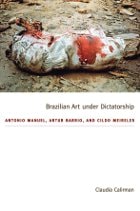
Brazilian Art under Dictatorship
Antonio Manuel, Artur Barrio, and Cildo MeirelesClaudia Calirman
Duke University Press, 2012
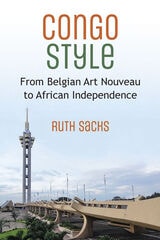
Congo Style
From Belgian Art Nouveau to African IndependenceRuth Sacks
University of Michigan Press, 2023
Congo Style presents a postcolonial approach to discussing the visual culture of two now-notorious regimes: King Leopold II’s Congo Colony and the state sites of Mobutu Sese Seko’s totalitarian Zaïre. Readers are brought into the living remains of sites once made up of ambitious modernist architecture and art in Kinshasa, Democratic Republic of the Congo. From the total artworks of Art Nouveau to the aggrandizing sites of post-independence Kinshasa, Congo Style investigates the experiential qualities of man-made environments intended to entertain, delight, seduce, and impress.
In her study of visual culture, Ruth Sacks sets out to reinstate the compelling wonder of nationalist architecture from Kinshasa’s post-independence era, such as the Tower of the Exchange (1974), Gécamines Tower (1977), and the artworks and exhibitions that accompanied them. While exploring post-independence nation-building, this book examines how the underlying ideology of Belgian Art Nouveau, a celebrated movement in Belgium, led to the dominating early colonial settler buildings of the ABC Hotels (circa 1908–13). Congo Style combines Sacks’s practice as a visual artist and her academic scholarship to provide an original study of early colonial and independence-era modernist sites in their African context.
Cultural Agency in the Americas
Doris Sommer, ed.
Duke University Press, 2006
Based in North and South America, scholars from fields including anthropology, performance studies, history, literature, and communications studies explore specific variations of cultural agency across Latin America. Contributors reflect, for example, on the paradoxical programming and reception of a state-controlled Cuban radio station that connects listeners at home and abroad; on the intricacies of indigenous protests in Brazil; and the formulation of cultural policies in cosmopolitan Mexico City. One contributor notes that trauma theory targets individual victims when it should address collective memory as it is worked through in performance and ritual; another examines how Mapuche leaders in Argentina perceived the pitfalls of ethnic essentialism and developed new ways to intervene in local government. Whether suggesting modes of cultural agency, tracking exemplary instances of it, or cautioning against potential missteps, the essays in this book encourage attentiveness to, and the multiplication of, the many extraordinary instantiations of cultural resourcefulness and creativity throughout Latin America and beyond.
Contributors. Arturo Arias, Claudia Briones, Néstor García Canclini, Denise Corte, Juan Carlos Godenzzi, Charles R. Hale, Ariana Hernández-Reguant, Claudio Lomnitz, Jesús Martín Barbero, J. Lorand Matory, Rosamel Millamán, Diane M. Nelson, Mary Louise Pratt, Alcida Rita Ramos, Doris Sommer, Diana Taylor, Santiago Villaveces
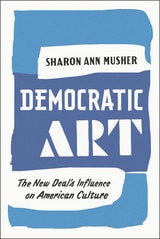
Democratic Art
The New Deal's Influence on American CultureSharon Ann Musher
University of Chicago Press, 2015
In Democratic Art, Sharon Musher explores these questions and uses them as a springboard for an examination of the role art can and should play in contemporary society. Drawing on close readings of government-funded architecture, murals, plays, writing, and photographs, Democratic Art examines the New Deal’s diverse cultural initiatives and outlines five perspectives on art that were prominent at the time: art as grandeur, enrichment, weapon, experience, and subversion. Musher argues that those engaged in New Deal art were part of an explicitly cultural agenda that sought not just to create art but to democratize and Americanize it as well. By tracing a range of aesthetic visions that flourished during the 1930s, this highly original book outlines the successes, shortcomings, and lessons of the golden age of government funding for the arts.
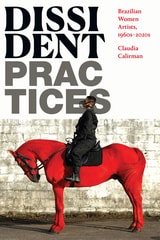
Dissident Practices
Brazilian Women Artists, 1960s–2020sClaudia Calirman
Duke University Press, 2023
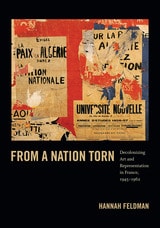
From a Nation Torn
Decolonizing Art and Representation in France, 1945-1962Hannah Feldman
Duke University Press, 2014

Imagined Museums
Art and Modernity in Postcolonial MoroccoKatarzyna Pieprzak
University of Minnesota Press, 2010
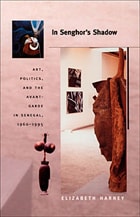
In Senghor's Shadow
Art, Politics, and the Avant-Garde in Senegal, 1960–1995Elizabeth Harney
Duke University Press, 2004
Heavily illustrated with nearly one hundred images, including some in color, In Senghor’s Shadow surveys the work of a range of Senegalese artists, including painters, muralists, sculptors, and performance-based groups—from those who worked at the height of Senghor’s patronage system to those who graduated from art school in the early 1990s. Harney reveals how, in the 1970s, avant-gardists contested Negritude beliefs by breaking out of established artistic forms. During the 1980s and 1990s, artists such as Moustapha Dimé, Germaine Anta Gaye, and Kan-Si engaged with avant-garde methods and local artistic forms to challenge both Senghor’s legacy and the broader art world’s understandings of cultural syncretism. Ultimately, Harney’s work illuminates the production and reception of modern Senegalese art within the global arena.

Lamps at High Noon
Jack S. Balch
University of Illinois Press, 1941
Charlie Gest, the wide-eyed and well-intentioned protagonist of the novel, confronts firsthand the project's sometimes underhanded efforts to monitor the political views of its writers. Named assistant director of the project in Monroe (a fictional St. Louis), Gest is vaguely aware that the program's good intentions do not always overshadow the abuses it tolerates, which include shielding corporate interests and avoiding hiring highly qualified black writers. Gest is hounded by a nagging suspicion that, like lamps that burn in broad daylight, the issues at stake in the work stoppage are not the ones that most need addressing.
Part radical socialist commentary, part absurdist theater, Balch's novel offers a peerless critical engagement of the economic constraints and political exigencies surrounding debates over the federal funding of art since the New Deal.
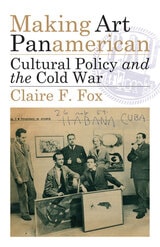
Making Art Panamerican
Cultural Policy and the Cold WarClaire F. Fox
University of Minnesota Press, 2013
Among the buildings on the National Mall in Washington, D.C., only the Pan American Union (PAU) houses an international organization. The first of many anticipated “peace palaces”constructed in the early twentieth century, the PAU began with a mission of cultural diplomacy, and after World War II its Visual Arts Section became a leader in the burgeoning hemispheric arts scene, proclaiming Latin America’s entrée into the international community as it forged connections between a growing base of middle-class art consumers on one hand and concepts of supranational citizenship and political and economic liberalism on the other.
Making Art Panamerican situates the ambitious visual arts programs of the PAU within the broader context of hemispheric cultural relations during the cold war. Focusing on the institutional interactions among aesthetic movements, cultural policy, and viewing publics, Claire F. Fox contends that in the postwar years, the PAU Visual Arts Section emerged as a major transfer point of hemispheric American modernist movements and played an important role in the consolidation of Latin American art as a continental object of study.
As it traces the careers of individual cultural policymakers and artists who intersected with the PAU in the two postwar decades—such as Concha Romero James, Charles Seeger, José Gómez Sicre, José Luis Cuevas, and Rafael Squirru—the book also charts the trajectories and displacements of sectors of the U.S. and Latin American intellectual left during a tumultuous interval that spans the Mexican Revolution, the Spanish Civil War, the New Deal, and the early cold war. Challenging the U.S. bias of conventional narratives about Panamericanism and the postwar shift in critical values from realism to abstraction, Making Art Panamerican illuminates the institutional dynamics that helped shape aesthetic movements in the critical decades following World War II.
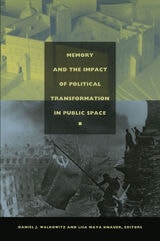
Memory and the Impact of Political Transformation in Public Space
Daniel J. Walkowitz and Lisa Maya Knauer, eds.
Duke University Press, 2004
This collection expands the scope of what is considered public history by pointing to silences and absences that are as telling as museums and memorials. Contributors remind us that for every monument that is erected, others—including one celebrating Sri Lanka’s independence and another honoring the Unknown Russian Soldier of World War II—remain on the drawing board. While some sites seem woefully underserved by a lack of public memorials—as do post–Pinochet Chile and post–civil war El Salvador—others run the risk of diluting meaning through overexposure, as may be happening with Israel’s Masada. Essayists examine public history as it is conveyed not only in marble and stone but also through cityscapes and performances such as popular songs and parades.
Contributors
James Carter
John Czaplicka
Kanishka Goonewardena
Lisa Maya Knauer
Anna Krylova
Teresa Meade
Bill Nasson
Mary Nolan
Cynthia Paces
Andrew Ross
Daniel Seltz
T. M. Scruggs
Irina Carlota Silber
Daniel J. Walkowitz
Yael Zerubavel
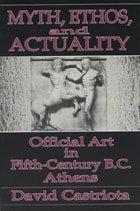
Myth, Ethos, and Actuality
Official Art in Fifth Century B.C. AthensDavid Castriota
University of Wisconsin Press, 1992
Using material remains, as well as the evidence of contemporary Greek history, rhetoric, and poetry, David Castriota interprets the Athenian monuments as vehicles of an official ideology intended to celebrate and justify the present in terms of the past.
Castriota focuses on the strategy of ethical antithesis that asserted Greek moral superiority over the “barbaric” Persians, whose invasion had been repelled a generation earlier. He examines how, in major public programs of painting and sculpture, the leading artists of the period recast the Persians in the guise of wild and impious mythic antagonists to associate them with the ethical flaws or weaknesses commonly ascribed to women, animals, and foreigners. The Athenians, in contrast, were compared to mythic protagonists representing the excellence and triumph of Hellenic culture.
Castriota’s study is innovative in emphasizing the ethical implication of mythic precedents, which required substantial alterations to render them more effective as archetypes for the defense of Greek culture against a foreign, morally inferior enemy. The book looks in new ways at how the patrons and planners sought to manipulate viewer response through the selective presentation or repackaging of mythic traditions.
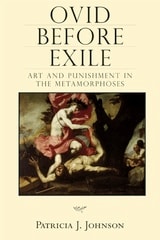
Ovid before Exile
Art and Punishment in the MetamorphosesPatricia J. Johnson
University of Wisconsin Press, 2007
Patricia J. Johnson demonstrates how the production of art—specifically poetry—changed dramatically during the reign of Augustus. By Ovid’s final decade in Rome, the atmosphere for artistic work had transformed, leading to a drop in poetic production of quality. Johnson shows how Ovid, in the episodes of artistic creation that anchor his Metamorphoses, responded to his audience and commented on artistic circumstances in Rome.
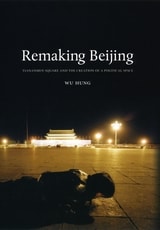
Remaking Beijing
Tiananmen Square and the Creation of a Political SpaceWu Hung
University of Chicago Press, 2005
Wu Hung grew up in Beijing and experienced much of the city's makeover firsthand. In this lavishly illustrated work, he offers a vivid, often personal account of the struggle over Beijing's reinvention, drawing particular attention to Tiananmen Square—the most sacred space in the People's Republic of China. Remaking Beijing considers the square's transformation from a restricted imperial domain into a public arena for political expression, from an epic symbol of socialism into a holy relic of the Maoist regime, and from an official and monumental complex into a site for unofficial and antigovernment demonstrations.
Wu Hung also explores how Tiananmen Square has become a touchstone for official art in modern China—as the site for Mao's monumental portrait, as the location of museums narrating revolutionary history, and as the grounds for extravagant National Day parades celebrating the revolutionary masses. He then shows how in recent years the square has inspired artists working without state sponsorship to create paintings, photographs, and even performances that reflect the spirit of the 1989 uprisings and pose a forceful challenge to official artworks and the sociopolitical system that supports them.
Remaking Beijing will reward anyone interested in modern Chinese history, society, and art, or, more generally, in how urban renewal becomes intertwined with cultural and national politics.
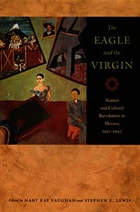
The Eagle and the Virgin
Nation and Cultural Revolution in Mexico, 1920–1940Mary Kay Vaughan and Stephen E. Lewis, eds.
Duke University Press, 2006
Contributors explore the nation-building efforts of the government, artists, entrepreneurs, and social movements; their contradictory, often conflicting intersection; and their inevitably transnational nature. Scholars of political and social history, communications, and art history describe the creation of national symbols, myths, histories, and heroes to inspire patriotism and transform workers and peasants into efficient, productive, gendered subjects. They analyze the aesthetics of nation building made visible in murals, music, and architecture; investigate state projects to promote health, anticlericalism, and education; and consider the role of mass communications, such as cinema and radio, and the impact of road building. They discuss how national identity was forged among social groups, specifically political Catholics, industrial workers, middle-class women, and indigenous communities. Most important, the volume weighs in on debates about the tension between the eagle (the modernizing secular state) and the Virgin of Guadalupe (the Catholic defense of faith and morality). It argues that despite bitter, violent conflict, the symbolic repertoire created to promote national identity and memory making eventually proved capacious enough to allow the eagle and the virgin to coexist peacefully.
Contributors. Adrian Bantjes, Katherine Bliss, María Teresa Fernández, Joy Elizabeth Hayes, Joanne Hershfield, Stephen E. Lewis, Claudio Lomnitz, Rick A. López, Sarah M. Lowe, Jean Meyer, James Oles, Patrice Olsen, Desmond Rochfort, Michael Snodgrass, Mary Kay Vaughan, Marco Velázquez, Wendy Waters, Adriana Zavala
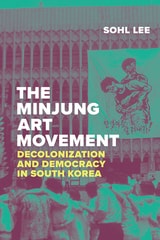
The Minjung Art Movement
Decolonization and Democracy in South KoreaSohl Lee
Duke University Press, 2026
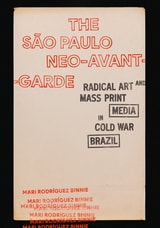
The São Paulo Neo-Avant-Garde
Radical Art and Mass Print Media in Cold War BrazilMari Rodríguez Binnie
University of Texas Press, 2024
How artists challenged a military dictatorship through mass print technologies in 1970s and 1980s São Paulo.
Throughout the 1970s and into the 1980s, during Brazil's military dictatorship, artists shifted their practices to critique the government and its sanitized images of Brazil, its use of torture, and its targeted persecutions. Mari Rodríguez Binnie's The São Paulo Neo-Avant-Garde examines these artworks and their engagement with politics and mainstream art institutions and practices.
As Binnie skillfully shows, artists appropriated processes like photocopy, offset lithography, and thermal and heliographic printing, making newly available technologies of mass production foundational to their work of resistance against both the dictatorship and the established art world. Often working collaboratively, these artists established alternative networks of exchange locally and internationally to circulate their work. As democracy was reestablished in Brazil, and in the decades that followed, their works largely fell out of sight. Here, in the first English-language book to focus entirely on conceptual practices in São Paulo in the 1970s and 1980s, Binnie unearths a scene critical to the development of contemporary Brazilian Art.

The Unfulfilled Promise
Public Subsidy of the Arts in AmericaEdward Arian
Temple University Press, 1993
Unsettling 'Sensation'
Arts Policy Lessons from the Brooklyn Museum of Art ControversyRothfield, Lawrence
Rutgers University Press, 2001
Unsettling 'Sensation'
Arts-Policy Lessons from the Brooklyn Museum of Art ControversyRothfield, Lawrence
Rutgers University Press, 2001
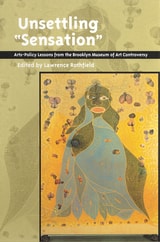
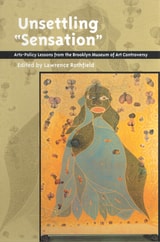
In September 1999, Sensation, an exhibition at the Brooklyn Museum, opened its doors, igniting a controversy still burning in the art world. This collection of cutting-edge art from the Saatchi collection in England, and the museum’s arrangements with Charles Saatchi to finance the show, so offended New York City mayor Rudolph Giuliani that he attempted to shut the museum down by withholding city funds that are crucially needed by that institution. Only a legal ruling prevented him from doing so. Like the Robert Mapplethorpe exhibition before it, Sensation once again raises questions about public spending for “controversial” art, but with the added dimension of religious conflict and charges of commercialization.
The contributors to this volume use the Sensation exhibition as a stepping-stone to analyze larger questions such as the authority the government has to withhold funds, various interpretations of the First Amendment, how to respect divergent cultural and religious values; and the economic stake of museums and dealers in art. In their articles—written expressly for this volume, and spanning the disciplines of law, cultural studies, public policy, and art—the contributors consider issues at the center of arts policy. They propose various legal strategies, curatorial practices, and standards of doing business intended to serve the public interest in the arts.
Voices in Aerosol
Youth Culture, Institutional Attunement, and Graffiti in Urban MexicoCaitlin Frances Bruce
University of Texas Press, 2024
2024 Visual Communication Division Award, National Communication Association
2025 Philosophy of Communication, Theory, and Critique Division Distinguished Book Award, National Communication Association
2025 Winans-Wichelns Memorial Award for Distinguished Scholarship in Rhetoric and Public Address, National Communication Association
How a city government in central Mexico evolved from waging war on graffiti in the early 2000s to sanctioning its creation a decade later, and how youth navigated these changing conditions for producing art.
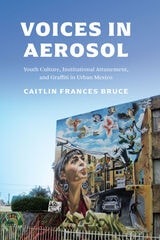
The local government, residents, and media outlets in León, Mexico, treated graffiti as a disease until the state began sponsoring artistic graffiti through a program of its own. In Voices in Aerosol, the first book-length study of state-sponsored graffiti, Caitlin Frances Bruce considers the changing perceptions and recognition of graffiti artists, their right to the city, and the use of public space over the span of eighteen years (2000–2018). Focusing on the midsized city of León, Bruce offers readers a look at the way negotiations with the neoliberal state unfolded at different levels and across decades.
Issues brought to light in this case study, such as graffiti as a threat and graffiti as a sign of gentrification, resonate powerfully with those germane to other urban landscapes throughout the Western Hemisphere and beyond. Combining archival work, interviews, considerations of urban planning, local politics in Mexico, and insights gained by observing graffiti events and other informal artistic encounters, Bruce offers a new lens through which to understand the interplay between sanctioned and unsanctioned forms of cultural expression. Ultimately, Voices in Aerosol builds a strong case for graffiti as a contested tool for "voicing" public demands.