Results by title
7 books match the query 'Artifacts'
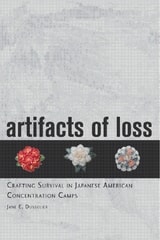
Artifacts of Loss
Crafting Survival in Japanese American Concentration CampsDusselier, Jane E
Rutgers University Press, 2008
In Artifacts of Loss, Jane E. Dusselier looks at the lives of these internees through the lens of their art. These camp-made creations included flowers made with tissue paper and shells, wood carvings of pets left behind, furniture made from discarded apple crates, gardens grown next to their housingùanything to help alleviate the visual deprivation and isolation caused by their circumstances. Their crafts were also central in sustaining, re-forming, and inspiring new relationships. Creating, exhibiting, consuming, living with, and thinking about art became embedded in the everyday patterns of camp life and helped provide internees with sustenance for mental, emotional, and psychic survival.
Dusselier urges her readers to consider these often overlooked folk crafts as meaningful political statements which are significant as material forms of protest and as representations of loss. She concludes briefly with a discussion of other displaced people around the globe today and the ways in which personal and group identity is reflected in similar creative ways.
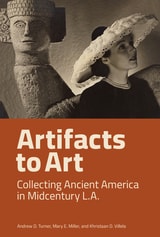
Artifacts to Art
Collecting Ancient America in Midcentury L.A.Andrew D. Turner
J. Paul Getty Trust, The, 2026
By the mid-twentieth century, ancient Mexican artifacts had undergone a striking transformation. Once dismissed as anthropological curiosities, sought after more for their ethnographic value than aesthetic merit, they had become prized artworks that were prominently displayed in major US museums, featured in advertisements and Hollywood films, and shown adorning the homes of celebrities.
At the center of this shift was Earl Stendahl, a savvy Los Angeles art dealer who played a pivotal role in shaping public and institutional perceptions of these objects. Through strategic marketing and a keen eye for opportunity, he repositioned these artifacts, selling them to an elite clientele that included movie stars, wealthy collectors, and museum curators. In doing so, he helped define a new canon of “ancient American art.”
Beneath this glamorous facade, however, lies a darker narrative of the looting, smuggling, and forgery that fueled this midcentury craze, exposing how the desire for authenticity and prestige often came at the expense of ethical collecting practices and cultural heritage. This book brings together art history, museum studies, and the politics of the antiquities trade, offering both a social history and a critical examination of how ancient Mexico’s past was sold in twentieth-century America.
This volume is published to accompany an exhibition on view at the Getty Research Institute at the Getty Center from June 23 to October 18, 2026.
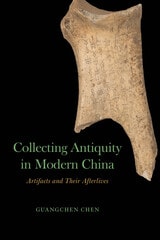
Collecting Antiquity in Modern China
Artifacts and Their AfterlivesGuangchen Chen
University of Chicago Press, 2026
In this book, Guangchen Chen argues that discerning collectors used antiquities to upend dominant discourses on history and cultural memory in twentieth-century China. Examining four categories of ancient artifacts—“carving” (oracle bones), “rubbing” (imprints of inscriptions and books), “brushing” (calligraphy), and “weaving” (textiles and costumes)—Chen explains how their modern (re)emergences changed our understanding of the relationship between tradition and modernity, textuality and materiality, and the very meaning of “Chineseness.”
Chen considers intellectuals such as Wang Yirong, Liu E, Luo Zhenyu, Wang Guowei, and Chen Mengjia, who played a pivotal role in the oracle bones’ modern reception. He also looks to major literary figures including Lu Xun, whose engagements with textual remnants of the past inspired his critique of Chinese culture; Guo Moruo, whose work on the calligraphic masterpiece Lantingxu contributed to the cultural-political climate that sparked the Cultural Revolution; Shi Zhecun, whose interest in inscriptions on ancient stelae helped him to hold fast to intellectual integrity in the face of political pressure; and Shen Congwen, whose obsession with ancient textiles saved him from committing suicide after his writing fell out of favor. These antiquarians used their collections as a strategy to synchronize historical time and to challenge two dominant yet contrasting ideologies in modern China: a regressive idealization of antiquity and an unquestioning trust in linear progress. During this turbulent period, long-lost artifacts came to function as omens, warnings, and revelations from another time, generating new meanings that were uniquely relevant to the present.
Curing Season
ArtifactsKristine Langley Mahler
West Virginia University Press, 2022
“A lovely and rapturous excavation and examination of the past, a lesson in writing oneself into history when it doesn’t offer you a space.” —Jenny Boully, author of Betwixt-and-Between: Essays on the Writing Life
After spending four years of adolescence in suburban North Carolina, Kristine Langley Mahler, even as an adult, is still buffeted by the cultural differences between her pioneer-like upbringing in Oregon and the settled southern traditions into which she could never assimilate. Collecting evidence of displacement—a graveyard in a mall parking lot, a suburban neighborhood of white kids bused to desegregate public schools in the 1990s, and the death of her best friend—Curing Season is an attempt to understand her failed grasp at belonging.
Mahler’s yearning for acceptance remains buried like a splinter, which she carefully tweezes out in the form of artifacts from her youth. But it isn’t until she encounters a book of local family histories that she takes inhabitation and truth apart, grafting and twisting and imprinting her history on theirs, until even she can no longer tell the difference between their truth and her own. Using inventive essay forms, Mahler pries apart the cracks of exclusion and experiments with the nature of belonging, memory, and place. Curing Season is a coming-of-age memoir for anyone who grew up anywhere but home.
Documents
Artifacts of Modern KnowledgeEdited by Annelise Riles
University of Michigan Press, 2006
Documents are everywhere in modern life, from the sciences to bureaucracy to law; at the same time, fieldworkers document social realities by collecting, producing, and exchanging documents of their own. Capping off a generation of reflection and critique about the promises and pitfalls of ethnographic methods, the contributors explore how ethnographers conceive, grasp, appreciate, and see patterns, demonstrating that the core of the ethnographic method now lies in the way ethnographers respond to, and increasingly share the professional passions and problems of, their subjects.
"Sophisticated and provocative. The original and unique focus of this volume effectively opens up a new arena of critique that will move ethnography and qualitative inquiry forward in a way that few other works do."
—George Marcus, Department of Anthropology, Rice University
"This edited collection asks how an understanding of documentary forms sheds light on the creation and circulation of modern forms of knowledge, expertise, and governance. This is a major intervention in how we understand the everyday practice and techne of the documentary impulse and documentary apparatuses of law, bureaucratic review, and other institutions of modernity, as well as linguistic anthropology, literary theory, and law. The topic of Documents is not just of interest because of epistemological quandaries in the human sciences over textualization and interpretation, but also because the domains to which we increasingly turn our attention are themselves auto-documentary."
Contributors: Mario Biagioli, Donald Brenneis, Carol Heimer, Hirokazu Miyazaki, Adam Reed, Annelise Riles, and Marilyn Strathern.
Annelise Riles is Professor of Law and Anthropology at Cornell University.
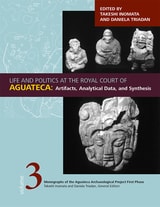
Life and Politics at the Royal Court of Aguateca
Artifacts, Analytical Data, and SynthesisTakeshi Inomata
University of Utah Press, 2014
Because of the surprise nature of the attack, most artifacts were left in their original locations, providing unprecedented views of the daily life of the Classic Maya. Detailed analyses of these objects and their distribution has shown that Mayan elites stored some of their food in their residences and that they also conducted various administrative duties there. The presence of numerous precious ornaments indicates that many of the Maya elite were also skilled craft producers.
Life and Politics at the Royal Court of Aguateca is the third and final volume of the monograph series on Aguateca. It presents the analyses of items not covered in the first two volumes, including figurines, ceramic laminates and masks, spindle whorls, ground stone, and bone artifacts, as well as hieroglyphic texts and plant and animal remains. It discusses the broad implications of this remarkable data set and provides a summation of the project.
Perspectives on American Book History
Artifacts and CommentaryScott E. Casper
University of Massachusetts Press, 2002
A collection of primary source materials and original essays, Perspectives on American Book History is the first text designed for the growing number of courses in American print culture, as well as a unique supplement for courses in American literature and history. It seeks to fill the void that has developed as the expanding history of the book has moved out of the archive and scholarly journal and into the classroom. The volume includes an introductory essay by Robert A. Gross, chair of the program in the history of the book at the American Antiquarian Society, fourteen chapters composed of primary artifacts and original essays by rising scholars in the field, and an annotated bibliography of research sources.
Chapters trace topics in American print culture from Puritan New England to the future of newspapers in a digital age. The artifacts and documents, most of which have never before been anthologized, include excerpts from readers' diaries, accounts of the printing and publishing trades, materials from the alternative press, commentaries on authorship and reading, and visual images. The essays place these primary source materials in their historical, literary, and political contexts and model the ways students might approach them.
In addition to the editors and Robert A. Gross, the contributors are Nancy Cook, Patricia Crain, Ann Fabian, Alice Fahs, Ellen Gruber Garvey, Jen A. Huntley-Smith, Charles Johanningsmeier, Jill Lepore, Russell L. Martin, Trysh Travis, Glenn Wallach, and Susan S. Williams.