Results by title
2 books match the query 'Artificial intelligence in literature'
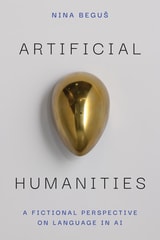
Artificial Humanities
A Fictional Perspective on Language in AINina Beguš
University of Michigan Press, 2025
Artificial Humanities explores how literature, history, and art can deepen our understanding of artificial intelligence and its development. By examining fictional representations of AI in parallel with actual technological developments, Nina Beguš presents a novel interdisciplinary framework for understanding the cultural, philosophical, and ethical dimensions of AI. She traces connections from Eliza Doolittle to ELIZA the chatbot and current language models, incorporates Slavic fictional examples from the Pygmalion paradigm, and compares mid-century science fiction and recent Hollywood films with contemporary developments in social robotics and virtual beings.
Highlighting the impact of human-like AI design, from gendered virtual assistants to romanticized social robots, the book shows how these technologies intersect with longstanding humanistic questions about the concepts of creativity and language as well as the relations between humans and machines. Additionally, the book explores AI’s applications in medical fields, particularly psychiatry and neurotechnology, including how AI interacts with the human body and mind to address conditions like paralysis. By emphasizing the philosophical and cultural implications of these technologies, Beguš highlights the need for responsible innovation that prioritizes human well-being as well as machine potential outside of human imitation. Accessible and thought-provoking, Artificial Humanities offers tools for analyzing and assessing technologies while they are being developed and invites readers to see how the humanities can guide us toward a more thoughtful future for AI.
Highlighting the impact of human-like AI design, from gendered virtual assistants to romanticized social robots, the book shows how these technologies intersect with longstanding humanistic questions about the concepts of creativity and language as well as the relations between humans and machines. Additionally, the book explores AI’s applications in medical fields, particularly psychiatry and neurotechnology, including how AI interacts with the human body and mind to address conditions like paralysis. By emphasizing the philosophical and cultural implications of these technologies, Beguš highlights the need for responsible innovation that prioritizes human well-being as well as machine potential outside of human imitation. Accessible and thought-provoking, Artificial Humanities offers tools for analyzing and assessing technologies while they are being developed and invites readers to see how the humanities can guide us toward a more thoughtful future for AI.
[more]
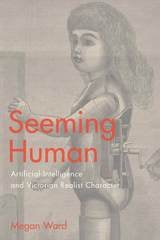
Seeming Human
Artificial Intelligence and Victorian Realist CharacterMegan Ward
The Ohio State University Press, 2018
Offers a new theory of realist character through character’s unexpected afterlife: the intelligent machine.
In Seeming Human, Megan Ward contends that mid-twentieth-century versions of artificial intelligence (AI) offer a theory of verisimilitude omitted by traditional histories of character, which often focus on the development of interiority and the shift from “flat” to “round” characters in the Victorian era. Instead, by reading character through AI, Megan Ward’s Seeming Human argues that routinization, predictability, automation, and even flatness are all features of realist characters.
Early artificial intelligence movements such as cybernetics, information theory, and the Turing test define ways of seeming—rather than being—human. Using these theories of verisimilitude to read Victorian novelists such as Elizabeth Gaskell, Margaret Oliphant, Anthony Trollope, Thomas Hardy, and Henry James, Seeming Human argues that mechanicity has been perceived as anti-realist because it is the element that we least want to identify as human. Because AI produces human-like intelligence, it makes clear that we must actually turn to machines in order to understand what makes realist characters seem so human.
[more]