Results by title
3 books match the query 'Arts, Renaissance'
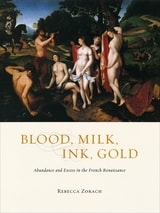
Blood, Milk, Ink, Gold
Abundance and Excess in the French RenaissanceRebecca Zorach
University of Chicago Press, 2005
Most people would be hard pressed to name a famous artist from Renaissance France. Yet sixteenth-century French kings believed they were the heirs of imperial Rome and commissioned a magnificent array of visual arts to secure their hopes of political ascendancy with images of overflowing abundance. With a wide-ranging yet richly detailed interdisciplinary approach, Rebecca Zorach examines the visual culture of the French Renaissance, where depictions of sacrifice, luxury, fertility, violence, metamorphosis, and sexual excess are central. Zorach looks at the cultural, political, and individual roles that played out in these artistic themes and how, eventually, these aesthetics of exuberant abundance disintegrated amidst perceptions of decadent excess.
Throughout the book, abundance and excess flow in liquids-blood, milk, ink, and gold-that highlight the materiality of objects and the human body, and explore the value (and values) accorded to them. The arts of the lavish royal court at Fontainebleau and in urban centers are here explored in a vibrant tableau that illuminates our own contemporary relationship to excess and desire.
From marvelous works by Francois Clouet to oversexed ornamental prints to Benvenuto Cellini's golden saltcellar fashioned for Francis I, Blood, Milk, Ink, Gold covers an astounding range of subjects with precision and panache, producing the most lucid, well-rounded portrait of the cultural politics of the French Renaissance to date.
[more]
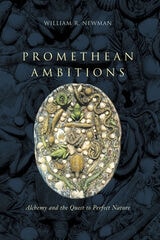
Promethean Ambitions
Alchemy and the Quest to Perfect NatureWilliam R. Newman
University of Chicago Press, 2004
In an age when the nature of reality is complicated daily by advances in bioengineering, cloning, and artificial intelligence, it is easy to forget that the ever-evolving boundary between nature and technology has long been a source of ethical and scientific concern: modern anxieties about the possibility of artificial life and the dangers of tinkering with nature more generally were shared by opponents of alchemy long before genetic science delivered us a cloned sheep named Dolly.
In Promethean Ambitions, William R. Newman ambitiously uses alchemy to investigate the thinning boundary between the natural and the artificial. Focusing primarily on the period between 1200 and 1700, Newman examines the labors of pioneering alchemists and the impassioned—and often negative—responses to their efforts. By the thirteenth century, Newman argues, alchemy had become a benchmark for determining the abilities of both men and demons, representing the epitome of creative power in the natural world. Newman frames the art-nature debate by contrasting the supposed transmutational power of alchemy with the merely representational abilities of the pictorial and plastic arts—a dispute which found artists such as Leonardo da Vinci and Bernard Palissy attacking alchemy as an irreligious fraud. The later assertion by the Paracelsian school that one could make an artificial human being—the homunculus—led to further disparagement of alchemy, but as Newman shows, the immense power over nature promised by the field contributed directly to the technological apologetics of Francis Bacon and his followers. By the mid-seventeenth century, the famous "father of modern chemistry," Robert Boyle, was employing the arguments of medieval alchemists to support the identity of naturally occurring substances with those manufactured by "chymical" means.
In using history to highlight the art-nature debate, Newman here shows that alchemy was not an unformed and capricious precursor to chemistry; it was an art founded on coherent philosophical and empirical principles, with vocal supporters and even louder critics, that attracted individuals of first-rate intellect. The historical relationship that Newman charts between human creation and nature has innumerable implications today, and he ably links contemporary issues to alchemical debates on the natural versus the artificial.
[more]

The Rule of Art
Literature and Painting in the RenaissanceClark Hulse
University of Chicago Press, 1990
What do Renaissance poetry and painting have in common? What are the social, ideological, and aesthetic bases for the links between them? And what role do those links play in creating the humanistic culture that still has power over us today?
These are the questions Clark Hulse takes up in this sophisticated interdisciplinary study of Renaissance aesthetics. Proposing an archeology of artistic knowledge, Hulse examines the theoretical language through which the poets, painters, and patrons of the Renaissance conceived of the relationship between the arts. That language is embedded in what he calls a "rule of art," a specific set of categories, assumptions, and practices that defined the two art forms and the relationship between them. Hulse charts the rise of both forms to the status of liberal arts requiring special intellectual training for artist and patron alike. In the process, he uncovers the history of the practice of theory in the Renaissance, revealing how artistic discourse lived in the world.
These are the questions Clark Hulse takes up in this sophisticated interdisciplinary study of Renaissance aesthetics. Proposing an archeology of artistic knowledge, Hulse examines the theoretical language through which the poets, painters, and patrons of the Renaissance conceived of the relationship between the arts. That language is embedded in what he calls a "rule of art," a specific set of categories, assumptions, and practices that defined the two art forms and the relationship between them. Hulse charts the rise of both forms to the status of liberal arts requiring special intellectual training for artist and patron alike. In the process, he uncovers the history of the practice of theory in the Renaissance, revealing how artistic discourse lived in the world.
[more]