Results by title

4 books match the query 'Arts and globalization'

cover of After Caliban: Caribbean Art in a Global Imaginary

After Caliban

Caribbean Art in a Global Imaginary

Erica Moiah James

Duke University Press, 2025
In After Caliban, Erica Moiah James examines the rise of global Caribbean artists in the 1990s and their production of a decolonized art history for the Caribbean. She draws on Aimé Césaire’s rewriting of Shakespeare’s The Tempest, in which Caliban becomes the sole author of his own story, dissolving his fixed position as colonized in relation to Prospero as colonizer. James shows how visual artists such as Marc Latamie, Janine Antoni, Belkis Ayón, Edouard Duval-Carrié, and Christopher Cozier followed Césaire’s model by employing a range of practices and methodologies that refused marginalization. Just as Césaire decolonized The Tempest, so too did these artists, who crafted a decolonial aesthetic that redefined their own cultural and historical narratives and positioned art as a key pathway toward a postcolonial future. By providing the foundation for a postcolonial, post-Caliban art world, these artists redefined the critical and popular notion of contemporary Caribbean art. At the same time, James argues, they fulfilled Césaire’s dream for a postcolonial Caribbean while creating a nonhegemonic art historical practice that exists beyond modern binaries and borders.
[more]
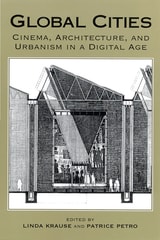
cover of Global Cities: Cinema, Architecture, and Urbanism in a Digital Age

Global Cities

Cinema, Architecture, and Urbanism in a Digital Age

Petro, Patrice

Rutgers University Press, 2003
In Global Cities, scholars from an impressive array of disciplines critique the growing body of literature on the process broadly known as "globalization." This interdisciplinary focus enables the authors to explore the complex geographies of modern cities, and offer possible strategies for reclaiming a sense of place and community in these globalized urban settings. While examining major cities including New York, Tokyo, Berlin, Paris, and Hong Kong, contributors insist that the study of urban experiences must remain as attentive to the material effects as to the psychic and social consequences of globalization. Accordingly, essays explore the implications of global culture for architecture, cinema, and communication--but do so in a way that highlights the importance of the spaces between such metropolitan centers. These locations, the authors argue, serve as increasingly important "frontier zones," where a diverse set of actors converge and contend for power and presence. Such a perspective ultimately adds nuance and meaning to our understanding of the heterogeneous urban landscapes of these global cities. Linda Krause is an associate professor in the Department of Architecture at the School of Architecture and Urban Planning, University of Wisconsin, Milwaukee. Patrice Petro is professor of film studies and director of the Center for International Education at the University of Wisconsin, Milwaukee. A volume in the New Directions in International Studies series, edited by Patrice Petro
[more]
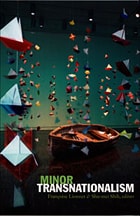
cover of Minor Transnationalism

Minor Transnationalism

Françoise Lionnet and Shu-mei Shih, eds.

Duke University Press, 2005

Minor Transnationalism moves beyond a binary model of minority cultural formations that often dominates contemporary cultural and postcolonial studies. Where that model presupposes that minorities necessarily and continuously engage with and against majority cultures in a vertical relationship of assimilation and opposition, this volume brings together case studies that reveal a much more varied terrain of minority interactions with both majority cultures and other minorities. The contributors recognize the persistence of colonial power relations and the power of global capital, attend to the inherent complexity of minor expressive cultures, and engage with multiple linguistic formations as they bring postcolonial minor cultural formations across national boundaries into productive comparison.

Based in a broad range of fields—including literature, history, African studies, Asian American studies, Asian studies, French and francophone studies, and Latin American studies—the contributors complicate ideas of minority cultural formations and challenge the notion that transnationalism is necessarily a homogenizing force. They cover topics as diverse as competing versions of Chinese womanhood; American rockabilly music in Japan; the trope of mestizaje in Chicano art and culture; dub poetry radio broadcasts in Jamaica; creole theater in Mauritius; and race relations in Salvador, Brazil. Together, they point toward a new theoretical vocabulary, one capacious enough to capture the almost infinitely complex experiences of minority groups and positions in a transnational world.

Contributors. Moradewun Adejunmobi, Ali Behdad, Michael Bourdaghs, Suzanne Gearhart, Susan Koshy, Françoise Lionnet, Seiji M. Lippit, Elizabeth Marchant, Kathleen McHugh, David Palumbo-Liu, Rafael Pérez-Torres, Jenny Sharpe, Shu-mei Shih , Tyler Stovall
[more]
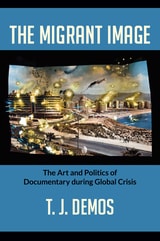
cover of The Migrant Image: The Art and Politics of Documentary during Global Crisis

The Migrant Image

The Art and Politics of Documentary during Global Crisis

T. J. Demos

Duke University Press, 2013

In The Migrant Image T. J. Demos examines the ways contemporary artists have reinvented documentary practices in their representations of mobile lives: refugees, migrants, the stateless, and the politically dispossessed. He presents a sophisticated analysis of how artists from the United States, Europe, North Africa, and the Middle East depict the often ignored effects of globalization and the ways their works connect viewers to the lived experiences of political and economic crisis. Demos investigates the cinematic approaches Steve McQueen, the Otolith Group, and Hito Steyerl employ to blur the real and imaginary in their films confronting geopolitical conflicts between North and South. He analyzes how Emily Jacir and Ahlam Shibli use blurs, lacuna, and blind spots in their photographs, performances, and conceptual strategies to directly address the dire circumstances of dislocated Palestinian people. He discusses the disparate interventions of Walid Raad in Lebanon, Ursula Biemann in North Africa, and Ayreen Anastas and Rene Gabri in the United States, and traces how their works offer images of conflict as much as a conflict of images. Throughout Demos shows the ways these artists creatively propose new possibilities for a politics of equality, social justice, and historical consciousness from within the aesthetic domain.
[more]