Results by title
4 books match the query 'Arum, Richard'
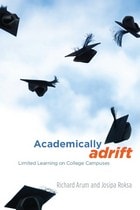
Academically Adrift
Limited Learning on College CampusesRichard Arum and Josipa Roksa
University of Chicago Press, 2010
In spite of soaring tuition costs, more and more students go to college every year. A bachelor’s degree is now required for entry into a growing number of professions. And some parents begin planning for the expense of sending their kids to college when they’re born. Almost everyone strives to go, but almost no one asks the fundamental question posed by Academically Adrift: are undergraduates really learning anything once they get there?
For a large proportion of students, Richard Arum and Josipa Roksa’s answer to that question is a definitive no. Their extensive research draws on survey responses, transcript data, and, for the first time, the state-of-the-art Collegiate Learning Assessment, a standardized test administered to students in their first semester and then again at the end of their second year. According to their analysis of more than 2,300 undergraduates at twenty-four institutions, 45 percent of these students demonstrate no significant improvement in a range of skills—including critical thinking, complex reasoning, and writing—during their first two years of college. As troubling as their findings are, Arum and Roksa argue that for many faculty and administrators they will come as no surprise—instead, they are the expected result of a student body distracted by socializing or working and an institutional culture that puts undergraduate learning close to the bottom of the priority list.
Academically Adrift holds sobering lessons for students, faculty, administrators, policy makers, and parents—all of whom are implicated in promoting or at least ignoring contemporary campus culture. Higher education faces crises on a number of fronts, but Arum and Roksa’s report that colleges are failing at their most basic mission will demand the attention of us all.
Aspiring Adults Adrift
Tentative Transitions of College GraduatesRichard Arum and Josipa Roksa
University of Chicago Press, 2014
The Liberal Arts Advantage
Measuring the Deeper Value of a College EducationEdited by Richard Arum, Paul Courant, and Allyson Flaster
University of Chicago Press, 2026
Showcases new measurement strategies for assessing the impact of a liberal arts education on students and society.
More than ever before, our society is questioning the meaning and value of higher education, and liberal arts education, in particular, has come under substantial scrutiny. Economic detractors characterize liberal arts education as impractical, claiming that college should prepare students for the workforce. Others object to the curriculum, portraying it as broken or misdirected. According to these critics, the liberal arts education being offered in the United States is marked by its rejection of core intellectual and ideological commitments.
In The Liberal Arts Advantage, a wide range of scholars argue for how and why a liberal arts education uniquely develops skill sets and expertise needed for individuals and society to thrive in the twenty-first century. The contributors address foundational questions about what liberal arts education is, how it has been conceptualized in the past, and what we can learn from its societal and professional impacts. They present compelling, unique research and new methodological tools for assessing the outcomes of liberal arts graduates. Offering grounded and well-founded arguments in favor of our education system, The Liberal Arts Advantage persuasively explains why educational leaders should reinvest in liberal arts education.
The State of the American Mind
16 Leading Critics on the New Anti-IntellectualismMark Bauerlein
Templeton Press, 2015
That was over twenty years ago. Since then, the United States has experienced unprecedented wealth, more youth enrolling in higher education than ever before, and technology advancements far beyond what many in the 1980s dreamed possible. And yet, the state of the American mind seems to have deteriorated further. Benjamin Franklin’s “self-made man” has become a man dependent on the state. Independence has turned into self-absorption. Liberty has been curtailed in the defense of multiculturalism.
In order to fully grasp the underpinnings of this shift away from the self-reliant, well-informed American, editors Mark Bauerlein and Adam Bellow have brought together a group of cultural and educational experts to discuss the root causes of the decline of the American mind. The writers of these fifteen original essays include E. D. Hirsch, Nicholas Eberstadt, and Dennis Prager, as well as Daniel Dreisbach, Gerald Graff, Richard Arum, Robert Whitaker, David T. Z. Mindich, Maggie Jackson, Jean Twenge, Jonathan Kay, Ilya Somin, Steve Wasserman, Greg Lukianoff, and R. R. Reno. Their essays are compiled into three main categories:
- States of Mind: Indicators of Intellectual and Cognitive Decline
- These essays broach specific mental deficiencies among the population, including lagging cultural IQ, low Biblical literacy, poor writing skills, and over-medication.
- Personal and Cognitive Habits/Interests
- These essays turn to specific mental behaviors and interests, including avoidance of the news, short attention spans, narcissism, and conspiracy obsessions.
- National Consequences
- These essays examine broader trends affecting populations and institutions, including rates of entitlement claims, voting habits, and a low-performing higher education system.