Results by title

2 books match the query 'Asian American students'
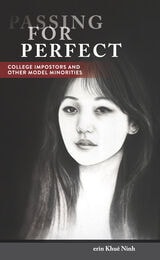
cover of Passing for Perfect: College Impostors and Other Model Minorities

Passing for Perfect

College Impostors and Other Model Minorities

erin Khuê Ninh

Temple University Press, 2021

In her engaging study, Passing for Perfect,erin Khuê Ninh considers the factors that drove college imposters such as Azia Kim—who pretended to be a Stanford freshman—and Jennifer Pan—who hired a hitman to kill her parents before they found out she had never received her high school diploma—to extreme lengths to appear successful. Why would someone make such an illogical choice? And how do they stage these lies so convincingly, and for so long? 

These outlier examples prompt Ninh to address the larger issue of the pressures and difficulties of striving to be model minority, where failure is too ruinous to admit. Passing for Perfect insists that being a “model minority” is not a “myth,” but coded into one’s programming as an identity—a set of convictions and aspirations, regardless of present socioeconomic status or future attainability—and that the true cost of turning children into high-achieving professionals may be higher than anyone can bear.  

Ninh’s book codifies for readers the difference between imposters who are con artists or shysters and those who don’t know how to stop passing for perfect.

[more]
cover of dear elia: Letters from the Asian American Abyss

dear elia

Letters from the Asian American Abyss

Mimi Khúc

Duke University Press, 2024

In dear elia Mimi Khúc revolutionizes how we understand mental health. Khúc traces the contemporary Asian American mental health crisis from the university into the maw of the COVID-19 pandemic, reenvisioning mental health through a pedagogy of unwellness—the recognition that we are all differentially unwell. In an intimate series of letters, she bears witness to Asian American unwellness up close and invites readers to recognize in it the shapes and sources of their own unwellness. Khúc draws linkages between student experience, the Asian immigrant family, the adjunctification of the university, and teaching methods pre- and post-COVID-19 to illuminate hidden roots of our collective unwellness: shared investments in compulsory wellness and meritocracy. She reveals the university as a central node and engine of unwellness and argues that we can no longer do Asian American studies without Asian American mental health—and vice versa. Interspersed throughout the book are reflective activities, including original tarot cards, that enact the very pedagogy Khúc advances, offering readers alternative ways of being that divest from structures of unwellness and open new possibilities for collective care.
[more]