Results by title
2 books match the query 'Asma, Stephen T.'

Against Fairness
Stephen T. Asma
University of Chicago Press, 2012
From the school yard to the workplace, there’s no charge more damning than “you’re being unfair!” Born out of democracy and raised in open markets, fairness has become our de facto modern creed. The very symbol of American ethics—Lady Justice—wears a blindfold as she weighs the law on her impartial scale. In our zealous pursuit of fairness, we have banished our urges to like one person more than another, one thing over another, hiding them away as dirty secrets of our humanity. In Against Fairness, polymath philosopher Stephen T. Asma drags them triumphantly back into the light. Through playful, witty, but always serious arguments and examples, he vindicates our unspoken and undeniable instinct to favor, making the case that we would all be better off if we showed our unfair tendencies a little more kindness—indeed, if we favored favoritism.
Conscious of the egalitarian feathers his argument is sure to ruffle, Asma makes his point by synthesizing a startling array of scientific findings, historical philosophies, cultural practices, analytic arguments, and a variety of personal and literary narratives to give a remarkably nuanced and thorough understanding of how fairness and favoritism fit within our moral architecture. Examining everything from the survival-enhancing biochemistry that makes our mothers love us to the motivating properties of our “affective community,” he not only shows how we favor but the reasons we should. Drawing on thinkers from Confucius to Tocqueville to Nietzsche, he reveals how we have confused fairness with more noble traits, like compassion and open-mindedness. He dismantles a number of seemingly egalitarian pursuits, from classwide Valentine’s Day cards to civil rights, to reveal the envy that lies at their hearts, going on to prove that we can still be kind to strangers, have no prejudice, and fight for equal opportunity at the same time we reserve the best of what we can offer for those dearest to us.
Fed up with the blue-ribbons-for-all absurdity of "fairness" today, and wary of the psychological paralysis it creates, Asma resets our moral compass with favoritism as its lodestar, providing a strikingly new and remarkably positive way to think through all our actions, big and small.
Watch an animated book trailer here: http://www.youtube.com/watch?v=GjPhTQ9zi5Q
Watch an animated book trailer here: http://www.youtube.com/watch?v=GjPhTQ9zi5Q
[more]
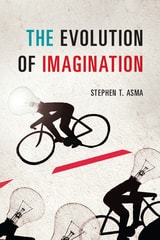
The Evolution of Imagination
Stephen T. Asma
University of Chicago Press, 2017
Consider Miles Davis, horn held high, sculpting a powerful musical statement full of tonal patterns, inside jokes, and thrilling climactic phrases—all on the fly. Or think of a comedy troupe riffing on a couple of cues from the audience until the whole room is erupting with laughter. Or maybe it’s a team of software engineers brainstorming their way to the next Google, or the Einsteins of the world code-cracking the mysteries of nature. Maybe it’s simply a child playing with her toys. What do all of these activities share? With wisdom, humor, and joy, philosopher Stephen T. Asma answers that question in this book: imagination. And from there he takes us on an extraordinary tour of the human creative spirit.
Guided by neuroscience, animal behavior, evolution, philosophy, and psychology, Asma burrows deep into the human psyche to look right at the enigmatic but powerful engine that is our improvisational creativity—the source, he argues, of our remarkable imaginational capacity. How is it, he asks, that a story can evoke a whole world inside of us? How are we able to rehearse a skill, a speech, or even an entire scenario simply by thinking about it? How does creativity go beyond experience and help us make something completely new? And how does our moral imagination help us sculpt a better society? As he shows, we live in a world that is only partly happening in reality. Huge swaths of our cognitive experiences are made up by “what-ifs,” “almosts,” and “maybes,” an imagined terrain that churns out one of the most overlooked but necessary resources for our flourishing: possibilities. Considering everything from how imagination works in our physical bodies to the ways we make images, from the mechanics of language and our ability to tell stories to the creative composition of self-consciousness, Asma expands our personal and day-to-day forms of imagination into a grand scale: as one of the decisive evolutionary forces that has guided human development from the Paleolithic era to today. The result is an inspiring look at the rich relationships among improvisation, imagination, and culture, and a privileged glimpse into the unique nature of our evolved minds.
Guided by neuroscience, animal behavior, evolution, philosophy, and psychology, Asma burrows deep into the human psyche to look right at the enigmatic but powerful engine that is our improvisational creativity—the source, he argues, of our remarkable imaginational capacity. How is it, he asks, that a story can evoke a whole world inside of us? How are we able to rehearse a skill, a speech, or even an entire scenario simply by thinking about it? How does creativity go beyond experience and help us make something completely new? And how does our moral imagination help us sculpt a better society? As he shows, we live in a world that is only partly happening in reality. Huge swaths of our cognitive experiences are made up by “what-ifs,” “almosts,” and “maybes,” an imagined terrain that churns out one of the most overlooked but necessary resources for our flourishing: possibilities. Considering everything from how imagination works in our physical bodies to the ways we make images, from the mechanics of language and our ability to tell stories to the creative composition of self-consciousness, Asma expands our personal and day-to-day forms of imagination into a grand scale: as one of the decisive evolutionary forces that has guided human development from the Paleolithic era to today. The result is an inspiring look at the rich relationships among improvisation, imagination, and culture, and a privileged glimpse into the unique nature of our evolved minds.
[more]