Results by title
14 books match the query 'Visibility'
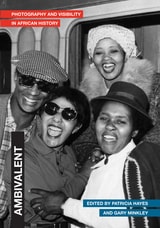
Ambivalent
Photography and Visibility in African HistoryPatricia Hayes
Ohio University Press, 2019
Going beyond photography as an isolated medium to engage larger questions and interlocking forms of expression and historical analysis, Ambivalent gathers a new generation of scholars based on the continent to offer an expansive frame for thinking about questions of photography and visibility in Africa. The volume presents African relationships with photography—and with visibility more generally—in ways that engage and disrupt the easy categories and genres that have characterized the field to date. Contributors pose new questions concerning the instability of the identity photograph in South Africa; ethnographic photographs as potential history; humanitarian discourse from the perspective of photographic survivors of atrocity photojournalism; the nuanced passage from studio to screen in postcolonial digital portraiture; and the burgeoning visual activism in West Africa.
As the contributors show, photography is itself a historical subject: it involves arrangement, financing, posture, positioning, and other kinds of work that are otherwise invisible. By moving us outside the frame of the photograph itself, by refusing to accept the photograph as the last word, this book makes photography an engaging and important subject of historical investigation. Ambivalent‘s contributors bring photography into conversation with orality, travel writing, ritual, psychoanalysis, and politics, with new approaches to questions of race, time, and postcolonial and decolonial histories.
Contributors: George Emeka Agbo, Isabelle de Rezende, Jung Ran Forte, Ingrid Masondo, Phindi Mnyaka, Okechukwu Nwafor, Vilho Shigwedha, Napandulwe Shiweda, Drew Thompson
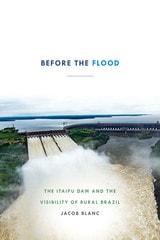
Before the Flood
The Itaipu Dam and the Visibility of Rural BrazilJacob Blanc
Duke University Press, 2019
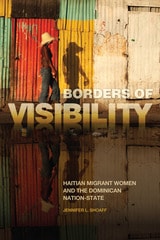
Borders of Visibility
Haitian Migrant Women and the Dominican Nation-Stateby Jennifer L. Shoaff
University of Alabama Press, 2018
An anthropological study of Haitian migrant women in the Dominican Republic.
Borders of Visibility offers extremely timely insight into the Dominican Republic’s racist treatment of Haitian descendants within its borders. Jennifer L. Shoaff employs multisited feminist research to focus on the geographies of power that intersect to inform the opportunities and constraints that migrant women must navigate to labor and live within a context that largely denies their human rights, access to citizenship, and a sense of security and belonging.
Paradoxically, these women are both hypervisible because of the blackness that they embody and invisible because they are marginalized by intersecting power inequalities. Haitian women must contend with diffuse legal, bureaucratic and discursive state-local practices across “border” sites that situate them as a specific kind of threat that must be contained. Shoaff examines this dialectic of mobility and containment across various sites in the northwest Dominican Republic, including the official border crossing, transborder and regional used-clothing markets, migrant settlements (bateyes), and other rural-urban contexts.
Shoaff combines ethnographic interviews, participant observation, institutional analyses of state structures and nongovernmental agencies, and archival documentation to bring this human rights issue to the fore. Although primarily grounded in critical ethnographic practice, this work contributes to the larger fields of transnational feminism, black studies, migration and border studies, political economy, and cultural geography. Borders of Visibility brings much needed attention to Haitian migrant women’s economic ingenuity and entrepreneurial savvy, their ability to survive and thrive, their often impossible choices whether to move or to stay, returning them to a place of visibility, while exposing the very structures that continue to render them invisible and, thus, expendable over time.
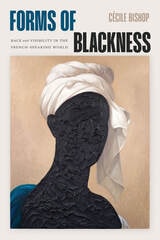
Forms of Blackness
Race and Visibility in the French-Speaking WorldCécile Bishop
Duke University Press, 2025
Considering race as form across literature, theory, painting, and photography, Cécile Bishop’s Forms of Blackness explores the formal devices that make blackness both visible and recognizable. In keeping with black Francophone theorists like Édouard Glissant and Frantz Fanon, Bishop uses the ambiguities these aesthetic forms carry to explore a range of identity concepts like opacity, formlessness, and doubleness. Bishop puts blackness-as-race and blackness-as-form in dialogue, showing how race disrupts the concept of artistic autonomy and how the aesthetic challenges race as a self-evident visual phenomenon. When thought together, form does not isolate blackness from race but rather calls attention to the material substrate that turns race into a phenomenon that can be experienced through sense perception. Moving between careful analysis and experimental modes of critique, Forms of Blackness offers a new way of thinking about the politics of visibility and offers a pressing invitation to question the ways we interpret what we see.

Improving the Visibility and Use of Digital Repositories
Kenneth Arlitsch
American Library Association, 2013

Innocent Lens
Race and Visibility on the Swedish ScreenBenjamin Mier-Cruz
University of Wisconsin Press, 2027
Sweden, like other Nordic countries, prides itself on being “colorblind” or immune to the kinds of racism found in, for example, the United States. In the 1960s and 1970s, white Swedish documentarians, in the fashion of early anthropologists, recorded racial tensions amid the US civil rights movement. More recently, in the twenty-first century, short films produced by Swedes of color have tackled racism and bigotry within Sweden.
Benjamin Mier-Cruz offers a comparative study of these two periods of Swedish documentary filmmaking. “Racially innocent” white documentarians of the mid-twentieth century developed an “aesthetics of altruism” predicated on Sweden’s assumed racial equalitarianism—a notion that their documentaries in turn helped create and maintain. In contemporary films, on the other hand, Swedes of color use the same filmic format to challenge not only their predecessors’ reductionist, pseudo-anthropological presentations but also Sweden’s purportedly colorblind ideology. Mier-Cruz’s close readings of films from both eras demonstrate the possibilities and limitations of the documentary form and the ways in which it is motivated by politics and activism.

Poetics of Visibility in the Contemporary Arab American Novel
Mazen Naous
The Ohio State University Press, 2020
Naous’s book offers analyses of Diana Abu-Jaber’s Arabian Jazz and Crescent, Rabih Alameddine’s Koolaids: The Art of War, Laila Halaby’s Once in a Promised Land, and Mohja Kahf’s The Girl in the Tangerine Scarf as ways to answer this question. Naous explores how these novels negotiate queer desire, music, Western and Middle Eastern art, gender, and relationships between other minorities. These poetics enable readers to see the nuance and richness of Arab American experience. Naous ultimately argues that fiction creates crucial spaces for reimagining and redefining intercultural relationships.
Social Media in Trinidad
Values and VisibilityJolynna Sinanan
University College London, 2017

The New Politics of Visibility
Spaces, Actors, Practices and Technologies in the VisibleEdited by Andrea Mubi Brighenti
Intellect Books, 2022
Not only does visibility matter to politics, but it is an increasingly intrinsic constituent element and a crucial asset of it. Accordingly, the challenge to social science is that of understanding how the new institutional, urban, and technological settings are reshaping the organization of the visible.
Ranging from urban public space to the new media and social media platforms, a team of distinguished scholars and researchers here addresses a vast terrain of inquiry by joining together original theoretical elaboration with careful empirical studies. The result is a thoroughly interdisciplinary endeavor, conducted with passion and insight. The New Politics of Visibility comprises nine original interdisciplinary chapters that analyze topical areas in the newly emerging modes of governance and society. The transformations of urban space and the working of new media form a core concern recurring through many of the essays but is by no means the sole topic, as other essays address the politics of visibility in crucial cultural spheres, including gender relations and professional life.
The Scar of Visibility
Medical Performances and Contemporary ArtPetra Kuppers
University of Minnesota Press, 2007
The Undocumented Everyday
Migrant Lives and the Politics of VisibilityRebecca M. Schreiber
University of Minnesota Press, 2018
Examining how undocumented migrants are using film, video, and other documentary media to challenge surveillance, detention, and deportation
As debates over immigration increasingly become flashpoints of political contention in the United States, a variety of advocacy groups, social service organizations, filmmakers, and artists have provided undocumented migrants with the tools and training to document their experiences.
In The Undocumented Everyday, Rebecca M. Schreiber examines the significance of self-representation by undocumented Mexican and Central American migrants, arguing that by centering their own subjectivity and presence through their use of documentary media, these migrants are effectively challenging intensified regimes of state surveillance and liberal strategies that emphasize visibility as a form of empowerment and inclusion. Schreiber explores documentation as both an aesthetic practice based on the visual conventions of social realism and a state-administered means of identification and control.
As Schreiber shows, by visualizing new ways of belonging not necessarily defined by citizenship, these migrants are remaking documentary media, combining formal visual strategies with those of amateur photography and performative elements to create a mixed-genre aesthetic. In doing so, they make political claims and create new forms of protection for migrant communities experiencing increased surveillance, detention, and deportation.
Urban Horror
Neoliberal Post-Socialism and the Limits of VisibilityErin Y. Huang
Duke University Press, 2020
Visual Occupations
Violence and Visibility in a Conflict ZoneGil Z. Hochberg
Duke University Press, 2015

Which Team Are You On?
Visibility and Gender Dissidence in Brazilian SoccerC. K. Snyder
University of Texas Press, 0
Examines how Brazilian soccer’s trailblazers—women, gay men, and trans players—leverage their visibility to fight marginalization and advance gender justice.
In Brazil, national identity is tightly bound up with soccer. In turn, soccer leaves a masculinist and heteronormative mark on what it means to be Brazilian. After all, for much of the twentieth century, the law deemed futbol “incompatible with female nature,” and women were banned from participating. Though the prohibition was lifted in 1979, the national soccer culture continued to serve the reproduction of a gendered society.
Which Team Are You On? develops theoretical and ethnographic insights into the struggle of dissident athletes for recognition and redistribution. By tracing three groundbreaking "firsts"—pioneer women Olympians, the national LGBTQ+ league (LiGay), and Brazil’s first trans team, the Meninos Bons de Bola—C. K. Snyder examines the athletes’ “visibility dilemma,” in which being seen is essential for legitimacy as futebolistas yet dangerously exposes players to violence and backlash. Snyder argues that, today, soccer is a key battleground for gender justice in Brazil, as a surging reactionary movement lays claim to the nation’s proud sporting heritage, placing women, gay, and trans athletes at even greater risk. To fight back, they take to the pitch, continuing to demand not only respect but also a place in the life of their country.