Results by title
9 books match the query 'Assault'
Assault on Paradise
Tatiana Lobo
Northwestern University Press, 1998
Assault on the Media
The Nixon YearsWilliam E. Porter and Thomas A. Mascaro
University of Michigan Press, 2024
Informed by a half-century of historical analyses and released documents, this expanded edition of William E. Porter’s award-winning Assault on the Media analyzes new documents of significance; synthesizes recent historical analyses; incorporates legal evaluations by journalism scholars; and traces how Nixon-era plans cultivated the divisive state of 21st-century society and amplified assaults on journalism. It also evaluates lasting concerns about the Supreme Court’s Pentagon Papers decision and journalists cited for contempt as a form of prior restraint; the currencies of power and race in protecting confidential sources; and regulatory decisions that hamper effective journalism. Assault on the Media not only documents the incidents and circumstances of governmental intimidation, harassment, and regulation of the news media during the Nixon presidency, but it offers insights into the long-term effects and their relevance today.
Assault with a Deadly Lie
A Nick Hoffman Novel of SuspenseLev Raphael
University of Wisconsin Press, 2014
A novel of suspense set in the academic world, Assault with a Deadly Lie probes the disturbing psychological impact of slander, harassment, stalking, police brutality, and the loss of personal safety. What will Nick do when his world threatens to collapse? How can he reestablish order in a suddenly chaotic life?
Assault with a Deadly Lie, the eighth installment of Lev Raphael's Nick Hoffman Mysteries, propels the series to a new level of danger and intrigue as Nick and Stefan are catapulted out of their tranquil existence by shocking accusations.
Finalist, Midwest Book Award for Mystery/Thriller Fiction, Midwest Independent Publishers Association
“A riveting great read for mystery/suspense fans, author Lev Raphael once again documents his impressive gifts as a storyteller, holding the reader’s rapt attention from beginning to end with unexpected plot twists and surprise twists.”—Jack Mason, Midwest Book Review
“Raphael portrays with frightening power the wrenching experience of victimization by the corporatized, PR-prioritized groves of academia, where both men teach, and by local authorities militarized into SWAT teams practicing police brutality. . . . The compelling core of this unusual novel is Raphael’s depiction of the agonizing reality of victims’ shame, in which someone ‘feels doubly exposed talking about the violation’ and so says nothing.”—Booklist
“Professor Nick Hoffman learns that even tenure can’t guarantee real security.”—Kirkus Reviews
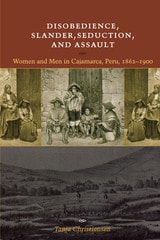
Disobedience, Slander, Seduction, and Assault
Women and Men in Cajamarca, Peru, 1862-1900By Tanja Christiansen
University of Texas Press, 2004
Though the law and courts of nineteenth-century Peru were institutions created by and for the ruling elite, women of all classes used the system to negotiate the complexities of property rights, childrearing, and marriage, and often to defend their very definitions of honor. Drawing on the trial transcripts of Cajamarca, a northern Peruvian province, from more than a century ago, this book shares eye-opening details about life among this community, in which reputation could determine a woman's chances of survival.
Exploring the processes of courtship, seduction, and familial duties revealed in these court records, historian Tanja Christiansen has unearthed a compelling panorama that includes marital strife, slander, disobedience, street brawls, and spousal abuse alongside documents that give evidence of affection and devotion. Her research also yields much new information about the protocols for conflict and cooperation among nineteenth-century Peruvian women from all social strata, and the prevalence of informal unions in an economy driven in large part by migratory male labor. Reviving a little-known aspect of Latin American history, Christiansen's book simultaneously brings to light an important microcosm of women's history during the nineteenth century.
Politics and the Human Body
Assault on DignityJean Bethke Elshtain
Vanderbilt University Press, 1995
In this challenging new book, Jean Bethke Elshtain, a nationally recognized scholar in political science and philosophy, and J. Timothy Cloyd, a strong new voice in social and political science, have assembled a collection of thought-provoking essays on these issues written by some of the finest minds of our day.
The Assault on American Labor Law
Unions Before the Supreme Court, 1965–2025Roger C. Hartley
University of Massachusetts Press, 2025
Reviewing the dismantling of American labor law in more than 100 Supreme Court cases
The National Labor Relations Act (NLRA), signed into law by Franklin Delano Roosevelt in 1935, guarantees the right of private sector employees to organize into trade unions, engage in collective bargaining, and take collective action such as strikes. Since its passage, the NLRA has functioned as the foundational statute of United States labor law. Opposed by conservatives and members of the Republican Party from the beginning, its provisions were largely upheld by the Supreme Court until the 1960s. In the latter part of the twentieth century and into the twenty-first, however, the Court began to erode the protections of the NLRA. While some cases have received widespread attention from commentators and scholars, such as Starbucks Corp. v. McKinney (2024), there have been numerous detrimental rulings that are little discussed. Taken as a whole, the Supreme Court’s efforts to undermine the NLRA appear sustained and systematic.
In The Assault on American Labor Law, distinguished labor law professor Roger C. Hartley collects and carefully reviews every Supreme Court decision concerning the NLRA over the past sixty years. By examining approximately 100 cases, Hartley demonstrates that the Court has often operated more like a legislature than a judicial body, effectively amending the NLRA’s collectivist policy underpinnings in favor of the interests of individuals and businesses. These judicial decisions create staggering obstacles for American workers to collectively organize and force them to face globalization, deindustrialization, and technological change individually, without the negotiating leverage provided by union representation. While scholars have suggested individual reforms to re-establish the efficacy of the NLRA, Hartley’s thorough study illuminates how the current crisis in US labor law evolved—a comprehensive view that is necessary to help restore the rights of workers to unionize.
The Assault on Progress
Technology and Time in American LiteratureJ. Adam Johns
University of Alabama Press, 2008
A belief in progress is a fundamental ethos in American history and culture. The Assault on Progress probes American literary works that challenge the prevailing notion of technology as a manifestation of progress. J. Adam Johns argues that the idea of technology-as-destiny has long been explored—and undercut—in American literary works and that literature remains a crucial site for ongoing debates in this area.
Johns studies the phenomenon by which each generation comes to regard itself as the hinge upon which history turns. He explores several works by historians of technology, focusing in detail on the works of literary critic Lewis Mumford, whose examinations of Herman Melville’s novels provide an early example of critical interest in the abandonment of progress as a value.
He goes on to study the works of William Faulkner and Ralph Ellison, focusing on the convergence of technology and race—machines and slavery, and highlights the ways that these writers have portrayed humans as reduced to machines, evidence that technological “progress” is not always progressive, or liberating to humanity.
The conclusion argues for a shift in our understanding of the relationship between technology and time. According to Johns, writers like Melville, Faulkner, and Ellison help us to think of technology separate from notions of progress, and therefore help us to escape from a perilous ideological bind that forever situates humankind at the end of history.

The Assault on Universities
A Manifesto for ResistanceEdited by Michael Bailey and Des Freedman
Pluto Press, 2011
With funding cuts well under way and many institutions already promising to charge the maximum £9,000 yearly tuition fee, university education for the majority is under threat. This book exposes the true motives behind the government's programme and provides the analytical tools to fight it.
Widespread student protests and occupations, often supported by staff, unions and society at large, show the public's opposition to funding cuts and fee increases. The contributors to this sharp, well-written collection, many of whom are active participants in the anti-cuts movement, outline what's at stake and why it matters. They argue that university education is becoming increasingly skewed towards vocational degrees, which devalues the arts and social sciences – subjects that allow creativity and political inquiry to flourish.
Released at the beginning of the new academic year, this book will be at the heart of debates around the future of higher education in the UK and beyond, inspiring both new and seasoned activists in the fight for the soul of our universities.
Thinker, Faker, Spinner, Spy
Corporate PR and the Assault on DemocracyEdited by David Miller and William Dinan
Pluto Press, 2007
Written by leading activists and writers, this book reveals the secrets of the PR trade including deception, the use of fake 'institutes', spying and dirty tricks. The impact can be devastating -- when the public is denied access to the truth, the results are rising inequality and environmental catastrophe.
Exposing the misdeeds of famous companies including Coca Cola, British Aerospace, Exxon and Monsanto, and revealing information about the covert funding of various apparently independent thinks tanks and institutes, the authors offer a guide to campaigns that can help us roll back corporate power and resist deceptive PR.