Results by title
11 books match the query 'Assessment'
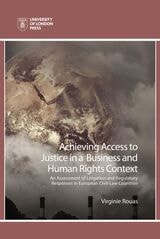
Achieving Access to Justice in a Business and Human Rights Context
An Assessment of Litigation and Regulatory Responses in European Civil-Law CountriesVirginie Rouas
University of London Press, 2022
Multinational enterprises, or MNEs, can contribute to economic prosperity and social development in the countries where they operate. At the same time, their activities may directly or indirectly cause harm to humans and to the environment. Historically, MNEs have rarely been held accountable for their involvement in human rights abuses and environmental damage. In recent years, however, activists have sought to hold parent companies directly liable for the harm caused by their group’s activities. They have also strategically used litigation to trigger corporate accountability reforms at international, regional, and national levels.
Focusing on Europe, this book evaluates the extent to which litigation against MNEs has been effective in achieving access to justice and corporate accountability, particularly in civil-law countries. It also considers whether ongoing regulatory developments, such as the adoption of mandatory human rights due diligence norms and the negotiations for a business and human rights treaty, can contribute to the realization of access to justice and corporate accountability in the future.
Anthropometric Standards for the Assessment of Growth and Nutritional Status
A. Roberto Frisancho
University of Michigan Press, 1990
Assessment and Advocacy
Using Project Outcome for Academic LibrariesGena Parsons-Diamond
Assoc of College & Research Libraries, 2024
In celebration of Project Outcome’s fifth anniversary, Assessment and Advocacy: Using Project Outcome for Academic Libraries collects case studies demonstrating how a variety of libraries have used Project Outcome to make improvements in their practice and highlighting the value the toolkit has brought to institutions and the academic library profession. Chapters capture ways to use Project Outcome to make small changes, like the optimal arrangement of a library’s study room furniture, to using Project Outcome data in conversation with datasets from other sources to provide greater insights into the contributions of academic libraries to student learning and success, as well as evidence that can be used in advocating for institutional, state, and federal funding.
Academic librarians know that their work makes a difference. You set students on the road to success and researchers on the road to results, providing valuable skills and access to knowledge that help our colleges and universities thrive. The challenge for libraries can be capturing meaningful data to support that story. Since 2019, the Project Outcome for Academic Libraries toolkit has helped library workers measure learning outcomes to drive change, make data-informed decisions, and demonstrate the impact and value of academic libraries. Learn how to use this data in your library, institution, and the profession with Assessment and Advocacy, all proceeds of which go to keeping Project Outcome free.
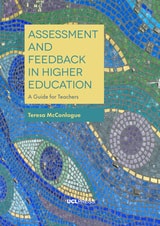
Assessment and Feedback in Higher Education
A Guide for TeachersTeresa McConlogue
University College London, 2020
Teachers spend much of their time on assessment, yet many higher education teachers have received minimal guidance on assessment design and marking. This means assessment can often be a source of stress and frustration. Offering a concise overview of assessment theory and practice, this guide provides teachers with the help they need. In education, theory and practice are often poorly linked. In this guide, Teresa McConlogue presents theoretical ideas and research findings and links them to practice. She considers recent theoretical work on feedback and suggests ways of developing evaluative judgment. Throughout the book, teachers are encouraged to examine their practice critically, and there are ideas for small-scale educational investigations, involving teachers, their colleagues, and students, such as using the Assessment Review Questionnaire to adapt assessments. This guide explores the concept of academic standards and proposes methods of co-constructing shared standards within a teaching team and with students through calibration activities.
Assessment in the Second Language Writing Classroom
Deborah Crusan
University of Michigan Press, 2010
Assessment in the Second Language Writing Classroom is a teacher and prospective teacher-friendly book, uncomplicated by the language of statistics. The book is for those who teach and assess second language writing in several different contexts: the IEP, the developmental writing classroom, and the sheltered composition classroom. In addition, teachers who experience a mixed population or teach cross-cultural composition will find the book a valuable resource. Other books have thoroughly covered the theoretical aspects of writing assessment, but none have focused as heavily as this book does on pragmatic classroom aspects of writing assessment. Further, no book to date has included an in-depth examination of the machine scoring of writing and its effects on second language writers.
Crusan not only makes a compelling case for becoming knowledgeable about L2 writing assessment but offers the means to do so. Her highly accessible, thought-provoking presentation of the conceptual and practical dimensions of writing assessment, both for the classroom and on a larger scale, promises to engage readers who have previously found the technical detail of other works on assessment off-putting, as well as those who have had no previous exposure to the study of assessment at all.

Assessment of Chronic Pain Patients with the MMPI-2
Laura S. Keller
University of Minnesota Press, 1991

Shaping the Campus Conversation on Student Learning and Experience
Activating the Results of Assessment in ActionKaren Brown
Assoc of College & Research Libraries, 2018
Textbooks in Academic Libraries
Selection, Circulation, and AssessmentChris Diaz
American Library Association, 2017
The Community College Library
AssessmentJanet Pinkley
American Library Association, 2022
Community college librarians are engaged in meaningful work designing and delivering library programs and services that meet the needs of their diverse populations and support student learning. The Community College Library series is meant to lift the voices of community college librarians and highlight their creativity, tenacity, and commitment to students.
The Community College Library: Assessment explores the research, comprehensive plans, and new approaches to assessment being created by community college librarians around the U.S. Chapters include sample activities and materials and cover topics including assessing student learning while shifting from Standards to Framework; investigating and communicating library instruction’s relationship to student retention; and building librarian assessment confidence through communities of research practice.
This book demonstrates the innovative and replicable ways community college librarians are measuring, evaluating, and reflecting on the services they provide, and how to use these assessments to demonstrate the value and impact of library services and advocate for resources.

The Problem of Assessment in Art and Design
Edited by Trevor Rayment
Intellect Books, 2007
Very Like a Whale
The Assessment of Writing ProgramsEdward M. White
Utah State University Press, 2015
Winner of the 2015 CPTSC Award for Excellence in Program Assessment
Written for those who design, redesign, and assess writing programs, Very Like a Whale is an intensive discussion of writing program assessment issues. Taking its title from Hamlet, the book explores the multifaceted forces that shape writing programs and the central role these programs can and should play in defining college education.
Given the new era of assessment in higher education, writing programs must provide valid evidence that they are serving students, instructors, administrators, alumni, accreditors, and policymakers. This book introduces new conceptualizations associated with assessment, making them clear and available to those in the profession of rhetoric and composition/writing studies. It also offers strategies that aid in gathering information about the relative success of a writing program in achieving its identified goals.
Philosophically and historically aligned with quantitative approaches, White, Elliot, and Peckham use case study and best-practice scholarship to demonstrate the applicability of their innovative approach, termed Design for Assessment (DFA). Well grounded in assessment theory, Very Like a Whale will be of practical use to new and seasoned writing program administrators alike, as well as to any educator involved with the accreditation process.