Results by title

6 books match the query 'Associations, institutions, etc'
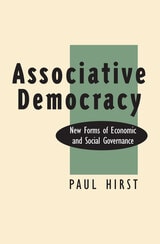
cover of Associative Democracy: New Forms of Economic and Social Governance

Associative Democracy

New Forms of Economic and Social Governance

Paul Hirst

University of Massachusetts Press, 1994

At the end of the twentieth century, it becomes ever more clear that Western countries are witnessing the exhaustion of the two great political and economic systems—democratic capitalism and collective state socialism—that have held sway for the past 150 years. Yet neither the traditional Right nor Left has been able to provide viable solutions to this crisis. In this book, Paul Hirst offers a new approach, which he calls associative democracy.

Not simply a utopian idea, associative democracy calls for new forms of economic and social governance as supplements to representative democracy and market economies. It addresses the problems of the overload of big government by democratizing and empowering civil society. It transfers social provision to self-governing voluntary associations, while retaining public funding and political accountability. In the economic sphere, it advocates regional economic regulation through public-private partnerships, the promotion of self-governing industrial districts, and the democratization of the company.

[more]
cover of Pragmatic Liberalism

Pragmatic Liberalism

Charles W. Anderson

University of Chicago Press, 1990

Drawing on the legacy of prominent pragmatic philosophers and political economists—C. S. Peirce, William James, John Dewey, Thorstein Veblen, and John R. Commons—Charles W. Anderson creatively brings pragmatism and liberalism together, striving to temper the excesses of both and to fashion a broader vision of the proper domain of political reason.
[more]
cover of Social Science in the Making: Essays on the Russell Sage Foundation, 1907-1972

Social Science in the Making

Essays on the Russell Sage Foundation, 1907-1972

David C. Hammack

Russell Sage Foundation, 1994
"Together, the historical essays in this volume provide the best account of how the Foundation moved away from its roots as a policy think tank.... This book of essays is the only extended treatment of the Foundation's history that includes both its distinguished early years and its emergence after World War II as the principal private foundation devoted to strengthening basic research in the social sciences." —ERIC WANNER, president of the Russell Sage Foundation, in his foreword to the volume
[more]
cover of The Governors' Lobbyists: Federal-State Relations Offices and Governors Associations in Washington

The Governors' Lobbyists

Federal-State Relations Offices and Governors Associations in Washington

Jennifer M. Jensen

University of Michigan Press, 2016
Today, approximately half of all American states have lobbying offices in Washington, DC, where governors are also represented by their own national, partisan, and regional associations. Jennifer M. Jensen’s The Governors’ Lobbyists draws on quantitative data, archival research, and more than 100 in-depth interviews to detail the political development of this constellation of advocacy organizations since the early 20th century and investigate the current role of the governors’ lobbyists in the U.S. federal system.

First, Jensen analyzes the critical ways in which state offices and governors’ associations promote their interests and, thus, complement other political safeguards of federalism. Next, she considers why, given their apparent power, governors engage lobbyists to serve as advocates and why governors have created both individual state offices and several associations for this advocacy work. Finally, using interest group theory to analyze both material and political costs and benefits, Jensen addresses the question of interest group variation: why, given the fairly clear material benefit a state draws from having a lobbying office in Washington, doesn’t every state have one?

This assessment of lobbying efforts by state governments and governors reveals much about role and relative power of states within the U.S. federal system.

[more]
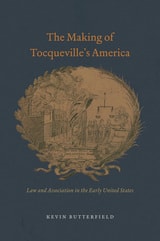
cover of The Making of Tocqueville's America: Law and Association in the Early United States

The Making of Tocqueville's America

Law and Association in the Early United States

Kevin Butterfield

University of Chicago Press, 2015

Alexis de Tocqueville was among the first to draw attention to Americans’ propensity to form voluntary associations—and to join them with a fervor and frequency unmatched anywhere in the world. For nearly two centuries, we have sought to understand how and why early nineteenth-century Americans were, in Tocqueville’s words, “forever forming associations.” In The Making of Tocqueville’s America, Kevin Butterfield argues that to understand this, we need to first ask: what did membership really mean to the growing number of affiliated Americans?

Butterfield explains that the first generations of American citizens found in the concept of membership—in churches, fraternities, reform societies, labor unions, and private business corporations—a mechanism to balance the tension between collective action and personal autonomy, something they accomplished by emphasizing law and procedural fairness. As this post-Revolutionary procedural culture developed, so too did the legal substructure of American civil society. Tocqueville, then, was wrong to see associations as the training ground for democracy, where people learned to honor one another’s voices and perspectives. Rather, they were the training ground for something no less valuable to the success of the American democratic experiment: increasingly formal and legalistic relations among people.
[more]
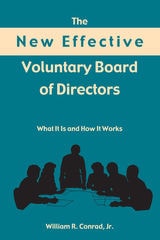
cover of The New Effective Voluntary Board of Directors: What It Is and How It Works

The New Effective Voluntary Board of Directors

What It Is and How It Works

William R. Conrad Jr.

Ohio University Press, 2003

More than one million nonprofit or voluntary organizations have been incorporated in the United States, and there are countless others throughout the world. Although they range in size and purpose from small social clubs to large and complex organizations such as universities and hospitals, they all have one thing in common: a board of directors of some type. What these boards do varies as much as the organizations themselves.

The New Effective Voluntary Board of Directors provides clear answers, illustrated with graphics, to previously ambiguous and bewildering questions, such as definitions of policy, the function of boards, the role of board members, and many other issues.

Dealing with the delicate balance in nonprofit organizations, the legal implications of serving on a board, the nonprofit leadership and management model, and other matters of concern, William Conrad applies his lifelong experience to providing a comprehensive, practical, and concise tool for those involved in the unique challenges associated with the leadership and management of nonprofit and voluntary groups.

With nearly 30,000 copies of earlier editions of this work in print, Swallow Press is pleased to publish the new, updated, and revised edition of this classic in its field.

[more]