Results by title
4 books match the query 'Atmospheric Science'
A Scientific Peak
How Boulder Became a World Center for Space and Atmospheric ScienceJoseph P. Bassi
American Meteorological Society, 2015
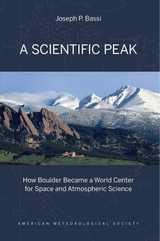
Scroll through a list of the latest incredible scientific discoveries and you might find an unexpected commonality—Boulder, Colorado. Once a Wild West city tucked where the Rocky Mountains meet the Great Plains, it is now home to some of the biggest names in science. Research centers, including the National Center for Atmospheric Research, National Institute of Standards and Technology, and the National Oceanic and Atmospheric Administration, are based there, while IBM, Lockheed Martin, and Ball Aerospace would come to reside alongside a dynamic start-up community.
A Scientific Peak chronicles Boulder’s meteoric rise to eventually become “America’s Smartest City” and a leader in space and atmospheric sciences. In just two decades following World War II, a tenacious group of researchers, supported by groups from local citizenry to the State of Colorado, managed to convince the US government and some of the world’s scientific pioneers to make Boulder a center of the new space age. Joseph P. Bassi introduces us to the characters, from citizens to scientists, and the mix of politics, passion, and sheer luck at the start of Boulder’s transformation from “Scientific Siberia” to the research mecca it is today.
A Scientific Peak chronicles Boulder’s meteoric rise to eventually become “America’s Smartest City” and a leader in space and atmospheric sciences. In just two decades following World War II, a tenacious group of researchers, supported by groups from local citizenry to the State of Colorado, managed to convince the US government and some of the world’s scientific pioneers to make Boulder a center of the new space age. Joseph P. Bassi introduces us to the characters, from citizens to scientists, and the mix of politics, passion, and sheer luck at the start of Boulder’s transformation from “Scientific Siberia” to the research mecca it is today.
[more]

Picturing the Atmosphere
Photography and the Advancement of Atmospheric ScienceTerrence R. Nathan
American Meteorological Society, 2021
[more]
Probing the Sky with Radio Waves
From Wireless Technology to the Development of Atmospheric ScienceChen-Pang Yeang
University of Chicago Press, 2013
By the late nineteenth century, engineers and experimental scientists generally knew how radio waves behaved, and by 1901 scientists were able to manipulate them to transmit messages across long distances. What no one could understand, however, was why radio waves followed the curvature of the Earth. Theorists puzzled over this for nearly twenty years before physicists confirmed the zig-zag theory, a solution that led to the discovery of a layer in the Earth’s upper atmosphere that bounces radio waves earthward—the ionosphere.
In Probing the Sky with Radio Waves, Chen-Pang Yeang documents this monumental discovery and the advances in radio ionospheric propagation research that occurred in its aftermath. Yeang illustrates how the discovery of the ionosphere transformed atmospheric science from what had been primarily an observational endeavor into an experimental science. It also gave researchers a host of new theories, experiments, and instruments with which to better understand the atmosphere’s constitution, the origin of atmospheric electricity, and how the sun and geomagnetism shape the Earth’s atmosphere.
This book will be warmly welcomed by scholars of astronomy, atmospheric science, geoscience, military and institutional history, and the history and philosophy of science and technology, as well as by radio amateurs and electrical engineers interested in historical perspectives on their craft.
[more]
The Mistral
A Windswept History of Modern FranceCatherine Tatiana Dunlop
University of Chicago Press, 2024
An in-depth look at the hidden power of the mistral wind and its effect on modern French history.
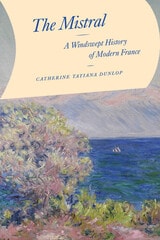
Every year, the chilly mistral wind blows through the Rhône valley of southern France, across the Camargue wetlands, and into the Mediterranean Sea. Most forceful when winter turns to spring, the wind knocks over trees, sweeps trains off their tracks, and destroys crops. Yet the mistral turns the sky clear and blue, as it often appears in depictions of Provence. The legendary wind is central to the area’s regional identity and has inspired artists and writers near and far for centuries.
This force of nature is the focus of Catherine Dunlop’s The Mistral, a wonderfully written examination of the power of the mistral wind, and in particular, the ways it challenged central tenets of nineteenth-century European society: order, mastery, and predictability. As Dunlop shows, while the modernizing state sought liberation from environmental realities through scientific advances, land modification, and other technological solutions, the wind blew on, literally crushing attempts at control, and becoming increasingly integral to regional feelings of place and community.
[more]