Results by title
7 books match the query 'Attachment'
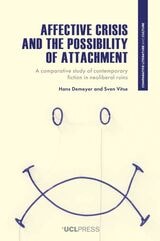
Affective Crisis and the Possibility of Attachment
A Comparative Study of Contemporary Fiction in Neoliberal RuinsHans Demeyer and Sven Vitse
University College London, 2026
An in-depth study of contemporary novels through the lens of affect theory and ideology critique.
Affective Crisis and the Possibility of Attachment offers a comparative critical study of contemporary fiction. It intervenes in discussions about contemporary fiction in its literary-historical relationship to postmodernism and in its socio-historical relationship to neoliberalism, arguing that contemporary literature is dominated by affective questions that are rooted in neoliberalism. Whereas previous research focused on either a literary-historical or a socio-historical approach, this study examines eighteen novels from various parts of the world in both their diachronic relation to postmodernism and in their synchronic relation to neoliberal society.
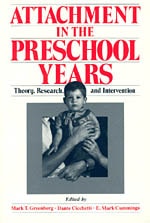
Attachment in the Preschool Years
Theory, Research, and InterventionEdited by Mark T. Greenberg, Dante Cicchetti, and E. Mark Cummings
University of Chicago Press, 1993
"There is a wealth of information and thought in this book; it does not have a weak or uninteresting chapter, starting with the Preface by Emde, and as a whole, it forms a sort of seminar."—John E. Bates, Contemporary Psychology
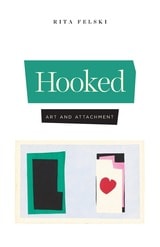
Hooked
Art and AttachmentRita Felski
University of Chicago Press, 2020
How does a novel entice or enlist us? How does a song surprise or seduce us? Why do we bristle when a friend belittles a book we love, or fall into a funk when a favored TV series comes to an end? What characterizes the aesthetic experiences of feeling captivated by works of art? In Hooked, Rita Felski challenges the ethos of critical aloofness that is a part of modern intellectuals’ self-image. The result is sure to be as widely read as Felski’s book, The Limits of Critique.
Wresting the language of affinity away from accusations of sticky sentiment and manipulative marketing, Felski argues that “being hooked” is as fundamental to the appreciation of high art as to the enjoyment of popular culture. Hooked zeroes in on three attachment devices that connect audiences to works of art: identification, attunement, and interpretation. Drawing on examples from literature, film, music, and painting—from Joni Mitchell to Matisse, from Thomas Bernhard to Thelma and Louise—Felski brings the language of attachment into the academy. Hooked returns us to the fundamentals of aesthetic experience, showing that the social meanings of artworks are generated not just by critics, but also by the responses of captivated audiences.
Hooked
Art and AttachmentRita Felski
University of Chicago Press, 2020
This is an auto-narrated audiobook edition of this book.
How does a novel entice or enlist us? How does a song surprise or seduce us? Why do we bristle when a friend belittles a book we love, or fall into a funk when a favored TV series comes to an end? What characterizes the aesthetic experiences of feeling captivated by works of art? In Hooked, Rita Felski challenges the ethos of critical aloofness that is a part of modern intellectuals’ self-image. The result is sure to be as widely read as Felski’s book, The Limits of Critique.
Wresting the language of affinity away from accusations of sticky sentiment and manipulative marketing, Felski argues that “being hooked” is as fundamental to the appreciation of high art as to the enjoyment of popular culture. Hooked zeroes in on three attachment devices that connect audiences to works of art: identification, attunement, and interpretation. Drawing on examples from literature, film, music, and painting—from Joni Mitchell to Matisse, from Thomas Bernhard to Thelma and Louise—Felski brings the language of attachment into the academy. Hooked returns us to the fundamentals of aesthetic experience, showing that the social meanings of artworks are generated not just by critics, but also by the responses of captivated audiences.

Shadow Girl
A Memoir Of AttachmentDeb Abramson
University of Iowa Press, 2002
In this psychological portrait of a family bound together by the uneasy permutations of love, Abramson relies not on sensationalist narrative but on a collection of the many small moments that glitter along the bumpy path of her life. Now and then she provides a broader, connecting perspective by stepping out of her story to reflect on the meaning of it all from the standpoint of the insightful, healed person she has managed—against all odds—to become.
Rich in metaphor and intimate detail, this is a lyrical story about moving from isolation toward connection, about seeing childhood not as a crippling refuge but as a point of departure, about discovering that it is possible to “have your shadows as well as your light.”
The Nature and Nurture of Love
From Imprinting to Attachment in Cold War AmericaMarga Vicedo
University of Chicago Press, 2013
Things Worth Keeping
The Value of Attachment in a Disposable WorldChristine Harold
University of Minnesota Press, 2020
A timely examination of the attachments we form to objects and how they might be used to reduce waste
Rampant consumerism has inundated our planet with pollution and waste. Yet attempts to create environmentally friendly forms of consumption are often co-opted by corporations looking to sell us more stuff. In Things Worth Keeping, Christine Harold investigates the attachments we form to the objects we buy, keep, and discard, and explores how these attachments might be marshaled to create less wasteful practices and balance our consumerist and ecological impulses.
Although all economies produce waste, no system generates as much or has become so adept at hiding its excesses as today’s mode of global capitalism. This book suggests that managing the material excesses of our lives as consumers requires us to build on, rather than reject, our desire for and attraction to objects. Increasing environmental awareness on its own will be ineffective at reversing ecological devastation, Harold argues, unless it is coupled with a more thorough understanding of how and why we love the things that imbue our lives with pleasure, meaning, and utility.
From Marie Kondo’s method for decluttering that asks whether the things in our lives “spark joy” to the advent of emotionally durable design, which seeks to reduce consumption and waste by increasing the meaningfulness of the relationship between user and product, Harold explores how consumer psychology and empathetic design can transform our perception of consumer products from disposable to interconnected. An urgent call for rethinking consumerism, Things Worth Keeping shows that by recognizing our responsibility for the things we produce, we can become better stewards of the planet.