Results by title
10 books match the query 'Attention'
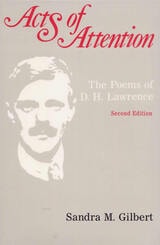
Acts of Attention, Second Edition
The Poems of D. H. LawrenceSandra M. Gilbert
Southern Illinois University Press, 1990
In the Preface to this second edition of her first book, Sandra M. Gilbert addresses the inevitable question: "How can you be a feminist and a Lawrentian?" The answer is intellectually satisfying and historically revealing as she traces an array of early twentieth-century women of letters, some of them proto-feminists, who revered Lawrence despite his countless statements that would today be condemned as "sexist."
H.D. regarded him as one of her "initiators" whose words "flamed alive, blue serpents on the page." Anais Nin insisted that he "had a complete realization of the feelings of women."
By focusing on Lawrence’s own definition of a poem as an "act of attention," Gilbert demonstrates how he developed the mature style of Birds, Beasts and Flowers, his finest collection of poetry. She discusses this volume at length, examines many of his later poems in detail, including the hymns from The Plumed Serpent, Pansies, Nettles, and More Pansies, and ends with a close look at Last Poems. Her detailed examination provides a clearer image of Lawrence as an artist—an artist whose poetry complements his novels and whose fiction enriches but does not outshine his poetry.
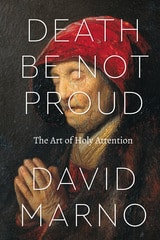
Death Be Not Proud
The Art of Holy AttentionDavid Marno
University of Chicago Press, 2016
If, in Malebranche’s view, attention is a hidden bond between religion and philosophy, devotional poetry is the area where this bond becomes visible. Marno shows that in works like “Death be not proud,” Donne’s most triumphant poem about the resurrection, the goal is to allow the poem’s speaker to experience a given doctrine as his own thought, as an idea occurring to him. But while the thought must feel like an unexpected event for the speaker, the poem itself is a careful preparation for it. And the key to this preparation is attention, the only state in which the speaker can perceive the doctrine as a cognitive gift. Along the way, Marno illuminates why attention is required in Christian devotion in the first place and uncovers a tradition of battling distraction that spans from ascetic thinkers and Church Fathers to Catholic spiritual exercises and Protestant prayer manuals.
Forms of Attention
Botticelli and HamletFrank Kermode
University of Chicago Press, 2011
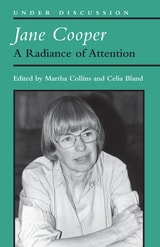
Jane Cooper
A Radiance of AttentionMartha Collins and Celia Bland, editors
University of Michigan Press, 2019
Martha Collins and Celia Bland bring together several decades’ worth of essential writing on Cooper’s poetry. While some pieces offer close examination of Cooper’s process or thoughtful consideration of the craft of a single poem, the volume also features reviews of her collections, including a previously unpublished piece on her first book, The Weather of Six Mornings (1969), by James Wright, a lifelong champion of her work. Marie Howe, Jan Heller Levi, and Thomas Lux, among others, share personal remembrances of Cooper as a teacher, colleague, and inspiration. L. R. Berger’s moving tribute to Cooper’s final days closes the volume. This book has much to offer for both readers who already love Cooper’s work and new readers, especially among younger poets, just discovering her enduring poems.
Reconceiving Decision-Making in Democratic Politics
Attention, Choice, and Public PolicyBryan D. Jones
University of Chicago Press, 1994
Individuals and political systems alike, Jones argues, tend to be attentive to only one issue at a time. Using numerous examples from elections, public opinion polls, congressional deliberations, and of bureaucratic decision-making, he shows how shifting attentiveness can and does alter choices and political outcomes—even when underlying preferences remain relatively fixed. An individual, for example, may initially decide to vote for a candidate because of her stand on spending but change his vote when he learns of her position on abortion, never really balancing the two options.
Resisting Extractivism
Peruvian Gold, Everyday Violence, and the Politics of AttentionMichael Wilson Becerril
Vanderbilt University Press, 2021
Peru is classified as one of the deadliest countries in the world for environmental defenders, where activists face many forms of violence. Through an ethnographic and systematic comparison of four gold-mining conflicts in Peru, Resisting Extractivism presents a vivid account of subtle and routine forms of violence, analyzing how meaning-making practices render certain types of damage and suffering noticeable while occluding others. The book thus builds a theory of violence from the ground up—how it is framed, how it impacts people’s lived experiences, and how it can be confronted. By excavating how the everyday interactions that underlie conflicts are discursively concealed and highlighted, this study assists in the prevention and transformation of violence over resource extraction in Latin America.
The book draws on a controlled, qualitative comparison of four case studies, extensive ethnographic research conducted over fourteen months of fieldwork, analysis of over nine hundred archives and documents, and unprecedented access to more than 250 semi-structured interviews with key actors across industry, the state, civil society, and the media. Michael Wilson Becerril identifies, traces, and compares these dynamics to explain how similar cases can lead to contrasting outcomes—insights that may be usefully applied in other contexts to save lives and build better futures.
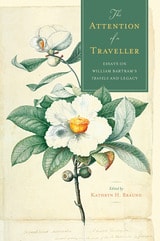
The Attention of a Traveller
Essays on William Bartram's "Travels" and LegacyEdited by Kathryn H. Braund
University of Alabama Press, 2022
An interdisciplinary reevaluation of William Bartram’s Travels, illuminating the natural, cultural, and intellectual landscapes of the eighteenth‑century Southeast through diverse scholarly lenses.
William Bartram, author of Travels through North and South Carolina, Georgia, East and West Florida, the Cherokee Country, the Extensive Territories of the Muscogulees, or Creek Confederacy, and the Country of the Chactaws, was colonial America’s first native born naturalist and artist, and the first author in the modern genre of writers who portrayed nature through personal experience as well as scientific observation. His book, first published in 1791, was based on his journeys through southern Indian nations and Britain’s southern colonies in the years just prior to the American Revolution and provides descriptions of the natural and cultural environments of what would soon become the American South. Scholars and general readers alike have long appreciated Bartram’s lush, vivid prose, his clarity of observation and evident wonder at the landscapes he traversed, and his engagement with the native nations whose lands he traveled through.
The Attention of a Traveller: Essays on William Bartram’s “Travels” and Legacy offers an interdisciplinary assessment of Bartram’s influence and evolving legacy, opening new avenues of research concerning the flora, fauna, and people connected to Bartram and his writings. Featuring 13 essays divided into five sections, contributors to the volume weave together scholarly perspectives from geology, art history, literary criticism, geography, and philosophy, alongside the more traditional Bartram-affiliated disciplines of biology and history. The collection concludes with a comprehensive treatment of the book as a material historical artifact.
The Economics of Attention
Style and Substance in the Age of InformationRichard A. Lanham
University of Chicago Press, 2006
With all the verve and erudition that have established his earlier books as classics, Richard A. Lanham here traces our epochal move from an economy of things and objects to an economy of attention. According to Lanham, the central commodity in our new age of information is not stuff but style, for style is what competes for our attention amidst the din and deluge of new media. In such a world, intellectual property will become more central to the economy than real property, while the arts and letters will grow to be more crucial than engineering, the physical sciences, and indeed economics as conventionally practiced. For Lanham, the arts and letters are the disciplines that study how human attention is allocated and how cultural capital is created and traded. In an economy of attention, style and substance change places. The new attention economy, therefore, will anoint a new set of moguls in the business world—not the CEOs or fund managers of yesteryear, but new masters of attention with a grounding in the humanities and liberal arts.
Lanham’s The Electronic Word was one of the earliest and most influential books on new electronic culture. The Economics of Attention builds on the best insights of that seminal book to map the new frontier that information technologies have created.
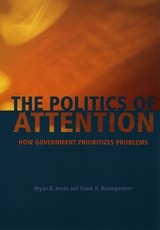
The Politics of Attention
How Government Prioritizes ProblemsBryan D. Jones and Frank R. Baumgartner
University of Chicago Press, 2005
Analyzing fifty years of data, Jones and Baumgartner's book is the first study of American politics based on a new information-processing perspective. The authors bring together the allocation of attention and the operation of governing institutions into a single model that traces public policies, public and media attention to them, and governmental decisions across multiple institutions.
The Politics of Attention offers a groundbreaking approach to American politics based on the responses of policymakers to the flow of information. It asks how the system solves, or fails to solve, problems rather than looking to how individual preferences are realized through political action.
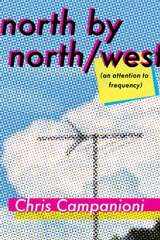
north by north/west
(an attention to frequency)Chris Campanioni
West Virginia University Press, 2025
2025 Foreword Indies Finalist, Nonfiction (Multicultural)
north by north/west is a hybrid work of creative nonfiction assembled as several iterative sequences—a discontinuous itinerary—of exile. Harnessing both montage and collage to represent the incohesive experience of being between cultures, categories, and language, this book is a personal, critical, and autoethnographic exploration of diasporic identity formation and creative expression amidst the cultural and political impacts of Cold War colonialism and fragmentation. As the narrator begins work on a rough translation of the 1959 film North by Northwest, focal points surface through textual correspondences with distant coordinates, shifting between close readings of Whitney Houston’s early music videos, current events reportage, illness journals, eighties spy movies, the most recent solar eclipse, Alfred Hitchcock’s unproduced films, Cold War “stay-behind operations,” an ill-fated party at the Festival de Cannes, and family accounts of migration. These meticulously arranged narrative threads—harnessing elements of a novel alongside poetry, photographs, and field notes—attempt to discompose the epistemology of the West/Global North in order to conceptualize a genre of work by the children of exiles who have been called “the post-dictatorship generation.”