Results by title
6 books match the query 'Authors, Argentine'
Conversations, Volume 1
Jorge Luis Borges and Osvaldo Ferrari
Seagull Books, 2014
The Argentine short-story writer, essayist, poet and translator, contributed immensely to twentieth-century literature, and more specifically to the genres of magical realism and fantasy. As he progressively lost his sight—he became completely blind by the age of fifty-five—the darkness behind his eyelids held enchanting imagery that translated into rich symbolism in his work. The inner workings of his curious mind are seen vividly in his conversations with Ferrari, and there’s not a subject on which he doesn’t cast surprising new light. As in his tale “The Other,” where two Borgeses meet up on a bench beside the River Charles, this is a dialogue between a young poet and the elder teller of tales where all experience floats in a miracle that defies linear time.
Conversations
Volume 2Jorge Luis Borges and Osvaldo Ferrari
Seagull Books, 2015
In Conversations: Volume 2, Borges and Ferrari engage in a dialogue that is both improvisational and frequently humorous as they touch on subjects as diverse as epic poetry, detective fiction, Buddhism, and the moon landing. With his signature wit, Borges offers insight into the philosophical basis of his stories and poems, his fascination with religious mysticism, and the idea of life as a dream. He also dwells on more personal themes, including the influence of his mother and father on his intellectual development, his friendships, and living with blindness. These recollections are alive to the passage of history, whether in the changing landscape of Buenos Aires or a succession of political conflicts, leading Borges to contemplate what he describes as his “South American destiny.”
The recurrent theme of these conversations, however, is a life lived through books. Borges draws on the resources of a mental library that embraces world literature—ancient and modern. He recalls the works that were a constant presence in his memory and maps his changing attitudes to a highly personal canon. In the prologue to the volume, Borges celebrates dialogue and the transmission of culture across time and place. These conversations are a testimony to the supple ways that Borges explored his own relation to numerous traditions.
On the Edge of the Holocaust
The Shoah in Latin American Literature and CultureEdna Aizenberg
Brandeis University Press, 2015
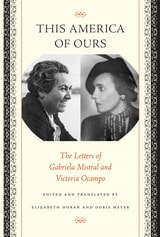
This America of Ours
The Letters of Gabriela Mistral and Victoria OcampoBy Gabriela Mistral and Victoria Ocampo
University of Texas Press, 2003
2005 — Best Book Translation Prize – New England Council of Latin American Studies
Gabriela Mistral and Victoria Ocampo were the two most influential and respected women writers of twentieth-century Latin America. Mistral, a plain, self-educated Chilean woman of the mountains who was a poet, journalist, and educator, became Latin America's first Nobel Laureate in 1945. Ocampo, a stunning Argentine woman of wealth, wrote hundreds of essays and founded the first-rate literary journal Sur. Though of very different backgrounds, their deep commitment to what they felt was "their" America forged a unique intellectual and emotional bond between them.
This collection of the previously unpublished correspondence between Mistral and Ocampo reveals the private side of two very public women. In these letters (as well as in essays that are included in an appendix), we see what Mistral and Ocampo thought about each other and about the intellectual and political atmosphere of their time (including the Spanish Civil War, World War II, and the dictatorships of Latin America) and particularly how they negotiated the complex issues of identity, nationality, and gender within their wide-ranging cultural connections to both the Americas and Europe.
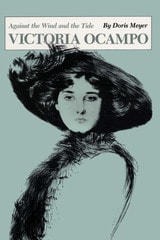
Victoria Ocampo
Against the Wind and the TideBy Doris Meyer
University of Texas Press, 1989
The "first lady of Argentine letters," Victoria Ocampo is best known as the architect of cultural bridges between the American and European continents and as the founder and director of Sur, an influential South American literary review and publishing house.
In this first biographical study in English of "la superbe Argentine," originally published in 1979, Doris Meyer considers Victoria Ocampo's role in introducing European and North American writers and artists to the South American public—through the pages of her review, through translations of their work, and through lecture tours and recitations. She examines Ocampo's personal relationships with some of the most illustrious writers and thinkers of this century—including José Ortega y Gasset, Rabindranath Tagore, Count Hermann Keyserling, Virginia Woolf, Adrienne Monnier, Vita Sackville-West, Gabriela Mistral, and many others. And she portrays an extraordinary woman who rebelled against the strictures of family and social class to become a leading personality in the fight for women's rights in Argentina and, later, a steadfast opponent of the Perón regime, for which she was sent to jail in 1953.
Fifteen of Victoria Ocampo's essays, selected from her more than ten volumes of prose and translated by Doris Meyer, complement the biographical study.
Women and Power in Argentine Literature
Stories, Interviews, and Critical EssaysBy Gwendolyn Díaz
University of Texas Press, 2007
The astonishing talent of Argentine women writers belies the struggles they have faced—not merely as overlooked authors, but as women of conviction facing oppression. The patriarchal pressures of the Perón years, the terror of the Dirty War, and, more recently, the economic collapse that gripped the nation in 2001 created such repressive conditions that some writers, such as Luisa Valenzuela, left the country for long periods. Not surprisingly, power has become an inescapable theme in Argentine women's fiction, and this collection shows how the dynamics of power capture not only the political world but also the personal one. Whether their characters are politicians and peasants, torturers and victims, parents and children, or lovers male and female, each writer explores the effects of power as it is exercised by or against women.
The fifteen writers chosen for Women and Power in Argentine Literature include famous names such as Valenzuela, as well as authors anthologized for the first time, most notably María Kodama, widow of Jorge Luis Borges. Each chapter begins with a "verbal portrait," editor Gwendolyn Díaz's personal impression of the author at ease, formed through hours of conversation and interviews. A biographical essay and critical commentary follow, with emphasis on the work included in this anthology. Díaz's interviews, translated from Spanish, and finally the stories themselves—only three of which have been previously published in English—complete the chapters. The extraordinary depth of these chapters reflects the nuanced, often controversial portrayals of power observed by Argentine women writers. Inspiring as well as insightful, Women and Power in Argentine Literature is ultimately about women who, in Díaz's words, "choose to speak their truth regardless of the consequences."