Results by title
9 books match the query 'Authors, Italian'
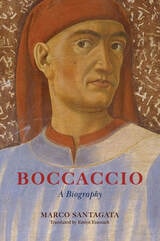
Boccaccio
A BiographyMarco Santagata
University of Chicago Press, 2025
Boccaccio (1313–75) stands with Dante and Petrarch as one of the “Three Crowns” of Italian letters, a trio of writers who shaped the history of humanism, literature, and poetry. In this book, Dante’s award-winning biographer, Marco Santagata, takes up the moving life and legacy of Boccaccio—whose unflinching story of a pandemic-era community (the Decameron) created new possibilities for vernacular Italian prose.
This landmark biography sheds new light on Boccaccio’s life—his family, friends, and foes, his aspirations, fears, and frustrations—and it shows how he was affected by transformations in Italian society. It also charts the influences that shaped Boccaccio’s understanding of literature: what kinds of stories it could tell and what kinds of characters it could depict; and, perhaps most importantly, what role art could play in a changing world. An insightful portrait of one of literature’s most important figures, this book promises to be the definitive biography of Boccaccio for many years to come.
Conversations with Primo Levi
Ferdinando Camon
Northwestern University Press, 1989
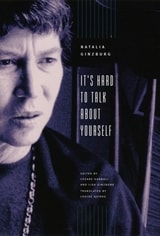
It's Hard to Talk about Yourself
Natalia Ginzburg
University of Chicago Press, 2003
Ginzburg's marriage to Leone Ginzburg, who met his death at the hands of the Nazis for his anti-Fascists activities, and her work for the Einaudi publishing house placed her squarely in the center of Italian political and cultural life. But whether writing about the Turin of her childhood, the Abruzzi countryside, where her family was interned during World War II, or contemporary Rome, Ginzburg never shied away from the traumas of history-even if she approached them only indirectly, through the mundane details and catastrophes of personal life.
Intensely reserved, Ginzburg said that she "crept toward autobiography stealthily like a wolf." But she did openly discuss her life and her work in an extraordinary series of interviews for Italian radio in 1990. Never before published in English, It's Hard to Talk about Yourself presents a vivid portrait of Ginzburg in her own words on the forces that shaped her remarkable life-politics, publishing, literature, and family. This fluid translation will join Ginzburg's autobiography, Family Sayings, as one of the most important records of her life and, as the editors write in their preface, "the last, unexpected, original book by Natalia Ginzburg."
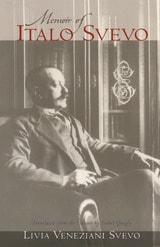
Memoir of Italo Svevo
Livia Veneziani Svevo
Northwestern University Press, 2001
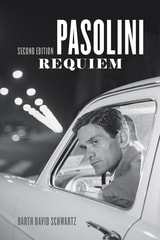
Pasolini Requiem
Second EditionBarth David Schwartz
University of Chicago Press, 2017
Based on extensive interviews with those who knew Pasolini, both friends and enemies, admirers and detractors, Pasolini Requiem chronicles his growth from poet in the provinces to Italy’s leading “civil poet”; his flight to Rome in 1950; the scandalous success of his two novels and political writing; and his transition to film, where he started as a contributor to the golden age of Italian cinema and ended with the shocking Salò, or the 120 Days of Sodom. Pasolini’s tragic and still unsolved murder has remained a subject of contentious debate for four decades. The enduring fascination with who committed the crime—and why—reflects his vital stature in Italy’s political and social history.
Updated throughout and with a new afterword covering the efforts to reopen the investigation—and the legal maelstrom surrounding Pasolini’s demise—this edition of Pasolini Requiem is a riveting account of one of the twentieth century’s most controversial, ever-present iconoclasts.
Primo Levi and the Politics of Survival
Frederic D. Homer
University of Missouri Press, 2001
At the age of twenty-five, Primo Levi was sent to Hell. Levi, an Italian chemist from Turin, was one of many swept up in the Holocaust of World War II and sent to die in the German concentration camp in Auschwitz. Of the 650 people transported to the camp in his group, only 15 men and 9 women survived. After Soviet liberation of the camp in 1945, Levi wrote books, essays, short stories, poetry, and a novel, in which he painstakingly described the horrors of his experience at Auschwitz. He also spent the rest of his life struggling with the fact that he was not among those who were killed.
In Primo Levi and the Politics of Survival, Frederic D. Homer looks at Primo Levi's life but, more important, shows him to be a significant political philosopher. In the course of his writings, Levi asked and answered his most haunting question: can someone be brutalized by a terrifying experience and, upon return to "ordinary life," recover from the physical and moral destruction he has suffered? Levi used this question to develop a philosophy positing that although man is no match for life, he can become better prepared to contend with the tragedies in life.
According to Levi, the horrors of the world occur because of the strength of human tendencies, which make relationships between human beings exceedingly fragile. He believed that we are ill-constituted beings who have tendencies toward violence and domination, dividing ourselves into Us and Them, with very shallow loyalties. He also maintained that our only refuge is in education and responsibility, which may counter these tendencies. Homer calls Levi's philosophy "optimistic pessimism."
As Homer demonstrates, Levi took his past experiences into account to determine that goodwill and democratic institutions do not come easily to people. Liberal society is to be earned through discipline and responsibility toward our weaknesses. Levi's answer is "civilized liberalism." To achieve this we must counter some of our most stubborn tendencies.
Homer also explores the impact of Levi's death, an apparent suicide, on the way in which his work and theories have been perceived. While several critics discount Levi's work because of the nature of his death, Homer argues that his death is consistent with his philosophy. A book rich in brutally honest philosophy, Primo Levi and the Politics of Survival compels one to look at serious questions about life, tragedy, optimism, solidarity, violence, and human nature.
Primo Levi
An IdentikitMarco Belpoliti
Seagull Books, 2022
Over the last seventy years, Primo Levi (1919–87) has been recognized as the foremost literary witness of the extermination of the European Jews. In Primo Levi: An Identikit, a product of twenty years of research, Marco Belpoliti explores Levi’s tormented life, his trajectory as a writer and intellectual, and, above all, his multifaceted and complex oeuvre.
Organized in a mosaic format, this volume devotes a different chapter to each of Levi’s books. In addition to tracing the history of each book’s composition, publication, and literary influences, Belpoliti explores their contents across the many worlds of Primo Levi: from chemistry to anthropology, biology to ethology, space flights to linguistics. If This Is a Man, his initially rejected masterpiece, is also reread with a fresh perspective. We learn of dreams, animals, and travel; of literary writing, comedy, and tragedy; of shame, memory, and the relationship with other writers such as Franz Kafka and Georges Perec, Jean Améry and Varlam Shalamov. Fundamental themes such as Judaism, the camp, and testimony innervate the book, which is complemented by photographs and letters found by the author in hitherto unexplored archives.
This will be the definitive book on Primo Levi, a treasure trove of stories and reflections that paint a rich, nuanced composite portrait of one of the twentieth century’s most unique and urgent voices.
The Honest Courtesan
Veronica Franco, Citizen and Writer in Sixteenth-Century VeniceMargaret F. Rosenthal
University of Chicago Press, 1992
Margaret F. Rosenthal draws a compelling portrait of Veronica Franco in her cultural social, and economic world. Rosenthal reveals in Franco's writing a passionate support of defenseless women, strong convictions about inequality, and, in the eroticized language of her epistolary verses, the seductive political nature of all poetic contests. It is Veronica Franco's insight into the power conflicts between men and women—and her awareness of the threat she posed to her male contemporaries—that makes her literary works and her dealings with Venetian intellectuals so pertinent today.
Combining the resources of biography, history, literary theory, and cultural criticism, this sophisticated interdisciplinary work presents an eloquent and often moving account of one woman's life as an act of self-creation and as a complex response to social forces and cultural conditions.
"A book . . . pleasurably redolent of Venice in the 16th-century. Rosenthal gives a vivid sense of a world of salons and coteries, of intricate networks of family and patronage, and of literary exchanges both intellectual and erotic."—Helen Hackett, Times Higher Education Supplement
The Honest Courtesan is the basis for the film Dangerous Beauty (1998) directed by Marshall Herskovitz. (The film was re-titled The Honest Courtesan for release in the UK and Europe in 1999.)
The Letters of Machiavelli
Niccolò Machiavelli
University of Chicago Press, 1988