Results by title

17 books match the query 'Automobile industry and trade'
cover of A History of Japan’s Government-Business Relationship: The Passenger Car Industry

A History of Japan’s Government-Business Relationship

The Passenger Car Industry

Phyllis A. Genther

University of Michigan Press, 1990
Despite the economic and political importance of the U.S.-Japan relationship and the extensive attention paid to automotive trade, few American scholars or policy makers are familiar with the history of Japanese government-business relations, either generally or for specific industries such as passenger cars. This book hopefully helps in a small way to fill that gap in our knowledge and, thus, to help strengthen the foundation from which we make public policy decisions about bilateral trade. [ix]
[more]
cover of Automobiles and the Future: Competition, Cooperation, and Change

Automobiles and the Future

Competition, Cooperation, and Change

Robert E. Cole, Editor

University of Michigan Press, 1983
At the time of the U.S.-Japan auto conferences in March 1983, the hoped-for economic recovery as manifested in auto sales had revealed itself quite modestly. Three months later, the indicators were more robust and certainly long overdue for those whose livelihood depends on the health of the industry--some of whom are university professors.
With Japanese import restrictions in place until March 1984 and drastically reduced break-even points for domestic manufactures, rising consumer demand holds great promise for the industry. The rapidly rising stock prices of the auto-makers captures well the sense of heightened optimism, as do the various forecasts for improved profits.
While the news is certainly welcome, it nevertheless should be greeted with caution. As Mr. Perkins noted at the conference, "we have a tendency to forget things very quickly. If we have a boom market this year, there is a good chance that a lot of things we learned will be forgotten."
To put the matter differently and more bluntly, with growing prosperity there is the risk that management will fall back into old habits, making impossible the achievement of sustained quality and productivity improvement. Similarly, the commitment to develop cooperative relations with workers and suppliers will weaken. The union will be under membership pressure to retrieve concessions rather than to take the longer-term view. This longer-term view recognizes that "up-front increases" and adherence to existing work rules increasingly come at the sacrifice of future job security. Government policymakers will turn their attention away from the industry. This may not mean a great deal given how weakly focused their attentions has been during the last three years and how mixed and contradictory government auto policies have been for over a decade.
[more]
cover of Cash, Crisis, and Corporate Governance: The Role of National Financial Systems in Industrial Restructuring

Cash, Crisis, and Corporate Governance

The Role of National Financial Systems in Industrial Restructuring

Victoria Marklew

University of Michigan Press, 1995
This study chronicles four large manufacturers during a period of crisis and restructuring when they needed vast sums of money just to survive -- let alone adapt to remain competitive. By focusing on how these firms found financing, Victoria Marklew shows that the way national financial systems channel money to industry is the key issue in industrial competitiveness. The author challenges the traditional approach in comparative political economy by starting her analysis of government-industry relations at the level of the firm. By so doing, the author is able to chart in a unique way the role governments play in setting the boundaries of financial systems and to show how these boundaries fundamentally determine the kinds of financing to which a firm has access. The case studies (comparing the British Steel Corporation's passage from state to private ownership, the French steel industry's evolution into the nationalized Usinor Sacilor, British Leyland's transition from a nationalized company to two privately-owned firms, and Peugeot SA's rise to a dominant firm in the French private sector) dramatically prove that whether ownership is public or private has little to do with a firm's ability to survive a crisis. By extending her arguments to the United States, Germany, and Japan, the author shows how apparently very different governments in fact behave remarkably similarly, highlighting more accurately where the key differences among them lie and what the consequences of these differences are.
[more]
cover of Competitiveness and Death: Trade and Politics in Cars, Beef, and Drugs

Competitiveness and Death

Trade and Politics in Cars, Beef, and Drugs

Gary Winslett

University of Michigan Press, 2021

Competitiveness and Death examines the increase and reduction of regulatory barriers to trade across three industries: environmental, labor, and safety rules on automobiles, consumer protection regulations on meat, and intellectual property regulations on medicines. The fundamental negotiation in trade and regulatory policymaking occurs between businesses, activists, and government officials.

​Gary Winslett builds on new trade theories to explain when and why businesses are most likely to lobby governments to reduce these regulatory trade barriers. He argues that businesses prevail when they can connect with broader concerns about national economic competitiveness. He examines how activist organizations overcome collective action problems and defend regulatory differences, arguing that they succeed when they can link their desire for barriers with preventing needless death. Competitiveness and Death provides a political companion to new trade theories in economics, questioning cleavage-based explanations of trade politics, demonstrating the underappreciated importance of activists, suggesting the limits of globalization, providing in-depth examination of previously ignored trade negotiations, qualifying the California Effect (the shift toward stricter regulatory standards), and showing the relative rarity of regulations used as disguised protectionism.
[more]
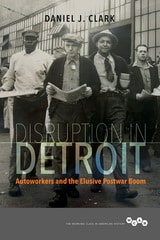
cover of Disruption in Detroit: Autoworkers and the Elusive Postwar Boom

Disruption in Detroit

Autoworkers and the Elusive Postwar Boom

Daniel J. Clark

University of Illinois Press, 2018
It is a bedrock American belief: the 1950s were a golden age of prosperity for autoworkers. Flush with high wages and enjoying the benefits of generous union contracts, these workers became the backbone of a thriving blue-collar middle class. It is also a myth. Daniel J. Clark began by interviewing dozens of former autoworkers in the Detroit area and found a different story--one of economic insecurity caused by frequent layoffs, unrealized contract provisions, and indispensable second jobs. Disruption in Detroit is a vivid portrait of workers and an industry that experienced anything but stable prosperity. As Clark reveals, the myths--whether of rising incomes or hard-nosed union bargaining success--came later. In the 1950s, ordinary autoworkers, union leaders, and auto company executives recognized that although jobs in their industry paid high wages, they were far from steady and often impossible to find.
[more]
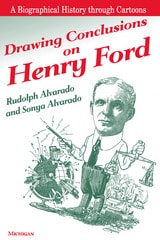
cover of Drawing Conclusions on Henry Ford

Drawing Conclusions on Henry Ford

Rudolph Alvarado and Sonya Alvarado

University of Michigan Press, 2001

For years political cartoons have shaped the often unflattering popular view of public figures. One of the most-often-portrayed figures of the twentieth century was the automobile manufacturer Henry Ford. Through editorial drawings, a vivid picture of Ford was presented that became the source of myths that surrounded him and continue even to this day.

Drawing Conclusions on Henry Ford is the first and only collection that brings together in one volume these editorial cartoons. They date back as far as the time Ford introduced the Model T in 1908 and extend forward to the introduction of the Model A and subsequent V8 engines in the 1930s. They illustrate the emergence of many of the popular myths surrounding Henry Ford, as seen and understood by the average citizen during the opening decades of the twentieth century. With 150 illustrations, the reader is able to trace the evolving images of Ford from a time period when caricature images of public figures were a primary source of information about those persons. Sometimes funny, sometimes sharp and critical, these cartoons are entertaining in themselves. Viewed as a whole, they create anew view of the Henry Ford story.

Rudolph V. Alvarado is a freelance writer and museum consultant, as well as the former programs leader for the Henry Ford Museum and Greenfield Village. Sonya Y. Alvarado is an instructor of English, at Eastern Michigan University and a former adjunct faculty member, Wayne State University.
[more]
cover of Industry at the Crossroads

Industry at the Crossroads

Robert E. Cole, Editor

University of Michigan Press, 1982

The mood of the first U of M U.S.-Japan Auto conference in January 1981 could only be described as electric. People wanted to know what our problems were and how we could begin to solve them. Inherent in the latter issue was the questions, what could we learn from the Japanese? One left the conference with a sense that there was a call for action, a mandate to address the problems facing industry.
The mood, about a year later, at the March 1982 U.S.-Japan Auto Conference was far more subdued. While undoubtedly this reflected the stream of statistics confirming the continually depressed state of the industry, another dynamic was possibly operating as well. Whereas the 1981 conference was "electric," a state of mind which flowed from a certain frustration at seemingly overwhelming difficulties and often vague expectations of what we might learn from the Japanese, the 1982 conference was more "workmanlike" in the sense that speakers discussed specifically what progress was being made in addressing problems. This more subdued, pragmatic approach continued throughout wand was reinforced by workshops held the day after the main conference.
Instead of discussing the virtues of the Just-In-Time system in Japan, speakers addressed the practical problems of introducing such a system in the U.S. firms. Instead of railing about the benefits or failings of regulation of the industry, they discussed what we could reasonably expect from regulation. Instead of exhorting the industry to adopt Japanese practices willy-nilly, they focused on some of the limitations of the Japanese model in a range of different areas. Instead of trying to identify some magic key to Japanese success in the automotive industry, they discussed the interrelationships among various factors. At the same, they continued to explore the basic issues transforming the auto industry worldwide. In this connection, they sought to unravel some of the complexities associated with the internalization of the auto industry and trade obligations under the GATT.
[more]
cover of Life in the Shadows of the Crystal Palace, 1910–1927: Ford Workers in the Model T Era

Life in the Shadows of the Crystal Palace, 1910–1927

Ford Workers in the Model T Era

Clarence Hooker

University of Wisconsin Press, 1997

This book shows how Ford's first large automotive plant—the Crystal Palace—transformed the sleepy village of Highland Park, Michigan, into an industrial boomtown that later became an urban ghetto, and the first American city whose life and well-being depended entirely upon the employment and production policies of the automotive industry.
[more]
cover of Poletown: COMMUNITY BETRAYED

Poletown

COMMUNITY BETRAYED

Jeanie Wylie

University of Illinois Press, 1989

More than 4,200 residents of Detroit's "Poletown" community lost their homes in the 1980s when the neighborhood was razed to accommodate construction of a Cadillac plant on land where generations of Polish immigrants had lived, worked, and worshipped. Poletown is the story of the only group in Detroit to oppose the construction plan: the Poles and blacks who fought side by side to save their neighborhood, one of the city's oldest integrated communities.
"This book is about the ramifications of raw corporate power going unchecked." -- John Conyers, Michigan congressman
"Racial class is a fundamental problem in America. But Poletown demonstrates that economic class is even more fundamental." -- Rev. Jesse Jackson

 
[more]
cover of Sloan Rules: Alfred P. Sloan and the Triumph of General Motors

Sloan Rules

Alfred P. Sloan and the Triumph of General Motors

David Farber

University of Chicago Press, 2002

Alfred P. Sloan Jr. became the president of General Motors in 1923 and stepped down as its CEO in 1946. During this time, he led GM past the Ford Motor Company and on to international business triumph by virtue of his brilliant managerial practices and his insights into the new consumer economy he and GM helped to produce. Bill Gates has said that Sloan's 1964 management tome, My Years with General Motors, "is probably the best book to read if you want to read only one book about business." And if you want to read only one book about Sloan, that book should be historian David Farber's Sloan Rules.

Here, for the first time, is a study of both the difficult man and the pathbreaking executive. Sloan Rules reveals the GM genius as not only a driven manager of men, machines, money, and markets but also a passionate and not always wise participant in the great events of his day. Sloan, for example, reviled Franklin Roosevelt and the New Deal; he firmly believed that politicians, government bureaucrats, and union leaders knew next to nothing about the workings of the new consumer economy, and he did his best to stop them from intervening in the private enterprise system. He was instrumental in transforming GM from the country's largest producer of cars into the mainstay of America's "Arsenal of Democracy" during World War II; after the war, he bet GM's future on renewed American prosperity and helped lead the country into a period of economic abundance. Through his business genius, his sometimes myopic social vision, and his vast fortune, Sloan was an architect of the corporate-dominated global society we live in today.

David Farber's story of America's first corporate genius is biography of the highest order, a portrait of an extraordinarily compelling and skillful man who shaped his era and ours.
[more]
cover of The American Automobile Industry: Rebirth or Requiem?

The American Automobile Industry

Rebirth or Requiem?

Robert E. Cole, Editor

University of Michigan Press, 1984
Amid the gloom, indeed the despair, that prevailed among auto industry spokesmen during early 1981, the University of Michigan held the first U.S.-Japan Auto Conference. With all the uncertainty that accompanies a march into new territory, the conference very much resembled a call to arms as industry, union, and government officials sought to comprehend and respond to the Japanese challenge. In the subsequent two conferences in 1982 and 1983, the concerned parties displayed an impressive willingness to roll up their sleeves and get on with creating the conditions for a renewal of the industry. Yet success seemed to elude their efforts, and frustrations mounted as the national recession lengthened and deepened.
It was not until the March 1984 conference that definite change in tone became apparent. By this time, it was clear that the industry was beginning to reap the fruits of its efforts. As Paul McCracken notes in his remarks, the market for new cars was manifesting its traditional high-geared response to improved business conditions, and the voluntary trade restraints were contributing to the ability of the industry to take advantage of this renewed prosperity. In addition, those who know the industry well knew that the major improvements in quality and productivity had been made, and many of the changes responsible for these improvements seem unlikely to be reversed. All this was much on the minds of speakers and participants during the March conference. The various speakers presented an image of people who thought that they were pretty much on the way toward addressing successfully their internal problems of productivity, quality, and marketing. All that remained was to dispose of the external factors that prevented the, from competing on that well-known if elusive "level playing field." [ix]
[more]
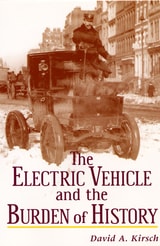
cover of The Electric Vehicle and the Burden of History

The Electric Vehicle and the Burden of History

Kirsch, David A

Rutgers University Press, 2000

In the late 1890s, at the dawn of the automobile era, steam, gasoline, and electric cars all competed to become the dominant automotive technology. By the early 1900s, the battle was over and internal combustion had won. Was the electric car ever a viable competitor? What characteristics of late nineteenth-century American society led to the choice of internal combustion over its steam and electric competitors? And might not other factors, under slightly differing initial conditions, have led to the adoption of one of the other motive powers as the technological standard for the American automobile?

David A. Kirsch examines the relationship of technology, society, and environment to choice, policy, and outcome in the history of American transportation. He takes the history of the Electric Vehicle Company as a starting point for a vision of an “alternative” automotive system in which gasoline and electric vehicles would have each been used to supply different kinds of transport services. Kirsch examines both the support—and lack thereof—for electric vehicles by the electric utility industry. Turning to the history of the electric truck, he explores the demise of the idea that different forms of transportation technology might coexist, each in its own distinct sphere of service.

A main argument throughout Kirsch’s book is that technological superiority cannot be determined devoid of social context. In the case of the automobile, technological superiority ultimately was located in the hearts and minds of engineers, consumers and drivers; it was not programmed inexorably into the chemical bonds of a gallon of refined petroleum. Finally, Kirsch connects the historic choice of internal combustion over electricity to current debates about the social and environmental impacts of the automobile, the introduction of new hybrid vehicles, and the continuing evolution of the American transportation system.
[more]
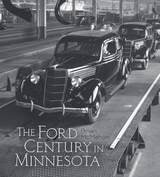
cover of The Ford Century in Minnesota

The Ford Century in Minnesota

Brian McMahon

University of Minnesota Press, 2016

In 1903, before the Ford Motor Company was even incorporated, Stephen Tenvoorde signed a contract to sell “Fordmobiles” at his bicycle shop in St. Cloud, Minnesota. Four generations later, the Tenvoorde family still operates what is now the oldest Ford dealership in the world. Brian McMahon chronicles how the fortunes of the company and the state became intertwined during that century.  

Ford assembled Model T cars in the world’s tallest automobile plant in Minneapolis and a three-story structure in St. Paul—both still standing. These factories quickly became functionally obsolete after the development of the moveable assembly line. The hunt for a new site to build a modern, single-story plant stirred intense rivalry between Minneapolis and St. Paul. Henry Ford took a rare personal interest in the search and selected a 125-acre parcel in St. Paul overlooking the recently built High Dam on the Mississippi River, which allowed for navigation and hydroelectric power. The Twin Cities Assembly Plant would go on to manufacture millions of cars, trucks, tractors, and military vehicles until its closure in 2011. 

Henry Ford’s large-scale experiments with every aspect of the industrial economy sent ripples and shockwaves through the lives of Minnesotans—management and assembly line workers, dealers and customers, families and communities. First-person accounts of more than forty retired auto workers share what it was like to work at Ford—from the early years of the Minneapolis plant to the final hours of the Twin Cities Assembly Plant in St. Paul. McMahon documents the company’s transformation—through the Depression, the rise of the United Auto Workers Union, World War II, women joining the workforce, competition from imported cars, globalization, outsourcing, and the closing of the plant. 

This publication was made possible in part by the people of Minnesota through a grant funded by an appropriation to the Minnesota Historical Society from the Minnesota Arts and Cultural Heritage Fund. Any views, findings, opinions, conclusions or recommendations expressed in this publication are those of the authors and do not necessarily represent those of the State of Minnesota, the Minnesota Historical Society, or the Minnesota Historic Resources Advisory Committee. 
[more]
cover of The Japanese Automotive Industry: Model and Challenge for the Future?

The Japanese Automotive Industry

Model and Challenge for the Future?

Robert E. Cole, Editor

University of Michigan Press, 1981
As the University of Michigan Center for Japanese Studies reflected on the deteriorating position of the domestic auto industry in the fall of 1980, and the strong competitive threat being posed by the Japanese automakers, we were struck by the extraordinary low quality of the public discussion of these critical issues. The national importance of the issues seemed only matched by the superficiality of the analyses being offered. The tendency to think in terms of scapegoats was particularly evident. The Japanese as the basic cause of our problems has been a particularly notable theme. To be sure, cooperation with the Japanese in formulating a rational overall trade policy may be an important part of the solution. It has also been fashionable to blame it all on American auto industry management for not concentrating on the production of small cars when "everyone knew" that was the thing to do. Alternatively, government meddling was blamed for all our problems. Clearly, the complex problem we faced required more penetrating analyses. It seemed therefore, that the time was ripe for a public seminar which moved beyond the rhetoric of the moment and probed some of the deeper causes of our problems and possible directions for future policy.
In holding the January 1981 auto conference, the Center took it as their task to begin addressing the critical issues facing the industry, with particular, but not exclusive, attention to examining the role of the Japanese auto industry. They had in mind not to simply conduct a rational discussion of the trade issue but to probe the sources of Japanese competitive strength, especially those features whose study might profit them.
In these proceedings, they bring those discussions to a wider audience. Question and answer sessions at the conference were necessarily short and a few speakers delivered abbreviated remarks; this volume restores a number of omissions, and provides additional answers to some pertinent questions put by the audience. The Center hopes to encourage the serious problem-solving these complex issues demand. Far too much time has been spent trying to fix the blame. [intro]
[more]
cover of Vehicle of Influence: Building a European Car Market

Vehicle of Influence

Building a European Car Market

Roland Stephen

University of Michigan Press, 2000
This study examines a crucial period in European integration, ending in the early 1990s, when significant progress was made towards the dream of a unified European market. It shows how European automakers were part of these changes and how their influence within the institutions of the European Union (EU) yielded a wide range of policy compromises governing a single European car market.
The book begins by reviewing the history of the EU and the logic of regional free trade, and goes on to develop a political explanation for the kinds of changes that actually occurred. The author argues that European automakers enjoyed a privileged place in the political arena, albeit one much transformed by the new institutions of the EU. Therefore, these firms often significantly influenced regional policy outcomes. The argument is applied to policymaking in the important areas of environmental regulation, trade, subsidies, and anti-trust regulation.
This work lies at the intersection of business, economics, and political science and is of interest to both experts and non-specialists with an interest in the tremendous economic and political changes brought about by the creation of a united Europe and, more generally, by the worldwide process of regional economic integration. Academics, professionals, businessmen, and leaders in government all have something to learn from the way in which firms and governments combined to build the largest car market in the world.
Roland Stephen is Assistant Professor in the Department of Political Science, North Carolina State University.
[more]
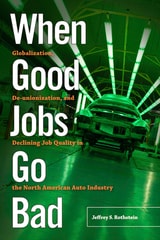
cover of When Good Jobs Go Bad: Globalization, De-unionization, and Declining Job Quality in the North American Auto Industry

When Good Jobs Go Bad

Globalization, De-unionization, and Declining Job Quality in the North American Auto Industry

Rothstein, Jeffrey S

Rutgers University Press, 2016

From Chinese factories making cheap toys for export, to sweatshops in Bangladesh where name-brand garments are sewn—studies on the impact of globalization on workers have tended to focus on the worst jobs and the worst conditions. But in When Good Jobs Go Bad, Jeffrey Rothstein looks at the impact of globalization on a major industry—the North American auto industry—to reveal that globalization has had a deleterious effect on even the most valued of blue-collar jobs.
 
Rothstein argues that the consolidation of the Mexican and U.S.-Canadian auto industries, the expanding number of foreign automakers in North America, and the spread of lean production have all undermined organized labor and harmed workers. Focusing on three General Motors plants assembling SUVs—an older plant in Janesville, Wisconsin; a newer and more viable plant in Arlington, Texas; and a “greenfield site” (a brand-new, state-of-the-art facility) in Silao, Mexico—When Good Jobs Go Bad shows how global competition has made nonstop, monotonous, standardized routines crucial for the survival of a plant, and it explains why workers and their local unions struggle to resist. For instance, in the United States, General Motors forced workers to accept intensified labor by threatening to close plants, which led local unions to adopt “keep the plant open” as their main goal. At its new factory in Silao, GM had hand-picked the union—one opposed to strikes and committed to labor-management cooperation—before it hired the first worker. 
 
Rothstein’s engaging comparative analysis, which incorporates the viewpoints of workers, union officials, and management, sheds new light on labor’s loss of bargaining power in recent decades, and highlights the negative impact of globalization on all jobs, both good and bad, from the sweatshop to the assembly line.
 
[more]
cover of Wrecked: How the American Automobile Industry Destroyed Its Capacity to Compete

Wrecked

How the American Automobile Industry Destroyed Its Capacity to Compete

Joshua Murray

Russell Sage Foundation, 2019

At its peak in the 1950s and 1960s, automobile manufacturing was the largest, most profitable industry in the United States and residents of industry hubs like Detroit and Flint, Michigan had some of the highest incomes in the country. Over the last half-century, the industry has declined, and American automakers now struggle to stay profitable. How did the most prosperous industry in the richest country in the world crash and burn? In Wrecked, sociologists Joshua Murray and Michael Schwartz offer an unprecedented historical-sociological analysis of the downfall of the auto industry. Through an in-depth examination of labor relations and the production processes of automakers in the U.S. and Japan both before and after World War II, they demonstrate that the decline of the American manufacturers was the unintended consequence of their attempts to weaken the bargaining power of their unions.
 
Today Japanese and many European automakers produce higher quality cars at lower cost than their American counterparts thanks to a flexible form of production characterized by long-term sole suppliers, assembly and supply plants located near each other, and just-in-time delivery of raw materials. While this style of production was, in fact, pioneered in the U.S. prior to World War II, in the years after the war, American automakers deliberately dismantled this system. As Murray and Schwartz show, flexible production accelerated innovation but also facilitated workers’ efforts to unionize plants and carry out work stoppages. To reduce the efficacy of strikes and combat the labor militancy that flourished between the Depression and the postwar period, the industry dispersed production across the nation, began maintaining large stockpiles of inventory, and eliminated single sourcing. While this restructuring of production did ultimately reduce workers’ leverage, it also decreased production efficiency and innovation. The U.S. auto industry has struggled ever since to compete with foreign automakers, and formerly thriving motor cities have suffered the consequences of mass deindustrialization.
 
Murray and Schwartz argue that new business models that reinstate flexible production and prioritize innovation rather than cheap labor could stem the outsourcing of jobs and help revive the auto industry. By clarifying the historical relationships between production processes, organized labor, and industrial innovation, Wrecked provides new insights into the inner workings and decline of the U.S. auto industry.
 
[more]