Results by title
7 books match the query 'Babylonia'
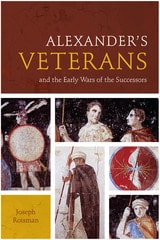
Alexander’s Veterans and the Early Wars of the Successors
By Joseph Roisman
University of Texas Press, 2012
This first focused analysis of veterans’ experiences in ancient Greece offers a fresh, “bottom-up” perspective on important military and political aspects of early Hellenistic history.
Runner-up, PROSE Award, Classics and Ancient History, 2013
From antiquity until now, most writers who have chronicled the events following the death of Alexander the Great have viewed this history through the careers, ambitions, and perspectives of Alexander’s elite successors. Few historians have probed the experiences and attitudes of the ordinary soldiers who followed Alexander on his campaigns and who were divided among his successors as they fought for control of his empire after his death. Yet the veterans played an important role in helping to shape the character and contours of the Hellenistic world.
This pathfinding book offers the first in-depth investigation of the Macedonian veterans’ experience during a crucial turning point in Greek history (323–316 BCE). Joseph Roisman discusses the military, social, and political circumstances that shaped the history of Alexander’s veterans, giving special attention to issues such as the soldiers’ conduct on and off the battlefield, the army assemblies, the volatile relationship between the troops and their generals, and other related themes, all from the perspective of the rank-and-file. Roisman also reexamines the biases of the ancient sources and how they affected ancient and modern depictions of Alexander’s veterans, as well as Alexander’s conflicts with his army, the veterans’ motives and goals, and their political contributions to Hellenistic history. He pays special attention to the Silver Shields, a group of Macedonian veterans famous for their invincibility and martial prowess, and assesses whether or not they deserved their formidable reputation.
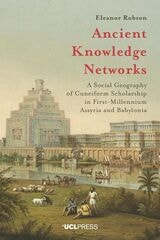
Ancient Knowledge Networks
A Social Geography of Cuneiform Scholarship in First-Millennium Assyria and BabyloniaEleanor Robson
University College London, 2019
Berossos and Manetho, Introduced and Translated
Native Traditions in Ancient Mesopotamia and EgyptGerald P. Verbrugghe and John M. Wickersham
University of Michigan Press, 2001
Berossos and Manetho offers particular emphasis on and discussion of the languages and scripts used to preserve the glorious past of these lands. Each author receives his own special introduction, which describes his life, the sources of his History, the nature and content of his writings, and his goals and accomplishments. There follows a translation of all the surviving ancient information about each author, and of all that can be recovered of his writings. For the first time, Berossos and Manetho--priests and contemporaries who write just when their lands had been pushed into Hellenization--have been translated in one volume.
This volume will appeal to all people interested in ancient Israel, Greek history, and ancient history in general.
Gerald P. Verbrugghe is Associate Professor of History, Rutgers University. John M. Wickersham is Professor of Classics and Classics Department Chairperson, Ursinus College.
Clio's Other Sons
Berossus and ManethoJohn Dillery
University of Michigan Press, 2015
Mesopotamia
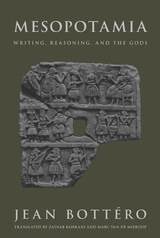
Writing, Reasoning, and the GodsJean Bottéro
University of Chicago Press, 1995
To give the reader some sense of how Mesopotamian civilization has been mediated and interpreted in its transmission through time, Bottero begins with an account of Assyriology, the discipline devoted to the ancient culture. This transmission, compounded with countless discoveries, would not have been possible without the surprising decipherment of the cuneiform writing system. Bottero also focuses on divination in the ancient world, contending that certain modes of worship in Mesopotamia, in their application of causality and proof, prefigure the "scientific mind."
Neo-Babylonian Trial Records
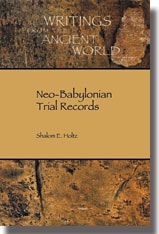
Shalom E. Holtz
SBL Press, 2014
New translations of fifty transliterated texts for research and classroom use
This collection of sixth-century B.C.E. Mesopotamian texts provides a close-up, often dramatic, view of ancient courtroom encounters shedding light on Neo-Babylonian legal culture and daily life. In addition to the legal texts, Holtz provides an introduction to Neo-Babylonian social history, archival records, and legal materials. This is an essential resource for scholars interested in the history of law.
Features
- Fifty new English translations
- Transliterations for use in advanced Akkadian courses
- Background essays perfect for courses dealing with ancient Near Eastern history and law
- Explanatory essays preceding each text and its translation
Who Were the Babylonians?
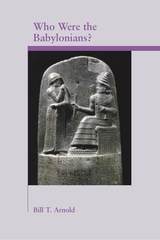
Bill T. Arnold
SBL Press, 2004