Results by title
16 books match the query 'Bakhtin, M. M. (Mikhail Mikhaĭlovich)'

A Dialogue of Voices
Feminist Literary Theory and BakhtinKaren Hohne and Helen Wussow, Editors
University of Minnesota Press, 1994
A Dialogue of Voices was first published in 1994. Minnesota Archive Editions uses digital technology to make long-unavailable books once again accessible, and are published unaltered from the original University of Minnesota Press editions.
The work of the Russian theorist Mikhail Bakhtin, particularly his notions of dialogics and genre, has had a substantial impact on contemporary critical practices. Until now, however, little attention has been paid to the possibilities and challenges Bakhtin presents to feminist theory, the task taken up in A Dialogue of Voices. The original essays in this book combine feminism and Bakhtin in unique ways and, by interpreting texts through these two lenses, arrive at new theoretical approaches. Together, these essays point to a new direction for feminist theory that originates in Bakhtin-one that would lead to a feminine être rather than a feminine écriture.
Focusing on feminist theorists such as Hélène Cixous, Teresa de Lauretis, Julia Kristeva, and Monique Wittig in conjunction with Bakhtin's concepts of dialogism, heteroglossia, and chronotope, the authors offer close readings of texts from a wide range of multicultural genres, including nature writing, sermon composition, nineteenth-century British women's fiction, the contemporary romance novel, Irish and French lyric poetry, and Latin American film. The result is a unique dialogue in which authors of both sexes, from several countries and different eras, speak against, for, and with one another in ways that reveal their works anew as well as the critical matrices surrounding them.Karen Hohne is an independent scholar and artist living in Moorhead, Minnesota. Helen Wussow is an assistant professor of English at Memphis State University.
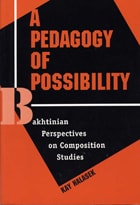
A Pedagogy of Possibility
Bakhtinian Perspectives on Composition StudiesKay Halasek
Southern Illinois University Press, 1999
In a book that itself exemplifies the dialogic scholarship it proposes, Kay Halasek reconceives composition studies from a Bakhtinian perspective, focusing on both the discipline's theoretical assumptions and its pedagogies.
Framing her discussions at every level of the discipline—theoretical, historical, pedagogical—Halasek provides an overview of portions of the Bakhtinian canon relevant to composition studies, explores the implications of Mikhail Bakhtin's work in the teaching of writing and for current debates about the role of theory in composition studies, and provides a model of scholarship that strives to maintain dialogic balance between practice and theory, between composition studies and Bakhtinian thought.
Halasek's study ranges broadly across the field of composition, painting in wide strokes a new picture of the discipline, focusing on the finer details of the rhetorical situation, and teasing out the implications of Bakhtinian thought for classroom practice by examining the nature of critical reading and writing, the efficacy and ethics of academic discourse, student resistance, and critical and conflict pedagogy. The book ends by setting out a pedagogy of possibility, what Halasek terms elsewhere a "post-critical pedagogy" that redefines and redirects current discussions of home versus academic literacies and discourses.
Bakhtin and Religion
A Feeling for FaithSusan M. Felch and Paul J. Contino
Northwestern University Press, 2001
These essays provide an overview of Bakhtin's attitude toward religion in general and Russian Orthodoxy in particular, addressing topics ranging from how Bakhtin's religious ideas informed his linguistic and aesthetic theories to the idea of love in his secular and religious thought and to the religious component of Bakhtin's theory of laughter.
Bakhtin and the Classics
R. Bracht Branham
Northwestern University Press, 2001
The authors, eminent classicists and distinguished critics of Bakhtin, put Bakhtin into dialogue with the classics--and classicists into dialogue with Bakhtin. Each essay offers a critical account of an important aspect of Bakhtin's thought and examines the value of his approach in the context of literary or cultural history. Beginning with an overview of Bakhtin's notion of carnival laughter, perhaps his central critical concept, the volume explores Bakhtin's thought and writing in relation to Homer's epic verse. Catullus's lyric poetry, ancient Roman novels, and Greek philosophy from Aristotle's theory of narrative to the work of Antiphon the Sophist. The results are of interest and importance to Bakhtinians, theorists, and classicists.
Bakhtin in Contexts
Across the DisciplinesAmy Mandelker
Northwestern University Press, 1995
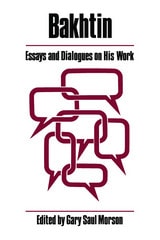
Bakhtin
Essays and Dialogues on His WorkEdited by Gary Saul Morson
University of Chicago Press, 1986
A groundbreaking collection of essays on the influential critic and philosopher
Mikhail Bakhtin (1895-1975) was a Russian philosopher and literary critic whose influence on a wide range of intellectual fields has only grown since his death, with his emphasis on dialogue and suspicion of systems having particularly resonance in literary studies and linguistics. This collection of essays, all originally published in the the journal Critical Inquiry, explores his literary and linguistic theory and its implications for theory in general and critical practice.
In addition to the critical essays, this book includes previously untranslated excerpts from Bakhtin's essays and notebooks.
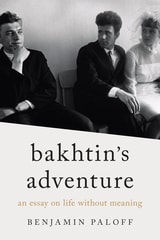
Bakhtin’s Adventure
An Essay on Life without MeaningBenjamin Paloff
Northwestern University Press, 2025
A century after Mikhail Bakhtin first began formulating his now-canonical reflections on freedom and literary representation, we often seem as confused as ever about the relationship between narrative form and what it means to live ethically. Focusing on the throughline of adventure in Bakhtin’s thought, we find a peculiar, yet no less ethically urgent challenge: not to imagine the literary hero as if they were a real person but to recognize how we are always imagining real people as if they were literary characters. This is a provocation with far-reaching consequences for how we understand ourselves, each other, and our situatedness in space and time.
In Bakhtin’s Adventure: An Essay on Life without Meaning, Benjamin Paloff argues that the major aesthetic, ethical, and sociological threads of Bakhtin’s thought intersect in his concept of adventure. Reading across a wide variety of media, from classic literature to contemporary film, Paloff demonstrates how, for Bakhtin and his interlocutors, the test of human freedom is whether narrative means nothing beyond its own adventure. Reframed in this light, Bakhtin’s most influential ideas (eventness, chronotope, heteroglossia, polyphony, carnival) form a cohesive model for how to maintain ethical relations in a world where we can never really know each other the way we know ourselves.
Corporeal Words
Mikhail Bakhtins Theology DiscourseAlexandar Mihailovic
Northwestern University Press, 1997
Dialogue at the Margins
Whorf, Bakhtin, and Linguistic RelativityEmily A. Schultz
University of Wisconsin Press, 1990
The “linguistic relativity principle” of pioneering American linguist Benjamin Whorf has been a focus of controversy among scholars of language for half a century. Many claim that this principle amounts to Whorf’s assertion that language determines thought and culture, while others vigorously reject such a claim. Emily Schultz rereads Whorf in terms of Russian theorist Mikhail Bakhtin, and argues that the Whorfian controversy is rooted in the polyphonic character of his best known texts. By combining Whorfian and Bakhtinian insights concerning variation within and across languages, Schultz offers a new dialogic interpretation of linguistic relativity that has profound implications for students and scholars of anthropology, linguistics, cognitive psychology, philosophy of language, and literary and art criticism.
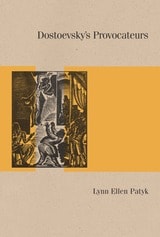
Dostoevsky’s Provocateurs
Lynn Ellen Patyk
Northwestern University Press, 2023
Confronting Bakhtin’s formative reading of Dostoevsky to recover the ways the novelist stokes conflict and engages readers—and to explore the reasons behind his adversarial approach
Like so many other elements of his work, Fyodor Dostoevsky’s deliberate deployment of provocation was both prescient and precocious. In this book, Lynn Ellen Patyk singles out these forms of incitement as a communicative strategy that drives his paradoxical art. Challenging, revising, and expanding on Mikhail Bakhtin’s foundational analysis in Problems of Dostoevsky’s Poetics, Patyk demonstrates that provocation is the moving mover of Dostoevsky’s poetics of conflict, and she identifies the literary devices he uses to propel plot conflict and capture our attention. Yet the full scope of Dostoevsky’s provocative authorial activity can only be grasped alongside an understanding of his key themes, which both probed and exploited the most divisive conflicts of his era. The ultimate stakes of such friction are, for him, nothing less than moral responsibility and the truth of identity.
Sober and strikingly original, compassionate but not uncritical, Dostoevsky’s Provocateurs exposes the charged current in the wiring of our modern selves. In an economy of attention and its spoils, provocation is an inexhaustibly renewable and often toxic resource.
Joyce, Bakhtin, and the Literary Tradition
Toward a Comparative Cultural PoeticsM. Keith Booker
University of Michigan Press, 1997
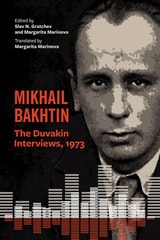
Mikhail Bakhtin
The Duvakin Interviews, 1973Slav N Gratchev
Bucknell University Press, 2019
Published by Bucknell University Press. Distributed worldwide by Rutgers University Press.
Saying And Silence
Frank Farmer
Utah State University Press, 2001
Frank Farmer has contributed important essays to the study of Bakhtin in composition, and in Saying and Silence he gathers some of those, along with several new essays, into a single volume. Scholars who specialize in Bakhtin will find this work engaging, but equally Farmer wants to explicate and apply Bakhtin for readers whose focus is teaching or some other nonspecialist dimension of writing scholarship.
Farmer explores the relationship between the meaningful word and the meaningful pause, between saying and silence, especially as the relationship emerges in our classrooms, our disciplinary conversations, and encounters with publics beyond the academy. Each of his chapters here addresses some aspect of how we and our students, colleagues, and critics have our say and speak our piece, often under conditions where silence is the institutionally sanctioned and preferred alternative. He has enlisted a number of Bakhtinian ideas (the superaddressee, outsideness, voice in dialogue) to help in the project of interpreting the silences we hear, naming the silences we do not hear, and of encouraging all silences to speak in ways that are freely chosen, not enforced.
Testimony after Catastrophe
Narrating the Traumas of Political ViolenceStevan Weine
Northwestern University Press, 2006
A deeply involving, compassionate, occasionally confrontational blend of practical hands-on experience and dialogic theory, emerging from the author's decade-long work in Europe and Chicago with survivors of the Balkan wars, this book is committed to the proposition that efforts to use testimony to address the consequences of political violence can be strengthened--though by no means guaranteed--if they are based on a fuller acknowledgment of the personal and ethical elements embodied in the narrative essence of testimony. These elements are what Testimony after Catastrophe seeks to reveal.

The Bakhtin Circle
Philosophy, Culture and PoliticsCraig Brandist
Pluto Press, 2002
This is the first book to bring together this significant new research on the Circle, setting it within a historical and intellectual context and emphasising the importance of the work of the Circle as a whole. Craig Brandist offers a new look at the significance of Bakhtin's legacy, and brings into clearer focus the contribution of others in the circle--including Voloshinov, Medvedev, Pumpianskii and Kagan--whose work has so often been obscured, assessing the fundamental role they played in shaping Bakhtinian thought.
The Gift of Active Empathy
Scheler, Bakhtin, and DostoevskyAlina Wyman
Northwestern University Press, 2016