Results by title
9 books match the query 'Ballad'
BALLAD OF TRENCHMOUTHT TAGGART
M. GLENN TAYLOR
West Virginia University Press, 2008
Ballad of Another Time
A NovelJose Luis Gonzalez; Translated by Asa Zatz
University of Wisconsin Press, 2004
Ballad of Baby Doe
"I Shall Walk Beside My Love"Duane A. Smith
University Press of Colorado, 2002
Inspired in 1953 by composer Douglas Moore's interest in Horace Tabor's story and funded by the Central City Opera House Association, the opera came together through a unique combination of hard work and serendipity. Smith relates how key people - including investors and historians in addition to creative talent - turned Moore's idea into a reality and brought the story of the Tabors to millions of opera fans worldwide. In addition, Smith compares the opera's libretto with historical reality, and the book even includes a chapter on the production written by John Moriarty, who conducted the opera in 1981, 1988, and 1996.
For anyone interested in opera history or this Colorado story in particular - the emblematic tale of silver millionaire Horace Tabor and the two women he married - The Ballad of Baby Doe will be the definitive history for years to come.

Ballad of Descent
Martin Vopenka
Northwestern University Press, 1995
Ballad of an American
A Graphic Biography of Paul RobesonSharon Rudahl
Rutgers University Press, 2021
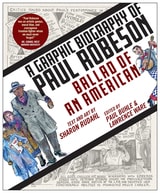
The first-ever graphic biography of Paul Robeson, Ballad of an American, charts Robeson’s career as a singer, actor, scholar, athlete, and activist who achieved global fame. Through his films, concerts, and records, he became a potent symbol representing the promise of a multicultural, multiracial American democracy at a time when, despite his stardom, he was denied personal access to his many audiences.
Robeson was a major figure in the rise of anti-colonialism in Africa and elsewhere, and a tireless campaigner for internationalism, peace, and human rights. Later in life, he embraced the civil rights and antiwar movements with the hope that new generations would attain his ideals of a peaceful and abundant world. Ballad of an American features beautifully drawn chapters by artist Sharon Rudahl, a compelling narrative about his life, and an afterword on the lasting impact of Robeson’s work in both the arts and politics. This graphic biography will enable all kinds of readers—especially newer generations who may be unfamiliar with him—to understand his life’s story and everlasting global significance.
Ballad of an American: A Graphic Biography of Paul Robeson is published in conjunction with Rutgers University’s centennial commemoration of Robeson’s 1919 graduation from the university.
Study guide for Ballad of an American: A Graphic Biography of Paul Robeson (https://d3tto5i5w9ogdd.cloudfront.net/wp-content/uploads/2021/05/10201015/YA_Adult-Study-Guide-for-A-Graphic-Biography-of-Paul-Robeson.pdf).
View the blad for Ballad of an American.
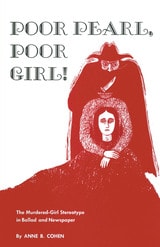
Poor Pearl, Poor Girl!
The Murdered-Girl Stereotype in Ballad and NewspaperBy Anne B. Cohen
University of Texas Press, 1973
The year was 1896, and nineteenth-century journalists called the murder of Pearl Bryan the "Crime of the Century." From the day Pearl's headless body was found to the execution of her murderers on the gallows, the details of the murder fascinated newspaper reporters and ballad composers alike.
Often glossing over the facts of the case, newspaper accounts presented the events according to stereotypes that were remarkably similar to those found in well-known murdered-girl ballads, such as "Pretty Polly," "Omie Wise," and "The Jealous Lover." Events, characters, motivations, and plot were presented through this framework: the simple country girl led astray by a clever degenerate. Nearly all variants of the Pearl Bryan ballad point the same moral:
Young ladies now take warning
Young men are so unjust,
It may be your best lover
But you know not whom to trust.
Representations of this formula appear in such diverse genres as the ballad "Poor Ellen Smith" and the novel An American Tragedy.
As Anne Cohen demonstrates, both newspaper accounts and ballads tell the Pearl Bryan story from the same moral stance, express the same interpretation of character, and are interested in the same details. Both distort facts to accommodate a shared pattern of storytelling. This pattern consists of a plot formula—the murdered-girl formula—that is accompanied by stereotyped scenes, actors, and phrases. The headless body—surely the most striking element in the Pearl Bryan case—is absent from those ballads that have survived. Anne Cohen contends that a decapitated heroine does not belong to the formula—a murdered heroine, yes, but not a decapitated one. Similarly, newspapers made much of Pearl's "innocence" and tended to downplay the second murderer. Only one murderer, the lover, belongs to the stereotype.
Poor Pearl, Poor Girl! is a ballad study conducted on historic- geographic lines; that is, it seeks to trace the history and interrelations of a series of ballad texts and to relate the ballads directly to their ideological and historical context in the American scene. It also compares the narrative techniques of ballad composition with the techniques of other forms of popular narrative, especially newspaper journalism.
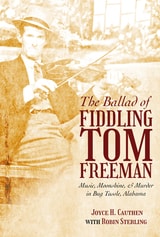
The Ballad of Fiddling Tom Freeman
Music, Moonshine, and Murder in Bug Tussle, AlabamaJoyce H. Cauthen with Robin Sterling
University of Alabama Press, 2026
A raw, firsthand account of feuds, fiddling, moonshining, and survival in a small Alabama town, told by its most colorful chronicler and shaped through careful historical insight.
The Ballad of Fiddling Tom Freeman is a riveting portrait of a forgotten America, drawn from the handwritten memoirs of a bootlegger, fiddler, and chronicler of life in Bug Tussle, Alabama, in the first half of the twentieth century. Today, rural voices are often drowned out by polished narratives, but this book resurrects the unfiltered perspective of a man who lived through—and candidly documented—the chaos and violence in his home place as he shared stories of the large close-knit families who lived there.
Freeman’s storytelling is as wild and tangled as the lives he describes, and author Joyce H. Cauthen, with the assistance of historical researcher Robin Sterling, brings clarity and context to his tales without sanding down their rough edges. The result is a vivid, bottom-up history of a place where lawlessness and loyalty often walked hand in hand.
The Ballad of Fiddling Tom Freeman stands out as a testament to the power of personal narrative. Not just a story about one man, it’s a window into a community shaped by hardship, music, and survival, told in a voice that refuses to be forgotten. This book is essential reading for historians, folklorists, musicians, and anyone drawn to the untamed stories of America’s backroads and backwoods.
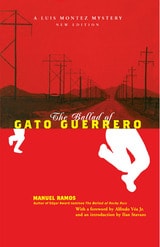
The Ballad of Gato Guerrero
Manuel Ramos
Northwestern University Press, 2003
The answer: his friend, Felix "Gato" Guerrero.
Trouble has always followed the larger-than-life Felix the Cat. Now it has jumped all over him. His girlfriend is the wife of a ruthless local crime lord and in spite of bullets and hit men he won't give her up. His former father-in-law blames him for a family tragedy and is bent on revenge. Worst of all, Felix is determined to remain unaware of the dangers. It's up to Montez-and not for the first time-to step in and save him.
As in his Edgar-nominated The Ballad of Rocky Ruiz, Manuel Ramos immerses readers not only in a thrilling mystery but also in the fascinating Chicano culture of the West. Fast-paced and richly textured, The Ballad of Gato Guerrero is an entertaining addition to the acclaimed Luis Montez mystery series.
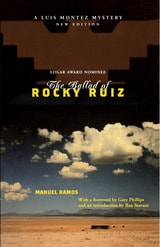
The Ballad of Rocky Ruiz
Manuel Ramos
Northwestern University Press, 2003
Twenty years ago, a gang attacked four Chicano student activists and shot down their leader, Rocky Ruiz. Now the survivors, Montez's former compatriots in the movement, are in danger. One is killed, another beaten, and a third driven into hiding. Enter Teresa Fuentes, a beautiful young lawyer determined to solve the mystery and just as determined to avoid becoming involved with Montez. To save his friends, Montez must reexamine the central event of their shared past-the murder of Rocky Ruiz. Just as difficult, he finds, may be to untangle his feelings for Teresa Fuentes.