Results by title
10 books match the query 'Ballads, English'

"The Whorehouse Bells Were Ringing" and Other Songs Cowboys Sing
Collected and edited by Guy Logsdon
University of Illinois Press, 1995
Winner of the Westerners International Co-Founders Awards of the Western History Association, 1990.
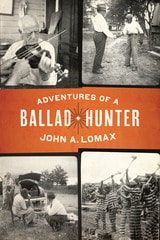
Adventures of a Ballad Hunter
By John A. Lomax, foreword by John Lomax III, John Nova Lomax, and Anna Lomax Wood
University of Texas Press, 2017
Growing up beside the Chisholm Trail, captivated by the songs of passing cowboys and his bosom friend, an African American farmhand, John A. Lomax developed a passion for American folk songs that ultimately made him one of the foremost authorities on this fundamental aspect of Americana. Across many decades and throughout the country, Lomax and his informants created over five thousand recordings of America’s musical heritage, including ballads, blues, children’s songs, fiddle tunes, field hollers, lullabies, play-party songs, religious dramas, spirituals, and work songs. He acted as honorary curator of the Archive of American Folk Song at the Library of Congress, directed the Slave Narrative Project of the WPA, and cofounded the Texas Folklore Society. Lomax’s books include Cowboy Songs and Other Frontier Ballads, American Ballads and Folk Songs, Negro Folk Songs as Sung by Leadbelly, and Our Singing Country, the last three coauthored with his son Alan Lomax.
Adventures of a Ballad Hunter is a memoir of Lomax’s eventful life. It recalls his early years and the fruitful decades he spent on the road collecting folk songs, on his own and later with son Alan and second wife Ruby Terrill Lomax. Vibrant, amusing, often haunting stories of the people he met and recorded are the gems of this book, which also gives lyrics for dozens of songs. Adventures of a Ballad Hunter illuminates vital traditions in American popular culture and the labor that has gone into their preservation.
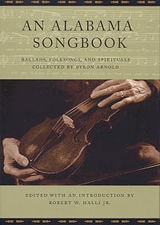
An Alabama Songbook
Ballads, Folksongs, and Spirituals Collected by Byron ArnoldRobert W. Halli Jr.
University of Alabama Press, 2004
Alabama is a state rich in folksong tradition, from old English ballads sung along the Tennessee River to children’s game songs played in Mobile, from the rhythmic work songs of the railroad gandy dancers of Gadsden to the spirituals of the Black Belt. The musical heritage of blacks and whites, rich and poor, hill folk and cotton farmers, these songs endure as a living part of the state’s varied past.
In the mid 1940s Byron Arnold, an eager young music professor from The University of Alabama, set out to find and record as many of these songs as he could and was rewarded by unstinting cooperation from many informants. Mrs. Julia Greer Marechal of Mobile, for example, was 90 years old, blind, and a semi-invalid, but she sang for Arnold for three hours, allowing the recording of 33 songs and exhausting Arnold and his technician. Helped by such living repositories as Mrs. Marechal, the Arnold collection grew to well over 500 songs, augmented by field notes and remarkable biographical information on the singers.
An Alabama Songbook is the result of Arnold’s efforts and those of his informants across the state and has been shaped by Robert W. Halli Jr. into a narrative enriched by more than 200 significant songs-lullabies, Civil War anthems, African-American gospel and secular songs, fiddle tunes, temperance songs, love ballads, play-party rhymes, and work songs. In the tradition of Alan Lomax’s The Folk Songs of North America and Vance Randolph’s Ozark Folksongs, this volume will appeal to general audiences, folklorists, ethnomusicologists, preservationists, traditional musicians, and historians.
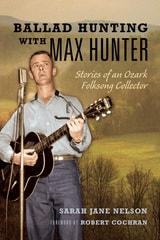
Ballad Hunting with Max Hunter
Stories of an Ozark Folksong CollectorSarah Jane Nelson; Foreword by Robert Cochran
University of Illinois Press, 2023
Sarah Jane Nelson chronicles Hunter’s song collecting adventures alongside portraits of the singers and mentors he met along the way. The guitar-strumming Hunter picked up the recording habit to expand his repertoire but almost immediately embraced the role of song preservationist. Being a local allowed Hunter to merge his native Ozark earthiness with sharp observational skills to connect--often more than once--with his singers. Hunter’s own ability to be present added to that sense of connection. Despite his painstaking approach, ballad collecting was also a source of pleasure for Hunter. Ultimately, his dedication to capturing Ozarks song culture in its natural state brought Hunter into contact with people like Vance Randolph, Mary Parler, and non-academic folklorists who shared his values.
Folk-Songs of the South
Collected Under the Auspices of the West Virginia Folk-Lore SocietyJohn Harrington Cox
West Virginia University Press, 2016
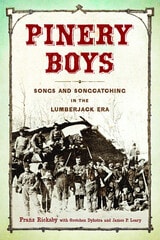
Pinery Boys
Songs and Songcatching in the Lumberjack EraEdited by Franz Rickaby with Gretchen Dykstra and James P. Leary
University of Wisconsin Press, 2017
Pinery Boys now incorporates, commemorates, contextualizes, and complements Rickaby's early work. It includes an introduction and annotations throughout by eminent folklore scholar James P. Leary and an engaging, impressively researched biography by Rickaby's granddaughter Gretchen Dykstra. Central to this edition are Rickaby's own introduction and the original fifty-one songs that he published—including "Jack Haggerty's Flat River Girl," "The Little Brown Bulls," "Ole from Norway," "The Red Iron Ore," and "Morrissey and the Russian Sailor"—plus fourteen additional songs selected to represent the varied collecting Rickaby did beyond the lumber camps.
Supplemented by historical photographs, Pinery Boys fully reveals Franz Rickaby as a visionary artist and scholar and provides glimpses into the past lives of woods poets and singers.
Poor Pearl, Poor Girl!
The Murdered-Girl Stereotype in Ballad and NewspaperBy Anne B. Cohen
University of Texas Press, 1973
The year was 1896, and nineteenth-century journalists called the murder of Pearl Bryan the "Crime of the Century." From the day Pearl's headless body was found to the execution of her murderers on the gallows, the details of the murder fascinated newspaper reporters and ballad composers alike.
Often glossing over the facts of the case, newspaper accounts presented the events according to stereotypes that were remarkably similar to those found in well-known murdered-girl ballads, such as "Pretty Polly," "Omie Wise," and "The Jealous Lover." Events, characters, motivations, and plot were presented through this framework: the simple country girl led astray by a clever degenerate. Nearly all variants of the Pearl Bryan ballad point the same moral:
Young ladies now take warning
Young men are so unjust,
It may be your best lover
But you know not whom to trust.
Representations of this formula appear in such diverse genres as the ballad "Poor Ellen Smith" and the novel An American Tragedy.
As Anne Cohen demonstrates, both newspaper accounts and ballads tell the Pearl Bryan story from the same moral stance, express the same interpretation of character, and are interested in the same details. Both distort facts to accommodate a shared pattern of storytelling. This pattern consists of a plot formula—the murdered-girl formula—that is accompanied by stereotyped scenes, actors, and phrases. The headless body—surely the most striking element in the Pearl Bryan case—is absent from those ballads that have survived. Anne Cohen contends that a decapitated heroine does not belong to the formula—a murdered heroine, yes, but not a decapitated one. Similarly, newspapers made much of Pearl's "innocence" and tended to downplay the second murderer. Only one murderer, the lover, belongs to the stereotype.
Poor Pearl, Poor Girl! is a ballad study conducted on historic- geographic lines; that is, it seeks to trace the history and interrelations of a series of ballad texts and to relate the ballads directly to their ideological and historical context in the American scene. It also compares the narrative techniques of ballad composition with the techniques of other forms of popular narrative, especially newspaper journalism.
The British Traditional Ballad in North America
By Tristram P. Coffin
University of Texas Press, 1977
Tristram Potter Coffin’s The British Traditional Ballad in North America, published in 1950, became recognized as the standard reference to the published material on the Child ballad in North America. Centering on the theme of story variation, the book examines ballad variation in general, treats the development of the traditional ballad into an art form, and provides a bibliographical guide to story variation as well as a general bibliography of titles referred to in the guide.
Roger deV. Renwick’s supplement to The British Traditional Ballad in North America provides a thorough review of all sources of North American ballad materials published from 1963, the date of the last revision of the original volume, to 1977. The references, which include published text fragments and published title lists of items in archival collections, are arranged according to each ballad’s story variations. Textual and thematic comparisons among ballads in the British and American tradition are made throughout. In his introductory essay Renwick synthesizes the various theoretical approaches to the phenomenon of variation that have appeared in scholarly publications since 1963 and provides examples from texts referred to in the bibliographical guide itself.
The supplement, like its parent work, is an invaluable reference tool for the study of variation in ballad form, content, and style. Together with the reprinted text of the 1963 edition, the supplement provides an exhaustive bibliography to the literature on the British traditional ballad in North America.
Unsettled
The Culture of Mobility and the Working Poor in Early Modern EnglandPatricia Fumerton
University of Chicago Press, 2006
Migrants made up a growing class of workers in late sixteenth- and seventeenth- century England. In fact, by 1650, half of England’s rural population consisted of homeless and itinerant laborers. Unsettled is an ambitious attempt to reconstruct the everyday lives of these dispossessed people. Patricia Fumerton offers an expansive portrait of unsettledness in early modern England that includes the homeless and housed alike.
Fumerton begins by building on recent studies of vagrancy, poverty, and servants, placing all in the light of a new domestic economy of mobility. She then looks at representations of the vagrant in a variety of pamphlets and literature of the period. Since seamen were a particularly large and prominent class of mobile wage-laborers in the seventeenth century, Fumerton turns to seamen generally and to an individual poor seaman as a case study of the unsettled subject: Edward Barlow (b. 1642) provides a rare opportunity to see how the laboring poor fashioned themselves, for he authored a journal of over 225,000 words and 147 pages of drawings. Barlow’s journal, studied extensively here for the first time, vividly charts what he himself termed his “unsettled mind” and the perpetual anxieties of England’s working and wayfaring poor. Ultimately, Fumerton explores representations of seamen as unsettled in the broadside ballads of Barlow’s time.
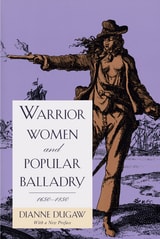
Warrior Women and Popular Balladry, 1650-1850
Dianne Dugaw
University of Chicago Press, 1995