Results by title
15 books match the query 'Baltimore (Md.)'
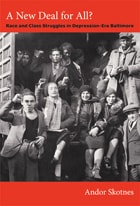
A New Deal for All?
Race and Class Struggles in Depression-Era BaltimoreAndor Skotnes
Duke University Press, 2012
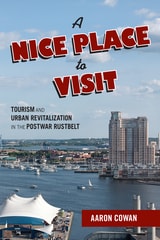
A Nice Place to Visit
Tourism and Urban Revitalization in the Postwar RustbeltAaron Cowan
Temple University Press, 2016
How did tourism gain a central role in the postwar American Rustbelt city? And how did tourism development reshape the meaning and function of these cities? These are the questions at the heart of Aaron Cowan’s groundbreaking book, A Nice Place to Visit.
Cowan provides an insightful, comparative look at the historical development of Cincinnati, St. Louis, Pittsburgh, and Baltimore in the post–World War II period to show how urban tourism provided a potential solution to the economic woes of deindustrialization. A Nice Place to Visit chronicles the visions of urban leaders who planned hotels, convention centers, stadiums, and festival marketplaces to remake these cities as tourist destinations. Cowan also addresses the ever-present tensions between tourist development and the needs and demands of residents in urban communities.
A Nice Place to Visit charts how these Rustbelt cities adapted to urban decline and struggled to meet the challenge of becoming an appealing place to visit, as well as good and just communities in which to live.
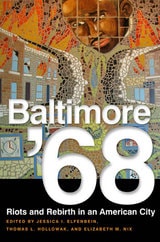
Baltimore '68
Riots and Rebirth in an American CityEdited by Jessica I. Elfenbein, Thomas L. Hollowak and Elizabeth M. Nix
Temple University Press, 2011
In 1968, Baltimore was home to a variety of ethnic, religious, and racial communities that, like those in other American cities, were confronting a quickly declining industrial base. In April of that year, disturbances broke the urban landscape along lines of race and class.
This book offers chapters on events leading up to the turmoil, the riots, and the aftermath as well as four rigorously edited and annotated oral histories of members of the Baltimore community. The combination of new scholarship and first-person accounts provides a comprehensive case study of this period of civil unrest four decades later.
This engaging, broad-based public history lays bare the diverse experiences of 1968 and their effects, emphasizing the role of specific human actions. By reflecting on the stories and analysis presented in this anthology, readers may feel empowered to pursue informed, responsible civic action of their own.
Baltimore '68 is the book component of a larger public history project, "Baltimore '68 Riots: Riots and Rebirth." The project's companion website (http://archives.ubalt.edu/bsr/index.html ) offers many more oral histories plus photos, art, and links to archival sources. The book and the website together make up an invaluable teaching resource on cities, social unrest, and racial politics in the 1960s. The project was the corecipient of the 2009 Outstanding Public History Project Award from the National Council on Public History.

Baltimore Portraits
Amos Badertscher
Duke University Press, 1999
The photographer’s focus on content rather than on elaborate technique reveals the intensely personal—and, indeed, autobiographical—nature of his portraits. Their simplicity along with the text’s intimacy affects the viewer in ways not easily forgotten. An introduction by Tyler Curtain contextualizes the photographs both within the history of Baltimore and its queer subculture and in relationship to contemporaneous work by photographers Nan Goldin, Robert Mapplethorpe, Cindy Sherman, Duane Michaels, and others. Curtain also positions the underlying concerns of Bardertscher’s art in relation to gay and lesbian cultural politics.
This striking collection of portraits, along with the photographer’s moving text, will impact not only a general audience of photographers and enthusiasts of the art but also those engaged with gay and lesbian studies, queer theory, and cultural studies in general. It is published in association with the Duke University Museum of Art.
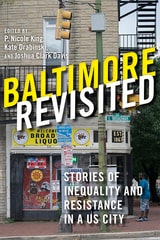
Baltimore Revisited
Stories of Inequality and Resistance in a U.S. CityEdited by P. Nicole King, Kate Drabinski, and Joshua Clark Davis
Rutgers University Press, 2019
To help untangle these apparent paradoxes, the editors of Baltimore Revisited have assembled a collection of over thirty experts from inside and outside academia. Together, they reveal that Baltimore has been ground zero for a slew of neoliberal policies, a place where inequality has increased as corporate interests have eagerly privatized public goods and services to maximize profits. But they also uncover how community members resist and reveal a long tradition of Baltimoreans who have fought for social justice.
The essays in this collection take readers on a tour through the city’s diverse neighborhoods, from the Lumbee Indian community in East Baltimore to the crusade for environmental justice in South Baltimore. Baltimore Revisited examines the city’s past, reflects upon the city’s present, and envisions the city’s future.
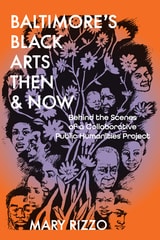
Baltimore's Black Arts Then & Now
Behind the Scenes of a Collaborative Public Humanities ProjectMary Rizzo
University of Iowa Press, 2026
Since 2017, a group of former Chicory editors, scholars, librarians, poets, teachers, and young writers have collaborated to use Chicory as a catalyst for intergenerational dialogue on social justice, race, and place. Baltimore’s Black Arts Then & Now documents this joint effort, offering valuable insights for public historians, educators, and humanists.
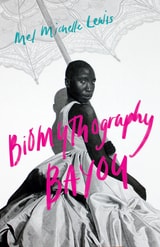
Biomythography Bayou
Mel Michelle Lewis
Bucknell University Press, 2025
Biomythography Bayou is more than just a book of memoir; it is a ritual for conjuring queer embodied knowledges and decolonial perspectives. Blending a rich gumbo of genres—from ingredients such as praise songs, folk tales, recipes, incantations, and invocations—it also includes a multimedia component, with “bayou tableau” images and audio recording links. Inspired by such writers as Audre Lorde, Zora Neale Hurston, and Octavia Butler, Mel Michelle Lewis draws from the well of her ancestors in order to chart a course toward healing Afrofutures. Showcasing the nature, folklore, dialect, foodways, music, and art of the Gulf’s coastal communities, Lewis finds poetic ways to celebrate their power and wisdom.
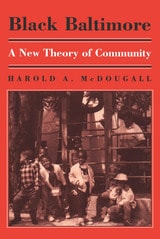
Black Baltimore
A New Theory of CommunityHarold Mcdougall
Temple University Press, 1993
Through extensive neighborhood interviews and a compelling assessment of the problems of unraveling communities in urban America, Harold McDougall reveals how, in sections of Baltimore, a "New Community" is developing. Relying more on vernacular culture, personal networking, and mutual support than on private wealth or public subsidy, the communities of black Baltimore provide an example of self-help and civic action that could and should be occurring in other inner-city areas. In this political history of Old West Baltimore, McDougall describes how "base communities"—small peer groups that share similar views, circumstances, and objectives—have helped neighborhoods respond to the failure of both government and the market to create conditions for a decent quality of life for all.
Arguing for the primacy of church leadership within the black community, the author describes how these small, flexible groups are creating the foundation of what he calls a New Community, where community-spirited organizers, clergy, public interest advocates, business people, and government workers interact and build relationships through which Baltimore's urban agenda is being developed.
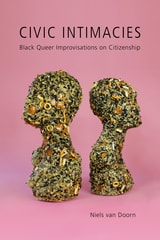
Civic Intimacies
Black Queer Improvisations on CitizenshipNiels van Doorn
Temple University Press, 2019
Black queer lives often exist outside conventional civic institutions and therefore have to explore alternative intimacies to experience a sense of belonging. Civic Intimacies examines how—and to what extent—these different forms of intimacy catalyze the values, aspirations, and collective flourishing of Black queer denizens of Baltimore. Niels van Doorn draws on 18 months of immersive ethnographic fieldwork for his innovative cross-disciplinary analysis of contemporary debates in political and cultural theory.
Van Doorn describes the way that these systematically marginalized communities improvise on citizenship not just to survive but also to thrive despite the proliferation of violence and insecurity in their lives. By reimagining citizenship as the everyday reparative work of building support structures, Civic Intimacies highlights the extent to which sex, kinship, memory, religious faith, and sexual health are rooted in collective practices that are deeply political. These systems sustain the lives of Black queer Baltimoreans who find themselves stuck in a city they cannot give up on—even though it has in many ways given up on them.
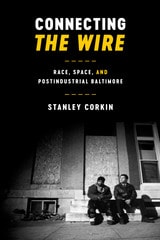
Connecting The Wire
Race, Space, and Postindustrial BaltimoreBy Stanley Corkin
University of Texas Press, 2017
Critically acclaimed as one of the best television shows ever produced, the HBO series The Wire (2002–2008) is a landmark event in television history, offering a raw and dramatically compelling vision of the teeming drug trade and the vitality of life in the abandoned spaces of the postindustrial United States. With a sprawling narrative that dramatizes the intersections of race, urban history, and the neoliberal moment, The Wire offers an intricate critique of a society riven by racism and inequality.
In Connecting The Wire, Stanley Corkin presents the first comprehensive, season-by-season analysis of the entire series. Focusing on the show’s depictions of the built environment of the city of Baltimore and the geographic dimensions of race and class, he analyzes how The Wire’s creator and showrunner, David Simon, uses the show to develop a social vision of its historical moment, as well as a device for critiquing many social “givens.” In The Wire’s gritty portrayals of drug dealers, cops, longshoremen, school officials and students, and members of the judicial system, Corkin maps a web of relationships and forces that define urban social life, and the lives of the urban underclass in particular, in the early twenty-first century. He makes a compelling case that, with its embedded history of race and race relations in the United States, The Wire is perhaps the most sustained and articulate exploration of urban life in contemporary popular culture.

Freedom's Port
The African American Community of Baltimore, 1790-1860Christopher Phillips
University of Illinois Press, 1997
He shows how it grew from a transient aggregate of individuals, many fresh from slavery, to a strong, overwhelmingly free community less wracked by class and intraracial divisions than were other cities. Almost from the start, Phillips states, Baltimore's African Americans forged their own freedom and actively defended it--in a state that maintained slavery and whose white leadership came to resent the liberties the city's black people had achieved.
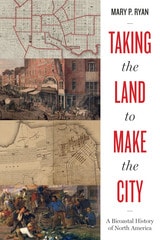
Taking the Land to Make the City
A Bicoastal History of North AmericaBy Mary P. Ryan
University of Texas Press, 2019
The history of the United States is often told as a movement westward, beginning at the Atlantic coast and following farmers across the continent. But cities played an equally important role in the country’s formation. Towns sprung up along the Pacific as well as the Atlantic, as Spaniards and Englishmen took Indian land and converted it into private property. In this reworking of early American history, Mary P. Ryan shows how cities—specifically San Francisco and Baltimore—were essential parties to the creation of the republics of the United States and Mexico.
Baltimore and San Francisco share common roots as early trading centers whose coastal locations immersed them in an international circulation of goods and ideas. Ryan traces their beginnings back to the first human habitation of each area, showing how the juggernaut toward capitalism and nation-building could not commence until Europeans had taken the land for city building. She then recounts how Mexican ayuntamientos and Anglo American city councils pioneered a prescient form of municipal sovereignty that served as both a crucible for democracy and a handmaid of capitalism. Moving into the nineteenth century, Ryan shows how the citizens of Baltimore and San Francisco molded landscape forms associated with the modern city: the gridded downtown, rudimentary streetcar suburbs, and outlying great parks. This history culminates in the era of the Civil War when the economic engines of cities helped forge the East and the West into one nation.
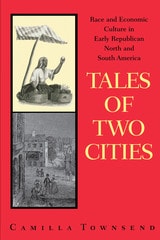
Tales of Two Cities
Race and Economic Culture in Early Republican North and South AmericaBy Camilla Townsend
University of Texas Press, 2000
With a common heritage as former colonies of Europe, why did the United States so outstrip Latin America in terms of economic development in the nineteenth century? In this innovative study, Camilla Townsend challenges the traditional view that North Americans succeeded because of better attitudes toward work—the Protestant work ethic—and argues instead that they prospered because of differences in attitudes towards workers that evolved in the colonial era.
Townsend builds her study around workers' lives in two very similar port cities in the 1820s and 1830s. Through the eyes of the young Frederick Douglass in Baltimore, Maryland, and an Indian woman named Ana Yagual in Guayaquil, Ecuador, she shows how differing attitudes towards race and class in North and South America affected local ways of doing business. This empirical research significantly clarifies the relationship between economic culture and racial identity and its long-term effects.
Teaching in the Terrordome
Two Years in West Baltimore with Teach for AmericaHeather Kirn Lanier
University of Missouri Press, 2012
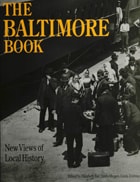
The Baltimore Book
New Views of Local HistoryLinda Shopes
Temple University Press, 1993
Baltimore has a long, colorful history that traditionally has been focused on famous men, social elites, and patriotic events. The Baltimore Book is both a history of "the other Baltimore" and a tour guide to places in the city that are important to labor, African American, and women's history. The book grew out of a popular local bus tour conducted by public historians, the People's History Tour of Baltimore, that began in 1982. This book records and adds sites to that tour; provides maps, photographs, and contemporary documents; and includes interviews with some of the uncelebrated people whose experiences as Baltimoreans reflect more about the city than Francis Scott Key ever did.
The tour begins at the B&O Railroad Station at Camden Yards, site of the railroad strike of 1877, moves on to Hampden-Woodbury, the mid-19th century cotton textile industry's company town, and stops on the way to visit Evergreen House and to hear the narratives of ex-slaves. We travel to Old West Baltimore, the late 19th-century center of commerce and culture for the African American community; Fells Point; Sparrows Point; the suburbs; Federal Hill; and Baltimore's "renaissance" at Harborplace. Interviews with community activists, civil rights workers, Catholic Workers, and labor union organizers bring color and passion to this historical tour. Specific labor struggles, class and race relations, and the contributions of women to Baltimore's development are emphasized at each stop.
In the series Critical Perspectives on the Past, edited by Susan Porter Benson, Stephen Brier, and Roy Rosenzweig.