Results by title
8 books match the query 'Banking'

Banking On It
Inside Baseball, Hardball Politics, and Building the Best Era in Phillies HistoryPaul Hagen with Kevin Cooney
Temple University Press, 2027
When Citizens Bank Park opened on April 3, 2024, it was the result of twelve years (and many false starts) of maneuvering for the venue to replace Veterans Stadium as the home to the Philadelphia Phillies. Banking On It describes the politicking that took place, from conflicts between the Phillies and the Philadelphia Eagles resulting from sharing a venue, to decisions about where to build the new ballpark, who would pay for it, and where the outfield fences would be placed.
Paul Hagen and Kevin Cooney recount the setbacks, frustrations, missteps, political machinations, and angst the team surmounted as the process played out. But Banking On It also details the benefits of all these efforts—the Phillies became a powerhouse franchise after settling into their new home. The new stadium helped the team elevate its game by generating money to attract and keep better players, including Jim Thome, Ryan Howard, and Kyle Schwarber taking advantage of groundwork laid by scouts and managers. The Phillies have had their most successful two decades in franchise history playing at Citizens Bank Park.
Banking On It celebrates the game, the team, and the stadium that helped create a championship era.
Banking on Reform
Political Parties and Central Bank Independence in the Industrial DemocraciesWilliam Bernhard
University of Michigan Press, 2002
Banking on Slavery
Financing Southern Expansion in the Antebellum United StatesSharon Ann Murphy
University of Chicago Press, 2023
It’s now widely understood that the fullest expression of nineteenth-century American capitalism was found in the structures of chattel slavery. It’s also understood that almost every other institution and aspect of life then was at least entangled with—and often profited from—slavery’s perpetuation. Yet as Sharon Ann Murphy shows in her powerful and unprecedented book, the centrality of enslaved labor to banking in the antebellum United States is far greater than previously thought.
Banking on Slavery sheds light on precisely how the financial relationships between banks and slaveholders worked across the nineteenth-century South. Murphy argues that the rapid spread of slavery in the South during the 1820s and ’30s depended significantly upon southern banks’ willingness to financialize enslaved lives, with the use of enslaved individuals as loan collateral proving central to these financial relationships. She makes clear how southern banks were ready—and, in some cases, even eager—to alter time-honored banking practices to meet the needs of slaveholders. In the end, many of these banks sacrificed themselves in their efforts to stabilize the slave economy. Murphy also details how banks and slaveholders transformed enslaved lives from physical bodies into abstract capital assets. Her book provides an essential examination of how our nation’s financial history is more intimately intertwined with the dehumanizing institution of slavery than scholars have previously thought.
Banking on Slavery
Financing Southern Expansion in the Antebellum United StatesSharon Ann Murphy
University of Chicago Press, 2023
A sobering excavation of how deeply nineteenth-century American banks were entwined with the institution of slavery.
It’s now widely understood that the fullest expression of nineteenth-century American capitalism was found in the structures of chattel slavery. It’s also understood that almost every other institution and aspect of life then was at least entangled with—and often profited from—slavery’s perpetuation. Yet as Sharon Ann Murphy shows in her powerful and unprecedented book, the centrality of enslaved labor to banking in the antebellum United States is far greater than previously thought.
Banking on Slavery sheds light on precisely how the financial relationships between banks and slaveholders worked across the nineteenth-century South. Murphy argues that the rapid spread of slavery in the South during the 1820s and ’30s depended significantly upon southern banks’ willingness to financialize enslaved lives, with the use of enslaved individuals as loan collateral proving central to these financial relationships. She makes clear how southern banks were ready—and, in some cases, even eager—to alter time-honored banking practices to meet the needs of slaveholders. In the end, many of these banks sacrificed themselves in their efforts to stabilize the slave economy. Murphy also details how banks and slaveholders transformed enslaved lives from physical bodies into abstract capital assets. Her book provides an essential examination of how our nation’s financial history is more intimately intertwined with the dehumanizing institution of slavery than scholars have previously thought.

Banking on Stability
Japan and the Cross-Pacific Dynamics of International Financial Crisis ManagementSaori N. Katada
University of Michigan Press, 2001
Banking on Stability looks at Japan's willingness to cooperate financially with the United States--its most important trade partner--in cases where such compliance yields an improvement in relations. Katada argues that the Japanese government carefully weighs the benefits arising in international and domestic realms when taking on the role of collective crisis manager and concludes that Japan is no exception in having private gain as a central motivation during international financial crises.
Saori Katada is Assistant Professor, School of International Relations, University of Southern California.
Banking on Words
The Failure of Language in the Age of Derivative FinanceArjun Appadurai
University of Chicago Press, 2015
Appadurai moves in four steps through his analysis. In the first, he highlights the importance of derivatives in contemporary finance, isolating them as the core technical innovation that markets have produced. In the second, he shows that derivatives are essentially written contracts about the future prices of assets—they are, crucially, a promise. Drawing on Mauss’s The Gift and Austin’s theories on linguistic performatives, Appadurai, in his third step, shows how the derivative exploits the linguistic power of the promise through the special form that money takes in finance as the most abstract form of commodity value. Finally, he pinpoints one crucial feature of derivatives (as seen in the housing market especially): that they can make promises that other promises will be broken. He then details how this feature spread contagiously through the market, snowballing into the systemic liquidity crisis that we are all too familiar with now.
With his characteristic clarity, Appadurai explains one of the most complicated—and yet absolutely central—aspects of our modern economy. He makes the critical link we have long needed to make: between the numerical force of money and the linguistic force of what we say we will do with it.
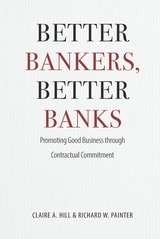
Better Bankers, Better Banks
Promoting Good Business through Contractual CommitmentClaire A. Hill and Richard W. Painter
University of Chicago Press, 2015
In Better Bankers, Better Banks, Claire A. Hill and Richard W. Painter look back at the history of banking and show how the current culture of bad behavior—dramatized by the corrupt, cocaine-snorting bankers of The Wolf of Wall Street—came to be. In the early 1980s, banks went from partnerships whose partners had personal liability to corporations whose managers had no such liability and could take risks with other people’s money. A major reason bankers remain resistant to change, Hill and Painter argue, is that while banks have been faced with large fines, penalties, and legal fees—which have exceeded one hundred billion dollars since the onset of the crisis—the banks (which really means the banks’shareholders) have paid them, not the bankers themselves. The problem also extends well beyond the pursuit of profit to the issue of how success is defined within the banking industry, where highly paid bankers clamor for status and clients may regard as inevitable bankers who prioritize their own self-interest. While many solutions have been proposed, Hill and Painter show that a successful transformation of banker behavior must begin with the bankers themselves. Bankers must be personally liable from their own assets for some portion of the bank’s losses from excessive risk-taking and illegal behavior. This would instill a culture that discourages such behavior and in turn influence the sorts of behavior society celebrates or condemns.
Despite many sensible proposals seeking to reign in excessive risk-taking, the continuing trajectory of scandals suggests that we’re far from ready to avert the next crisis. Better Bankers, Better Banks is a refreshing call for bankers to return to the idea that theirs is a noble profession.

Cybersecurity in Banking
Shriram K. Vasudevan
The Institution of Engineering and Technology, 2026