Results by title
6 books match the query 'Banks and banking, Central'
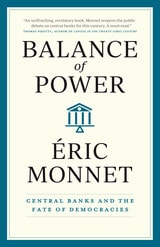
Balance of Power
Central Banks and the Fate of DemocraciesÉric Monnet
University of Chicago Press, 2024
Central banks now stand between societies and collapse, but are they still democratic?
Two decades of financial crises have dramatically expanded central banks’ powers. In 2008, and then again in 2020, unelected banking officials found themselves suddenly responsible for the public welfare—not just because it was necessary but based on an idea that their independence from political systems would insulate them from the whims of populism. Now, as international crises continue and the scope of monetary interventions grows in response, these bankers have become increasingly powerful.
In Balance of Power, economist and historian Éric Monnet charts the rise of central banks as the nominally independent—but unavoidably political—superpowers of modern societies. This trajectory, Monnet argues, is neither inevitable nor unstoppable. By embracing the political natures of today’s central banks, we can construct systems of accountability for how they interact with states and societies. Monnet shows that this effort will do more than guard against unjust power; it will put the banks to work for greater, more democratic ends.
With existential challenges looming and the work of the Federal Reserve and European Central Bank more important than ever, Balance of Power offers a trenchant case for what this century’s central banks can—and must—become.
[more]
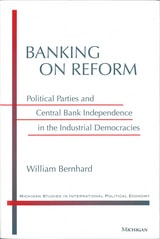
Banking on Reform
Political Parties and Central Bank Independence in the Industrial DemocraciesWilliam Bernhard
University of Michigan Press, 2002
Banking on Reform examines the political determinants of recent reforms to monetary policy institutions in the industrial democracies. With these reforms, political parties have sought to draw on the political credibility of an independent central bank to cope with electoral consequences of economic internalization and deindustrialization.
New Zealand and Italy made the initial efforts to grant their central banks independence. More recently, France, Spain, Britain, and Sweden have reformed their central banks' independence. Additionally, members of the European Union have implemented a single currency, with an independent European central bank to administer monetary policy.
Banking on Reform stresses the politics surrounding the choice of these institutions, specifically the motivations of political parties. Where intraparty conflicts have threatened the party's ability to hold office, politicians have adopted an independent central bank. Where political parties have been secluded from the political consequences of economic change, reform has been thwarted or delayed. The drive toward a single currency also reflects these political concerns. By delegating monetary policy to the European level, politicians in the member states removed a potentially divisive issue from the domestic political agenda, allowing parties to rebuild their support constructed on the basis of other issues. William T. Bernhard provides a variety of evidence to support his argument, such as in-depth case accounts of recent central bank reforms in Italy and Britain, the role of the German Bundesbank in the policy process, and the adoption of the single currency in Europe. Additionally, he utilizes quantitative and statistical tests to enhance his argument.
This book will appeal to political scientists, economists, and other social scientists interested in the political and institutional consequences of economic globalization.
William T. Bernhard is Assistant Professor of Political Science, University of Illinois, Urbana-Champaign.
[more]
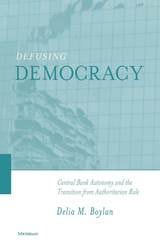
Defusing Democracy
Central Bank Autonomy and the Transition from Authoritarian RuleDelia M. Boylan
University of Michigan Press, 2001
Many of today's new democracies are constrained by institutional forms designed by previous authoritarian rulers. In this timely and provocative study, Delia M. Boylan traces the emergence of these vestigial governance structures to strategic behavior by outgoing elites seeking to protect their interests from the vicissitudes of democratic rule.
One important outgrowth of this political insulation strategy--and the empirical centerpiece of Boylan's analysis--is the existence of new, highly independent central banks in countries throughout the developing world. This represents a striking transformation, for not only does central bank autonomy remove a key aspect of economic decision making from democratic control; in practice it has also kept many of the would-be expansionist governments that hold power today from overturning the neoliberal policies favored by authoritarian predecessors.
To illustrate these points, Defusing Democracy takes a fresh look at two transitional polities in Latin America--Chile and Mexico--where variation in the proximity of the democratic "threat" correspondingly yielded different levels of central bank autonomy.
Boylan concludes by extending her analysis to institutional contexts beyond Latin America and to insulation strategies other than central bank autonomy. Defusing Democracy will be of interest to anyone--political scientists, economists, and policymakers alike--concerned about the genesis and consolidation of democracy around the globe.
Delia M. Boylan is Assistant Professor, Harris Graduate School of Public Policy Studies, University of Chicago.
[more]
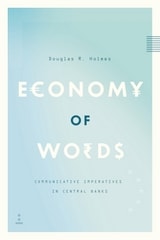
Economy of Words
Communicative Imperatives in Central BanksDouglas R. Holmes
University of Chicago Press, 2013
Markets are artifacts of language—so Douglas R. Holmes argues in this deeply researched look at central banks and the people who run them. Working at the intersection of anthropology, linguistics, and economics, he shows how central bankers have been engaging in communicative experiments that predate the financial crisis and continue to be refined amid its unfolding turmoil—experiments that do not merely describe the economy, but actually create its distinctive features.
Holmes examines the New York District Branch of the Federal Reserve, the European Central Bank, Deutsche Bundesbank, and the Bank of England, among others, and shows how officials there have created a new monetary regime that relies on collaboration with the public to achieve the ends of monetary policy. Central bankers, Holmes argues, have shifted the conceptual anchor of monetary affairs away from standards such as gold or fixed exchange rates and toward an evolving relationship with the public, one rooted in sentiments and expectations. Going behind closed doors to reveal the intellectual world of central banks,Economy of Words offers provocative new insights into the way our economic circumstances are conceptualized and ultimately managed.
Holmes examines the New York District Branch of the Federal Reserve, the European Central Bank, Deutsche Bundesbank, and the Bank of England, among others, and shows how officials there have created a new monetary regime that relies on collaboration with the public to achieve the ends of monetary policy. Central bankers, Holmes argues, have shifted the conceptual anchor of monetary affairs away from standards such as gold or fixed exchange rates and toward an evolving relationship with the public, one rooted in sentiments and expectations. Going behind closed doors to reveal the intellectual world of central banks,Economy of Words offers provocative new insights into the way our economic circumstances are conceptualized and ultimately managed.
[more]
Negotiated Reform
The Multilevel Governance of Financial RegulationEdited by Renate Mayntz
Campus Verlag, 2016
Multilevel structures are becoming increasingly characteristic of the world in which we live. This book is a unique study of policy making in a multilevel political system extending from the national to the international level. Taking as its subject the process of financial market reforms that took place following the recent financial crisis, it brings together an international group of renowned social scientists to explore the interplay between international organizations, European authorities, and regulators in the United States, the United Kingdom, and Germany in global financial decision making. Contributors thoroughly explore a small set of reform issues—including bank structure, bank capital, resolution, and over-the-counter trading of derivatives—to provide a detailed view of the vertical and horizontal interactions between these actors as related to a set of key questions: Are those states affected by the crisis adopting internationally negotiated regulations? Or are they instead determining the European and international reform agenda? Are the agreed upon policies contributing to greater harmonization of financial regulation in a multilevel political system? Or is the process being dominated by differing national interests?
[more]

The Bank War
Andrew Jackson, Nicholas Biddle, and the Fight for American FinancePaul Kahan
Westholme Publishing, 2022
The Battle over the Charter of the Second Bank of the United States and Its Lasting Impact on the American Economy
Late one night in July 1832,Martin Van Buren rushed to the White House where he found an ailing President Andrew Jackson weakened but resolute. Thundering against his political antagonists, Jackson bellowed: “The Bank, Mr. Van Buren, is trying to kill me, but I shall kill it!”With those famous words, Jackson formally declared “war” against the Second Bank of the United States and its president Nicholas Biddle. The Bank of the United States, which held the majority of Federal monies, had been established as a means of centralizing and stabilizing American currency and the economy, particularly during the country’s vulnerable early years. Jackson and his allies viewed the bank as both elitist and a threat to states’ rights. Throughout his first term, Jackson had attacked the bank viciously but failed to take action against the institution. Congress’ decision to recharter the bank forced Jackson to either make good on his rhetoric and veto the recharter or sign the recharter bill and be condemned as a hypocrite.
In The Bank War: Andrew Jackson, Nicholas Biddle, and the Fight for American Finance, historian Paul Kahan explores one of the most important and dramatic events in American political and economic history, from the idea of centralized banking and the First Bank of the United States to Jackson’s triumph, the era of “free banking,” and the creation of the Federal Reserve System. Relying on a range of primary and secondary source material, the book also shows how the Bank War was a manifestation of the debates that were sparked at the Constitutional Convention—the role of the executive branch and the role of the federal government in American society—debates that endure to this day as philosophical differences that often divide the United States.
[more]