Results by title
7 books match the query 'Benin'

African Science
Witchcraft, Vodun, and Healing in Southern BeninDouglas J. Falen
University of Wisconsin Press, 2020
Although the Beninese understanding of àze reflects positive scientific properties in its use of specialized knowledge to harness nature's energy and realize economic success, its boundless power is inherently ambivalent because it can corrupt its users, who dispense death and destruction. Witches and healers are equivalent to supervillains and superheroes, locked in epic battles over malevolent and benevolent human desires. Beninese people's discourse about such mystical confrontations expresses a philosophy of moral duality and cosmic balance. Falen demonstrates how a deep engagement with another lived reality opens our minds and contributes to understanding across cultural difference.
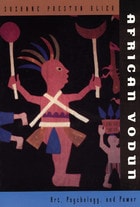
African Vodun
Art, Psychology, and PowerSuzanne Preston Blier
University of Chicago Press, 1994
In this first major study of its kind, Suzanne Preston Blier examines the artworks of the contemporary vodun cultures of southern Benin and Togo in West Africa as well as the related voudou traditions of Haiti, New Orleans, and historic Salem, Massachusetts. Blier employs a variety of theoretically sophisticated psychological, anthropological, and art historical approaches to explore the contrasts inherent in the vodun arts—commoners versus royalty, popular versus elite, "low" art versus "high." She examines the relation between art and the slave trade, the psychological dynamics of artistic expression, the significance of the body in sculptural expression, and indigenous perceptions of the psyche.
Throughout, Blier pushes African art history to a new height of cultural awareness that recognizes the complexity of traditional African societies as it acknowledges the role of social power in shaping aesthetics and meaning generally. This book will be of critical importance not only to those concerned with African, African American, and Caribbean art, but also to anthropologists, African diaspora scholars, students of comparative religion and comparative psychology, and anyone fascinated by the traditions of voudou and vodun.
"An extraordinary tour de force."—Choice
"Extraordinarily detailed....Blier's examination of the entire, often mysterious history of vodun is...in a word, definitive."—Booklist
"A serious study that concentrates on the hidden power of objects and the meaning behind that potency is long overdue. Welcome Susan Blier's African Vodun....Certainly a must for...those concerned with the psychology of art."—Janet L. Stanley, Art Documentation
"[Blier] is usually sensitive to the need to resist imposing Western artistic values and academic methodologies inappropriately upon such art. But she offers the reader a gift even more precious; she offers rare insights into how various art forms—sculpture and home architecture in particular—yield meanings for the African users of such art.—Norman Weinstein, Boston Book Review
Dahomean Narrative
A Cross-Cultural AnalysisMelville J. Herskovits and Frances S. Herskovits
Northwestern University Press, 1998
Published as a companion piece to Northwestern University Press's West African Folktales, Dahomean Narrative provides the basic texts of material collected in the field, and shows how they were collected, analyzed, and theorized in the anthropological and folklore disciplinary traditions of Herskovits's day. The result is a wide-ranging collection, culled from an entire narrative tradition, that remains unique among anthropological publications.
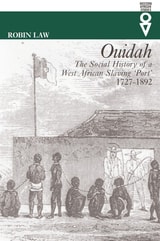
Ouidah
The Social History of a West African Slaving Port, 1727–1892Robin Law
Ohio University Press, 2004
Ouidah, an African town in the Republic of Benin, was the principal precolonial commercial center of its region and the second-most-important town of the Dahomey kingdom. It served as a major outlet for the transatlantic slave trade. Between the seventeenth and the nineteenth centuries, Ouidah was the most important embarkation point for slaves in the region of West Africa known to outsiders as the Slave Coast. This is the first detailed study of the town’s history and of its role in the Atlantic slave trade.
Ouidah is a well-documented case study of precolonial urbanism, of the evolution of a merchant community, and in particular of the growth of a group of private traders whose relations with the Dahomian monarchy grew increasingly problematic over time.

Transforming Vòdún
Musical Change and Postcolonial Healing in Benin's Jazz and Brass Band MusicSarah Politz
University of Michigan Press, 2023
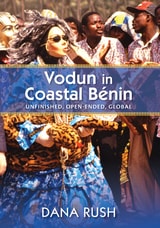
Vodun in Coastal Benin
Unfinished, Open-Ended, GlobalDana Rush
Vanderbilt University Press, 2013
The book is richly illustrated with color photographs of Vodun shrines, temple wall paintings, masquerades, and Hindu chromolithographs.
This book is the first publication in a new series called "Critical Investigations of the African Diaspora." The series grows out of Issues in Critical Investigation, a Vanderbilt initiative to assist junior scholars through critical feedback from senior faculty, annual symposia, and prize competitions in the humanities and social sciences. Dana Rush's Vodun in Coastal Benin is the winner of the inaugural Anna Julia Cooper Prize in the Humanities.
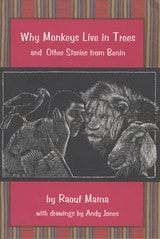
Why Monkeys Live in Trees and Other Stories from Benin
Raouf Mama
Northwestern University Press, 2006
The Western African Republic of Benin (formerly Dahomey) is gifted with a great folktale tradition, one of the richest in the world. As pieces of oral literature and cultural history, these tales shed light on some of the values and beliefs as well as the customs and traditions of the people of Benin.