Results by title
18 books match the query 'Bilingual Education'
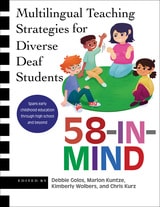
58-IN-MIND
Multilingual Teaching Strategies for Diverse Deaf StudentsDebbie Golos
Gallaudet University Press, 2024
Each chapter is written by a team of researchers and P–12 teachers with at least one Deaf coauthor. With seventy-five percent of the authors being Deaf, this is the first teaching methods book to harness the expertise of Deaf professionals at this level, highlighting their vital role in Deaf education and in shaping inclusive and effective learning environments. This book meets the need for a resource that recognizes the diversity of Deaf students by creating space in the classroom to honor their home/heritage languages, cultures, races, genders, abilities, hearing levels, and other multiple and intersecting identities. Written in a conversational tone, the book includes core recommendations for instruction of the targeted subject area, examples of key strategies, lessons and real stories from those working in the field, suggestions for practice, and recommended resources.
“58-IN-MIND” in the title refers to the version of the ASL sign "stick" that is made on the forehead, which is equivalent to the English idiom “to stick in one's mind.” As in, when students learn in a culturally responsive manner, the learning is likely to stick. The title also alludes indirectly to the collective aspirations of the chapter authors that the practices discussed in the book will also stick in the readers’ minds, and thus have a transformative impact on the way Deaf students are taught.
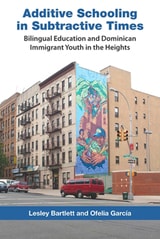
Additive Schooling in Subtractive Times
Bilingual Education and Dominican Immigrant Youth in the HeightsLesley Bartlett
Vanderbilt University Press, 2011
After offering a history of the school's formation, the authors detail the ways in which federal No Child Left Behind policies, New York State accountability measures, and New York City's educational reforms under Mayor Michael Bloomberg complicated the school's efforts. The book then describes the dynamic bilingual pedagogical approach adopted within the school to help students develop academic Spanish and English. Focusing on the lives of twenty immigrant youth, Bartlett and Garcia also show that, although the school achieves high completion rates, the graduating students nevertheless face difficult postsecondary educational and work environments that too often consign them to the ranks of the working poor.
Communities of Practice
An Alaskan Native Model for Language Teaching and LearningEdited by Patrick E. Marlow and Sabine Siekmann
University of Arizona Press, 2013
In Alaska, the Second Language Acquisition Teacher Education (SLATE) project was designed to enable Indigenous communities and schools to improve the quality of native-language and English-language instruction and assessment by focusing on the elimination of barriers that have historically hindered degree completion for Indigenous and rural teachers. The Guided Research Collaborative (GRC) model, was employed to support the development of communities of practice through near-peer mentoring and mutual scaffolding. Through this important new model, teachers of both the heritage language, in this case Central Yup’ik, and English were able to situate their professional development into a larger global context based on current notions of multilingualism.
In Communities of Practice contributors show how the SLATE program was developed and implemented, providing an important model for improving second-language instruction and assessment. Through an in-depth analysis of the program, contributors show how this project can be successfully adapted in other communities via its commitment to local control in language programming and a model based on community-driven research.
Communities of Practice demonstrates how an initial cohort of Yup’ik- and English-language teachers collaborated to negotiate and ultimately completed the SLATE program. In so doing, these educators enhanced the program and their own effectiveness as teachers through a greater understanding of language learning. It is these understandings that will ultimately allow heritage- and English-language teachers to work together to foster their students’ success in any language.
Corrective Feedback for Oral Language Errors
What Every Second Language Teacher Needs to KnowHilal Ergül
University of Michigan Press, 2027
Speaking activities are where language comes alive, and where teachers face the constant question of whether to correct errors on the spot or let communication flow. Correct too much and learners may shut down; correct too little and persistent errors can fossilize. Taking this everyday dilemma seriously, this book explains what research actually shows about correcting spoken errors, why timing and feedback type matter, and how learner factors like anxiety and attention shape what students take in. Most importantly, the book helps teachers make practical, confident choices about oral corrective feedback without turning interaction into interruption.
Extending beyond a grammar-dominant focus, Ergül addresses pragmatics and discourse intonation as consequential but often neglected correction targets, and frames pronunciation feedback around intelligibility and functional load rather than native-likeness. The book also examines technology-mediated corrective feedback (including synchronous computer-mediated communication, speech visualization, and AI-based tools) as options that can expand feedback opportunities when aligned with instructional goals. With concrete classroom guidance, reproducible student handouts, and reflection tools, Corrective Feedback for Oral Language Errors supports teachers who want learners to speak more, speak more accurately, and build long-term confidence.
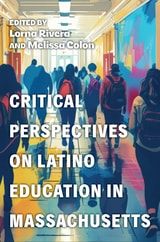
Critical Perspectives on Latino Education in Massachusetts
Lorna Rivera and Melissa Colón, editors
University of Massachusetts Press, 2025
In Massachusetts, the Latino population increased by 475 percent between 1980 and 2017, marking a dramatic growth. This diverse ethnic community of Puerto Ricans, Dominicans, Salvadoreans, Colombians, Brazilians, and more also contains a wide range of cultures, immigration and migration experiences, languages, and socio-political backgrounds. However, there are numerous commonalities involving education. Recent research at the Mauricio Gastón Institute for Latino Community Development and Policy reveals that Latino students in Massachusetts are more likely to attend public schools, in communities with significant academic achievement and opportunity gaps as well as other challenges, from food scarcity to higher rates of unemployment. At the same time, the state-wide shift to standards-based education has had a disproportionately negative impact on Latino students, who already feel the effects of politically motivated anti-immigrant policies and laws that limit bilingual education.
This collection of essays, from those working inside the classroom as well as researchers taking a broader look at policy, addresses the array of issues facing Latino students in Massachusetts. These perspectives paint a complex picture of the educational experience for Latinos, and offer expert suggestions for improving classrooms, school environments, and ultimate educational outcomes for an important growing demographic in the Commonwealth.
In addition to editors Lorna Rivera and Melissa Colón, this volume’s contributors include Almudena G. Abeyta, Nasteho Ali, Cristina Araujo Brinkerhoff, Michael Berardino, Alex Briesacher, Thomas Conroy, Judenie Dabel, Liya Escalera, Luis Enrique Esquivel, Deyja Enriquez, Isahiah Erilus, Nyal Fuentes, Jazmin Rubi Flete Gomez, Manuel Frau-Ramos, Kimberly A. S. Howard, Patricia Krueger-Henney, Steven Lue, Mary Jo Marion, Timothy E. Murphy, Cecilia Nardi, Laurie Occhipinti, Alexandra Oliver-Davila, Chong Myung Park, Angelica Rodriquez, Marta T. Rosa, Diana Santiago, Melissa Sargent, Ester Shapiro, V. Scott H. Solberg, Fabián Torres-Ardila, Ashley Torres Carrasquillo, Paul Trunfio, Carmen N. Veloria, and Heilam Xie.
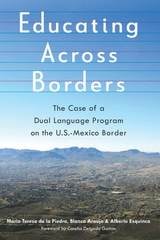
Educating Across Borders
The Case of a Dual Language Program on the U.S.-Mexico BorderMaría Teresa de la Piedra, Blanca Araujo, and Alberto Esquinca; Foreword by Concha Delgado Gaitan
University of Arizona Press, 2018
The authors, who themselves live and work on the border, question artificially created cultural and linguistic borders. To explore this issue, they employed participant-observation, focus groups, and individual interviews with teachers, administrators, and staff members to construct rich understandings of the experiences of transfronterizx students. These ethnographic accounts of their daily lives counter entrenched deficit perspectives about transnational learners.
Drawing on border theory, immigration and border studies, funds of knowledge, and multimodal literacies, Educating Across Borders is a critical contribution toward the formation of a theory of physical and metaphorical border crossings that ethnic minoritized students in U.S. schools must make as they traverse the educational system.
Interpreter Education in the Digital Age
Innovation, Access, and ChangeSuzanne Ehrlich
Gallaudet University Press, 2015
Initiatives described in this collection range from the implementation of on-demand interpreting using iPad technology to create personalized, small-group, multidimensional models suited to digital media for 160 languages; introducing students to interpreting in a 3D world through an IVY virtual environment; applying gaming principles to interpreter education; assessing the amenability of the digital pen in the hybrid mode of interpreting; developing multimedia content for both open access and structured interpreter education environments; to preparing interpreting students for interactions in social media forums, and more. Interpreter Education in the Digital Age provides a context for the application of technologies in interpreter education from an international viewpoint across languages and modalities.
Practical Pronunciation
Pronunciation Strategies in PracticeDJ Kaiser
University of Michigan Press, 2026
CEFR Level: C1
Key Features
- A series of 210 audio recordings provides opportunities for learners to listen for key aspects of pronunciation and practice items from the book on their own.
- Twenty-nine videos provide short explanations and visual demonstrations of many of the strategies included throughout the book.
- Recommendations on ways to integrate digital tools into pronunciation exploration and practice provide learners and teachers with multiple ways to customize pronunciation practice to meet varied professional speaking contexts, academic goals, and personal interests.
- Practice items and exercises incorporate higher-frequency words from the Corpus of Contemporary American English.
- A glossary and several quick-reference charts make it easy to look up or clarify key terms and linguistic terminology or to visually review consonant and vowel charts.
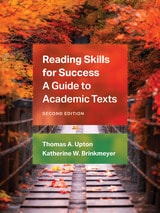
Reading Skills for Success
A Guide to Academic TextsThomas A. Upton and Katherine W. Brinkmeyer
University of Michigan Press, 2026
In this new edition, Reading Skills for Success continues to help students develop the reading skills and strategies they need to transition to reading material in mainstream academic settings. Designed for precollege readers and nonnative speakers of English alike, the fully revised book focuses on the text-based, linguistic preparedness necessary to quickly spot key information and organizational structure in texts and avoid miscomprehension.
Written by academic experts who are practicing teachers in ESL intensive English, the book is grounded in sound pedagogical methods. Teachers will work through specific reading strategies with students; use the general activities and sample academic chapters in the book to practice the strategies being taught; and then have the students turn to outside readings, like their academic textbooks, to practice the strategies they are learning. Accessible for teachers and students, Reading Skills for Success provides a guide for developing text-based processing skills to improve reading confidence.
In Reading Skills for Success, 2nd Edition, students will:
- Learn to use word-level clues to increase reading comprehension.
- Recognize different types of expository text structures.
- Develop study skills for intensive analytical reading of academic prose.
- Practice reading strategies for in-depth, long-term understanding of complex academic texts.
- Apply skills to excerpts from actual textbooks used in first-year college courses representing a wide variety of fields in the humanities, social sciences, and sciences.
CEFR level: A1-B1
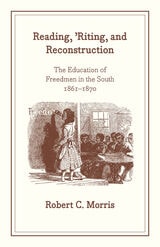
Reading, 'Riting, and Reconstruction
The Education of Freedmen in the South, 1861-1870Robert C. Morris
University of Chicago Press, 1981
This study of education for freedmen following Emancipation is the definitive treatment of the subject. Employing a wide range of sources, Robert C. Morris examines the organizations that staffed and managed black schools in the South, with particular attention paid to the activities of the Freedman’s Bureau. He looks as well at those who came to teach, a diverse group—white, black, Northern, Southern—and at the curricula and textbooks they used. While giving special emphasis to the Freedmen’s Bureau school program, Morris places the freedmen’s educational movement fully in its nineteenth-century context, relating it both to the antislavery crusade that preceded it and to the conservative era of race relations that followed.
Second Language Acquisition Myths
Applying Second Language Research to Classroom TeachingSteven Brown and Jenifer Larson-Hall
University of Michigan Press, 2012
This volume was conceived as a first book in SLA for advanced undergraduate or introductory master’s courses that include education majors, foreign language education majors, and English majors. It’s also an excellent resource for practicing teachers.
Both the research and pedagogy in this book are based on the newest research in the field of second language acquisition. It is not the goal of this book to address every SLA theory or teach research methodology. It does however address the myths and questions that non-specialist teacher candidates have about language learning.
Steven Brown is the co-author of the introductory applied linguistics textbook Understanding Language Structure, Interaction, and Variation textbook (and workbook).
The myths challenged in this book are:
§ Children learn languages quickly and easily while adults are ineffective in comparison.
§ A true bilingual is someone who speaks two languages perfectly.
§ You can acquire a language simply through listening or reading.
§ Practice makes perfect.
§ Language students learn (and retain) what they are taught.
§ Language learners always benefit from correction.
§ Individual differences are a major, perhaps the major, factor in SLA.
§ Language acquisition is the individual acquisition of grammar.
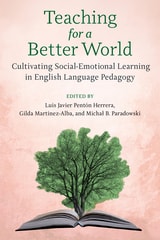
Teaching for a Better World
Cultivating Social-Emotional Learning in English Language PedagogyEdited by Luis Javier Pentón Herrera, Gilda Martínez-Alba, and Michal B. Paradowski
University of Michigan Press, 2026
In a world where language connects people across cultures, Teaching for a Better World invites readers to imagine classrooms where words do more than teach grammar; they build empathy, resilience, and understanding. This groundbreaking volume is the first to focus on the integration of social-emotional learning (SEL) into English language teaching from a global perspective, bringing together educators and researchers from diverse cultural and educational contexts. Through conceptual discussions, research, and practical examples, the authors demonstrate how English lessons can also be lessons in compassion, collaboration, and global citizenship.
Organized into three sections—Conceptual Pieces, Empirical Studies, and Practical Examples—the book offers a comprehensive examination of SEL’s theoretical foundations, evidence-based practices, and real-world classroom applications. Contributors explore SEL through lenses such as culturally responsive pedagogy, trauma-sensitive practices, teacher and student well-being, ecolinguistics, and intercultural dialogue. Readers will find innovative and practical ways to create inclusive, culturally responsive classrooms; support student and teacher well-being; and use English as a bridge for intercultural dialogue. Accessible and inspiring, this book’s combination of conceptual depth, empirical rigor, and applied strategies position it as a foundational resource for advancing research and practice in SEL-informed English language pedagogy worldwide.
Readers of Teaching for a Better World will
- Learn pedagogically sound ways to foster empathy and resilience while creating inclusive, culturally responsive classrooms.
- Find ready-to-use lesson plans and activities.
- Encounter diverse perspectives of educators from a range of contexts, including conflict-affected regions, refugee resettlement contexts, and higher education.
Tell Me How It Reads
Tutoring Deaf and Hearing Students in the Writing CenterRebecca Day Babcock
Gallaudet University Press, 2012
Deaf students are attending mainstream postsecondary institutions in increasing numbers, raising the stakes for the complicated and multifaceted task of tutoring deaf students at these schools. Common tutoring practices used with hearing students do not necessarily work for deaf people. Rebecca Day Babcock researched and wrote Tell Me How It Reads: Tutoring Deaf and Hearing Students in the Writing Center to supply writing instructors an effective set of methods for teaching Deaf and other students how to be better writers.
Babcock’s book is based on the resulting study of tutoring writing in the college context with both deaf and hearing students and their tutors. She describes in detail sessions between deaf students, hearing tutors, and the interpreters that help them communicate, using a variety of English or contact signing rather than ASL in the tutorials. These experiences illustrate the key differences between deaf-hearing and hearing-hearing tutorials and suggest ways to modify tutoring and tutor-training practices accordingly. Although this study describes methods for tutoring deaf students, its focus on students who learn differently can apply to teaching writing to Learning Disabled students, ESL students, and other students with different learning styles. Ultimately, the well-grounded theory analysis within Tell Me How It Reads provides a complete paradigm for tutoring in all writing centers.
The Unplanned Lesson
How to Stop Searching for Activities and Start Engaging StudentsIan Roth and Paul Wicking
University of Michigan Press, 2023

Translanguaging
What Every Teacher Needs to KnowJacob Huckle
University of Michigan Press, 2027
Multilingual learners bring a wealth of resources to the classroom in the form of their various languages. How can teachers tap into these resources as part of the learning process? How can we intentionally embrace linguistic diversity in our classrooms through the way we design learning? Despite the proliferation of research and writing about pedagogical translanguaging, many teachers do not feel equipped to effectively implement translanguaging approaches in their teaching.
Translanguaging provides a comprehensive introduction to the what, why, and how of translanguaging. The book synthesizes the research literature for a non-specialist audience, and builds on these insights by providing practical guidance for how students can be empowered to use all their linguistic resources—not just English or the language of instruction—to learn and thrive in school or college. Whether teachers of ESL or other subjects, all teachers will benefit from the practical guidance about translanguaging in this book and will be equipped to begin rethinking and redesigning their teaching to make more space for students’ multilingualism.
Using a Genre-Based and Multimodal Approach to Teach Oral Academic Communication
Megan M. Siczek
University of Michigan Press, 2026
This book introduces a model course design and its guiding principles, then explicitly describes a variety of oral communication assignments that promote engaged learning, including steps in the instructional sequence, tips for teaching, and sample guidance to be shared with students. It emphasizes the importance of leveraging students’ cultural and linguistic strengths and global experiences to promote their agency as learners. The principles and practices described in this book are grounded in an English for Academic Purposes (EAP) context but are easily adaptable to other instructional settings and teaching modalities. Implementing a genre-based and multimodal approach helps build students’ rhetorical awareness, increases their communicative capacity, and enables them to participate actively in their academic discourse communities.
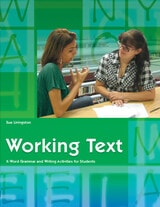
Working Text (Student Workbook)
X-Word Grammar and Writing Activities for StudentsSue Livingston
Gallaudet University Press, 2010
Working Test: X-Word Grammar and Writing Activities for Students features 86 X-Word Grammar reading and writing exercises divided into five parts of increasing complexity. Deaf, second-language, and other students experiencing difficulty with English composition can perform these exercises as homework or as in-class activities. Through these exercises, they can master English grammar, improve their facility with language constructions, and meet the challenges of becoming better writers.
Working Text (Teacher's Guide)
Teaching Deaf and Second-Language Students to Be Better WritersSue Livingston
Gallaudet University Press, 2010
After teaching developmental writing to deaf students for may years, Sue Livingston found that students who can read and analyze written texts become better writers. They achieve their improvement by reading, then writing about what they have read. Livingston has embodied her successful approach in Working Text: Teaching Deaf and Second-Language Students to Be Better Writers.
In this straightforward instructional book, Livingston first explains what is involved and why her methods work with deaf students, second-language students, and other students who need to improve their writing ability. Upon this foundation, Working Text delineates how to teach students to write through reading and writing exercises. These exercises have been carefully crafted using the X-Word Grammar approach to help students discover common language constructions that they can apply to their own writing. As the students progress, their understanding of the elements of good writing will grow.
Working Text also includes all of the exercises and appendices featured in the Working Test: X-Word Grammar and Writing Activities for Students workbook, both in print and on on a special CD. The answers for the exercises are included as well, as are sample quizzes, and the CD can be used in the classroom for interactive lessons in conjunction with the student workbook. Working Text: Teaching Deaf and Second-Language Students to Be Better Writers, in concert with its companion student workbook, will help deaf, second-language, and other students develop into markedly better, more confident writers.