Results by title
8 books match the query 'Biological invasions'
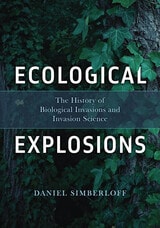
Ecological Explosions
The History of Biological Invasions and Invasion ScienceDaniel Simberloff
University of Chicago Press, 2025
From the arrival of the naval shipworm in the Black Sea in the first millennium BC to the escape of the Burmese python in Florida in 1992, humans have moved species to new locations, deliberately or inadvertently, for thousands of years. Agricultural and environmental impacts of some invasions were evident early, although whether observers recognized that the cause was an introduced species is uncertain. The history of invasion biology truly begins in the sixteenth through eighteenth centuries, when explorers noticed European species on various distant islands and in North America. In the nineteenth century, biogeographers, studying species distributions across the globe, introduced the first native and non-native species categorizations, and prominent researchers like Charles Darwin began to describe the impacts of introduced species. In the nineteenth and twentieth centuries, as humans moved increasing numbers of species across the globe, the advent of modern ecology deepened our understanding of the scope of the problem.
In Ecological Explosions, invasive species expert Daniel Simberloff provides a thorough overview of the development of invasion science, from early research—including from the perspectives of leading scientists like Aldo Leopold—to the field’s future. Simberloff explores the work of pioneering ecologists like Charles Elton, antecedents of what became today’s invasion biology, before discussing the field’s true emergence in the 1980s, its explosive methodological and theoretical expansion, its integration with other disciplines, and its increasing visibility, not only within the biological literature but also in government policies across the world in the 1990s. Finally, he investigates current controversies, such as the debate over whether the entire science is xenophobic, and asks how ecosystems might adapt to a rapidly globalizing world and ever-increasing numbers of introduced species—including the joro spider, lionfish, spotted lanternfly, common reed, and Asian carp.
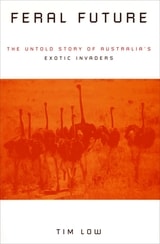
Feral Future
The Untold Story of Australia's Exotic InvadersTim Low
University of Chicago Press, 2002
Australia is far from alone in facing horrific ecological and economic damage from invading plants and animals, and in Low's capable hands, Australia's experiences serve as a wake-up call for all of us. He covers how invasive species like cane toads and pond apple got to Australia (often through misguided but intentional introductions) and what we can do to stop them. He also covers the many pests that Australia has exported to the world, including the paperbark tree (Melaleuca) that infests hundreds of thousands of acres in south Florida.
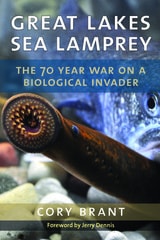
Great Lakes Sea Lamprey
The 70 Year War on a Biological InvaderCory Brant
University of Michigan Press, 2019
Threatening the complete collapse of the fishery, the sea lamprey invasion triggered an environmental awakening in the region and prompted an international treaty that secured unprecedented cooperation across political boundaries to protect the Great Lakes. Fueled by a pioneering scientific spirit, the war on Great Lakes sea lampreys led to discoveries that are the backbone of the program that eventually brought the creature under control and still protects the largest freshwater ecosystem in the world to this day.
Great Lakes Sea Lamprey draws on extensive interviews with individuals who experienced the invasion firsthand as well as a trove of unexplored archival materials to tell the incredible story of sea lamprey in the Great Lakes—what started the invasion, how it was halted, and what this history can teach us about the response to biological invaders in the present and future. Richly illustrated with color and black & white photographs, the book will interest readers concerned with the health of the Great Lakes, the history of the conservation movement, and the ongoing threat of invasive species.
Invasive Exotic Species in the Sonoran Region
Edited by Barbara Tellman
University of Arizona Press, 2002
The book brings together contributors from academia, government, and nonprofit organizations, including such experts as Gary Paul Nabhan, Richard Mack, and Alberto Búrquez-Montijo. They review historic and even prehistoric origins of non-native species—not only exotic plants, amphibians, and mammals but also insects, fish, and birds. They then examine significant problems in each major subregion and ecosystem and discuss control efforts. The volume contains the first compiled list of more than 500 naturalized exotic species in the Sonoran region. Invasive species issues are rapidly emerging as major environmental concerns both locally and worldwide. This book assists professionals—ecologists, conservation biologists, and policy makers—involved in invasive species control in the Southwest and will be a rich resource for all concerned with protecting native species and their habitats.
Invasive Species in a Globalized World
Ecological, Social, and Legal Perspectives on PolicyEdited by Reuben P. Keller, Marc W. Cadotte, and Glenn Sandiford
University of Chicago Press, 2014
Yet even though ecological research has led to public conversation and policy recommendations, those recommendations have frequently been ignored, and the efforts to counter invasive species have been largely unsuccessful. Recognizing the need to engage experts across the life, social, and legal sciences as well as the humanities, the editors of this volume have drawn together a wide variety of ecologists, historians, economists, legal scholars, policy makers, and communications scholars, to facilitate a dialogue among these disciplines and understand fully the invasive species phenomenon. Aided by case studies of well-known invasives such as the cane toad of Australia and the emerald ash borer, Asian carp, and sea lampreys that threaten US ecosystems, Invasive Species in a Globalized World offers strategies for developing and implementing anti-invasive policies designed to stop their introduction and spread, and to limit their effects.

Pandora's Locks
The Opening of the Great Lakes-St. Lawrence SeawayJeff Alexander
Michigan State University Press, 2009
The St. Lawrence Seaway was considered one of the world's greatest engineering achievements when it opened in 1959. The $1 billion project-a series of locks, canals, and dams that tamed the ferocious St. Lawrence River-opened the Great Lakes to the global shipping industry.
Linking ports on lakes Superior, Michigan, Huron, Erie, and Ontario to shipping hubs on the world's seven seas increased global trade in the Great Lakes region. But it came at an extraordinarily high price. Foreign species that immigrated into the lakes in ocean freighters' ballast water tanks unleashed a biological shift that reconfigured the world's largest freshwater ecosystems.
Pandora's Locks is the story of politicians and engineers who, driven by hubris and handicapped by ignorance, demanded that the Seaway be built at any cost. It is the tragic tale of government agencies that could have prevented ocean freighters from laying waste to the Great Lakes ecosystems, but failed to act until it was too late. Blending science with compelling personal accounts, this book is the first comprehensive account of how inviting transoceanic freighters into North America's freshwater seas transformed these wondrous lakes.
The Ecology of Invasions by Animals and Plants
Charles S. Elton
University of Chicago Press, 2000
Much as Rachel Carson's Silent Spring was a call to action against the pesticides that were devastating bird populations, Charles S. Elton's classic The Ecology of Invasions by Animals and Plants sounded an early warning about an environmental catastrophe that has become all too familiar today—the invasion of nonnative species. From kudzu to zebra mussels to Asian long-horned beetles, nonnative species are colonizing new habitats around the world at an alarming rate thanks to accidental and intentional human intervention. One of the leading causes of extinctions of native animals and plants, invasive species also wreak severe economic havoc, causing $79 billion worth of damage in the United States alone.
Elton explains the devastating effects that invasive species can have on local ecosystems in clear, concise language and with numerous examples. The first book on invasion biology, and still the most cited, Elton's masterpiece provides an accessible, engaging introduction to one of the most important environmental crises of our time.
Trespassing Natures
Species Migration and the Right to SpaceDonnie Johnson Sackey
The Ohio State University Press, 2024
As old worlds become hostile and new spaces become hospitable, many species are shifting their ranges to live in locations where they have never previously existed. Biological and sociocultural realms collide and boundaries blur, making it increasingly difficult to mark definitively who belongs and who is a trespasser. In Trespassing Natures, Donnie Johnson Sackey troubles the idea of biological “invasion,” turning our attention away from scientific considerations and toward the discursive and rhetorical dimensions of this term—offering a new paradigm that recasts this issue as a question of what it means to live in multi-species communities. Presenting case studies on bed bugs, bighead carp, feral cats, and mackerel, Sackey argues that the identification of a species as an invader is not merely a scientific act, but a cultural and political one. By questioning issues around space, identity, and the institutions that make human participation apparent, Sackey redirects focus away from the belief that a single species threatens space. Ultimately, Trespassing Natures asks us to expand our idea of community and question who has the right to space.