Results by title
15 books match the query 'Biologists'
Adventures in the Wild
Tales from Biologists of the Natural StateJoy Trauth
University of Arkansas Press, 2008
Bear Wrangler
Memoirs of an Alaska Pioneer BiologistWill Troyer
University of Alaska Press, 2008
Curators
Behind the Scenes of Natural History MuseumsLance Grande
University of Chicago Press, 2017
At the heart of it all from the very start have been curators. Yet after three decades as a natural history curator, Lance Grande found that he still had to explain to people what he does. This book is the answer—and, oh, what an answer it is: lively, exciting, up-to-date, it offers a portrait of curators and their research like none we’ve seen, one that conveys the intellectual excitement and the educational and social value of curation. Grande uses the personal story of his own career—most of it spent at Chicago’s storied Field Museum—to structure his account as he explores the value of research and collections, the importance of public engagement, changing ecological and ethical considerations, and the impact of rapidly improving technology. Throughout, we are guided by Grande’s keen sense of mission, of a job where the why is always as important as the what.
This beautifully written and richly illustrated book is a clear-eyed but loving account of natural history museums, their curators, and their ever-expanding roles in the twenty-first century.
Dreamers, Visionaries, and Revolutionaries in the Life Sciences
Edited by Oren Harman and Michael R. Dietrich
University of Chicago Press, 2018
From the Frenchman Jean-Baptiste Lamarck, who coined the word “biology” in the early nineteenth century, to the American James Lovelock, for whom the Earth is a living, breathing organism, these dreamers innovated in ways that forced their contemporaries to reexamine comfortable truths. With this collection readers will follow Jane Goodall into the hidden world of apes in African jungles and Francis Crick as he attacks the problem of consciousness. Join Mary Lasker on her campaign to conquer cancer and follow geneticist George Church as he dreams of bringing back woolly mammoths and Neanderthals. In these lives and the many others featured in these pages, we discover visions that were sometimes fantastical, quixotic, and even threatening and destabilizing, but always a challenge to the status quo.
Hear Him Roar
A NovelAndrew Wingfield
Utah State University Press, 2005
Into the Night
Rick Adams
University Press of Colorado, 2013
Contributors tell of confronting North American bears, cougars, and rattlesnakes; suffering red ctenid spider bites in the tropical rain forest; swimming through layers of feeding-frenzied hammerhead sharks in the Galapagos; evading the wrath of African bull elephants in South Africa; and delighting in the curious and gentle nature of foxes and unconditional acceptance by a family of owls. They describe “fire in the sky” across a treeless tundra, a sea ablaze with bioluminescent algae, nighttime earthquakes on the Pacific Rim, and hurricanes and erupting volcanoes on a Caribbean island.
Into the Night reveals rare and unexpected insights into nocturnal field research, illuminating experiences, discoveries, and challenges faced by intrepid biologists studying nature’s nightly marvels across the globe. This volume will be of interest to scientists and general readers alike.
Life and Times of a Big River
An Uncommon Natural History of Alaska's Upper YukonPeter J. Marchand
University of Alaska Press, 2015
Life and Times of a Big River follows Peter J. Marchand and his team of biologists as they set out to explore the land that would ultimately become the Yukon-Charley Rivers National Preserve. Their encounters with strange plants, rare insects, and little-known mammals bring to life a land once thought to be static and monotonous. And their struggles to navigate and adapt to an unforgiving environment capture the rigorous demands of remote field work. Weaving in and out of Marchand's narrative is an account of the natural and cultural history of the area as it relates to the expedition and the region’s Native peoples. Life and Times of a Big River chorincles this riveting, one-of-a-kind journey of uncertainty and discovery from a disparate (and at one point desperate) group of biologists.
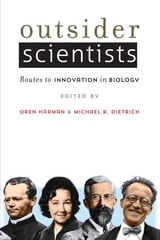
Outsider Scientists
Routes to Innovation in BiologyEdited by Oren Harman and Michael R. Dietrich
University of Chicago Press, 2013
Peril in the Ponds
Deformed Frogs, Politics, and a Biologist's QuestJudy Helgen
University of Massachusetts Press, 2012
By the 1990s, wetlands across the United States were endangered from pollution and decades of drainage to convert them into farmland and urban developments. But when deformed frogs—many with missing legs or eyes, footless stumps, or misshapen jaws—began to emerge from Minnesota wetlands, alarm bells went off. What caused such deformities? Pollution? Ultraviolet rays? Biological agents? And could the mysterious cause also pose a threat to humans?
Judy Helgen writes with passionate concern about vulnerable frogs and wetlands as she navigates through a maze of inquisitive media and a reluctant government agency. She reports on the complexity of a growing catastrophe for frogs and broadens the issue as she researches and meets with scientists from around the world. She affirms the importance of examining aquatic life to understand pollution and the need to rescue our remaining wetlands. She also shares the fears expressed by the teachers, students, and other citizens who found these creatures, sensed a problem, and looked to her for answers. Ultimately, this is a story about the biological beauty of wetlands and our need to pay attention to the environment around us.
Sewall Wright and Evolutionary Biology
William B. Provine
University of Chicago Press, 1986
"In Sewall Wright and Evolutionary Biology . . . Provine has produced an intellectual biography which serves to chart in considerable detail both the life and work of one man and the history of evolutionary theory in the middle half of this century. Provine is admirably suited to his task. . . . The resulting book is clearly a labour of love which will be of great interest to those who have a mature interest in the history of evolutionary theory."-John Durant, ;ITimes Higher Education Supplement;X
Stalking the Big Bird
A Tale of Turkeys, Biologists, and BureaucratsHarley Shaw
University of Arizona Press, 2004
State and federal wildlife agencies have for some sixty years functioned under the belief that increased knowledge produced by research improves our ability to manage wildlife. Shaw suggests that the more we know about a species, the more difficult clear decisions may often become. He offers shrewd observations on the difficulties of interpreting and implementing research results in the face of pressures exerted by government bureaucracies, non-governmental organizations, and politically powerful loggers, ranchers, land developers, and environmentalists. He also shows that management of even a common game bird may be beyond the capabilities of responsible resource management agencies. Through stories about his own experiences studying Merriam's wild turkey—anecdotes about the foibles of field work and the bureaucratic boondoggles of wildlife management—Shaw reveals some of the complexities involved in wildlife research.
Drawing on a lifetime of work and reflection, his book shows that sound research and effective management of this animal—and, by extension, others—are severely hampered by political agendas, social misunderstandings, inappropriate research, and above all, human indifference. As entertaining as it is informative, Stalking the Big Bird will be of interest to environmentalists, hunters, and resource managers—or anyone confused by the practices of modern wildlife conservation. It will help both professionals and lay readers understand our relationship with one wild subspecies, and in the process get a better handle on the true goals in managing the wild.
The Chicago Guide to Landing a Job in Academic Biology
C. Ray Chandler, Lorne M. Wolfe, and Daniel E. L. Promislow
University of Chicago Press, 2007
An academic career in the biological sciences typically demands well over a decade of technical training. So it’s ironic that when a scholar reaches the most critical stage in that career—the search for a job following graduate work—he or she receives little or no formal preparation. Instead, students are thrown into the job market with only cursory guidance on how to search for and land a position.
Now there’s help. Carefully, clearly, and with a welcome sense of humor, The Chicago Guide to Landing a Job in Academic Biology leads graduate students and postdoctoral fellows through the perils and rewards of their first job search. The authors—who collectively have for decades mentored students and served on hiring committees—have honed their advice in workshops at biology meetings across the country. The resulting guide covers everything from how to pack an overnight bag without wrinkling a suit to selecting the right job to apply for in the first place. The authors have taken care to make their advice useful to all areas of academic biology—from cell biology and molecular genetics to evolution and ecology—and they give tips on how applicants can tailor their approaches to different institutions from major research universities to small private colleges.
With jobs in the sciences ever more difficult to come by, The Chicago Guide to Landing a Job in Academic Biology is designed to help students and post-docs navigate the tricky terrain of an academic job search—from the first year of a graduate program to the final negotiations of a job offer.
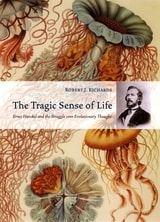
The Tragic Sense of Life
Ernst Haeckel and the Struggle over Evolutionary ThoughtRobert J. Richards
University of Chicago Press, 2008
Prior to the First World War, more people learned of evolutionary theory from the voluminous writings of Charles Darwin’s foremost champion in Germany, Ernst Haeckel (1834–1919), than from any other source, including the writings of Darwin himself. But, with detractors ranging from paleontologist Stephen Jay Gould to modern-day creationists and advocates of intelligent design, Haeckel is better known as a divisive figure than as a pioneering biologist. Robert J. Richards’s intellectual biography rehabilitates Haeckel, providing the most accurate measure of his science and art yet written, as well as a moving account of Haeckel’s eventful life.
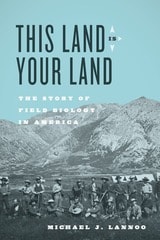
This Land Is Your Land
The Story of Field Biology in AmericaMichael J. Lannoo
University of Chicago Press, 2018
Lannoo illuminates characters such as John Wesley Powell, William Temple Hornaday, and Olaus and Adolph Murie—homegrown midwestern field biologists who either headed east to populate major research centers or went west to conduct their fieldwork along the frontier. From the pioneering work of Victor Shelford, Henry Chandler Cowles, and Aldo Leopold to contemporary insights from biologists such as Jim Furnish and historians such as William Cronon, Lannoo’s unearthing of American—and particularly midwestern—field biologists reveals how these scientists influenced American ecology, conservation biology, and restoration ecology, and in turn drove global conservation efforts through environmental legislation and land set-asides. This Land Is Your Land reveals the little-known legacy of midwestern field biologists, whose ethos and discoveries have enabled us to preserve and understand not just their land, but all lands.
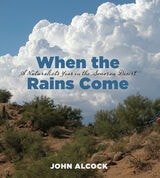
When the Rains Come
A Naturalist’s Year in the Sonoran DesertJohn Alcock
University of Arizona Press, 2009
John Alcock knows the Sonoran Desert better than just about anyone else, and in this book he tracks the changes he observes in plant and animal life over the course of a drought year. Combining scientific knowledge with years of exploring the desert, he describes the variety of ways in which the wait for rain takes place—and what happens when it finally comes.
The desert is a land of five seasons, featuring two summers—hot, dry months followed by monsoon—and Alcock looks at the changes that take place in an entire desert community over the course of all five. He describes what he finds on hikes in the Usery Mountains near Phoenix, where he has studied desert life over three decades and where frequent visits have enabled him to notice effects of seasonal variation that might escape a casual glance.
Blending a personal perspective with field observation, Alcock shows how desert ecology depends entirely on rainfall. He touches on a wide range of topics concerning the desert’s natural history, noting the response of saguaro flowers to heat and the habits of predators, whether soaring red-tailed hawk or tiny horned lizard. He also describes unusual aspects of insects that few desert hikers will have noticed, such as the disruptive color pattern of certain grasshoppers that is more effective than most camouflage.
When the Rains Come is brimming with new insights into the desert, from the mating behaviors of insects to urban sprawl, and features photographs that document changes in the landscape as drought years come and go. It brings us the desert in the harshest of times—and shows that it is still teeming with life.