Results by title
8 books match the query 'Biometric identification'
Age Factors in Biometric Processing
Michael Fairhurst
The Institution of Engineering and Technology, 2013
As biometrics-based identification and identity authentication become increasingly widespread in their deployment, it becomes correspondingly important to consider more carefully issues relating to reliability, usability and inclusion. One factor which is particularly important in this context is that of the relationship between the nature of the measurements extracted from a particular biometric modality and the age of the sample donor, and the effect which age has on physiological and behavioural characteristics invoked in a biometric transaction.
[more]
Artificial Intelligence for Biometrics and Cybersecurity
Technology and applicationsAhmed A. Abd El-Latif
The Institution of Engineering and Technology, 2023
The integration of new technologies is resulting in an increased demand for security and authentication in all types of data communications. Cybersecurity is the protection of networks and systems from theft. Biometric technologies use unique traits of particular parts of the body such facial recognition, iris, fingerprints and voice to identify individuals' physical and behavioural characteristics. Although there are many challenges associated with extracting, storing and processing such data, biometric and cybersecurity technologies along with artificial intelligence (AI) are offering new approaches to verification procedures and mitigating security risks.
[more]

Bodies as Evidence
Security, Knowledge, and PowerMark Maguire, Ursula Rao, and Nils Zurawski, editors
Duke University Press, 2018
From biometrics to predictive policing, contemporary security relies on sophisticated scientific evidence-gathering and knowledge-making focused on the human body. Bringing together new anthropological perspectives on the complexities of security in the present moment, the contributors to Bodies as Evidence reveal how bodies have become critical sources of evidence that is organized and deployed to classify, recognize, and manage human life. Through global case studies that explore biometric identification, border control, forensics, predictive policing, and counterterrorism, the contributors show how security discourses and practices that target the body contribute to new configurations of knowledge and power. At the same time, margins of error, unreliable technologies, and a growing suspicion of scientific evidence in a “post-truth” era contribute to growing insecurity, especially among marginalized populations.
Contributors. Carolina Alonso-Bejarano, Gregory Feldman, Francisco J. Ferrándiz, Daniel M. Goldstein, Ieva Jusionyte, Amade M’charek, Mark Maguire, Joseph P. Masco, Ursula Rao, Antonius C. G. M. Robben, Joseba Zulaika, Nils Zurawski
Contributors. Carolina Alonso-Bejarano, Gregory Feldman, Francisco J. Ferrándiz, Daniel M. Goldstein, Ieva Jusionyte, Amade M’charek, Mark Maguire, Joseph P. Masco, Ursula Rao, Antonius C. G. M. Robben, Joseba Zulaika, Nils Zurawski
[more]
Iris and Periocular Biometric Recognition
Christian Rathgeb
The Institution of Engineering and Technology, 2017
Iris recognition technologies for identity management are already deployed globally in several large-scale nationwide biometric projects and are currently entering the mobile market. More recently, periocular recognition has been employed to augment the biometric performance of the iris in unconstrained environments where only the ocular region is present in the image.
[more]
Mobile Biometrics
Guodong Guo
The Institution of Engineering and Technology, 2017
Mobile biometrics - the use of physical and/or behavioral characteristics of humans to allow their recognition by mobile/smart phones - aims to achieve conventional functionality and robustness while also supporting portability and mobility, bringing greater convenience and opportunity for its deployment in a wide range of operational environments from consumer applications to law enforcement. But achieving these aims brings new challenges such as issues with power consumption, algorithm complexity, device memory limitations, frequent changes in operational environment, security, durability, reliability, and connectivity. Mobile Biometrics provides a timely survey of the state of the art research and developments in this rapidly growing area.
[more]
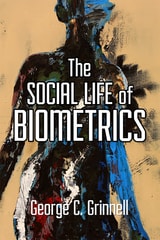
The Social Life of Biometrics
George C Grinnell
Rutgers University Press, 2020
In The Social Life of Biometrics, biometrics is loosely defined as a discrete technology of identification that associates physical features with a legal identity. Author George Grinnell considers the social and cultural life of biometrics by examining what it is asked to do, imagined to do, and its intended and unintended effects. As a human-focused account of technology, the book contends that biometrics needs to be understood as a mode of thought that informs how we live and understand one another; it is not simply a neutral technology of identification. Placing our biometric present in historical and cultural perspective, The Social Life of Biometrics examines a range of human experiences of biometrics. It features individual stories from locations as diverse as Turkey, Canada, Qatar, Six Nations territory in New York State, Iraq, the skies above New York City, a university campus and Nairobi to give cultural accounts of identification and look at the ongoing legacies of our biometric ambitions. It ends by considering the ethics surrounding biometrics and human identity, migration, movement, strangers, borders, and the nature of the body and its coherence. How has biometric thought structured ideas about borders, race, covered faces, migration, territory, citizenship, and international responsibility? What might happen if identity was less defined by the question of “who’s there?” and much more by the question “how do you live?”
[more]
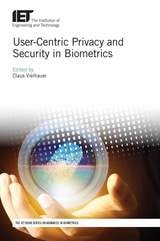
User-Centric Privacy and Security in Biometrics
Claus Vielhauer
The Institution of Engineering and Technology, 2018
The interplay of privacy, security and user-determination is an important consideration in the roll-out of biometric technologies. It brings into play requirements such as privacy of biometric data in systems, communication and databases, soft biometric profiling, biometric recognition of persons across distributed systems and in nomadic scenarios, and the convergence between user convenience, usability and authentication reliability.
[more]
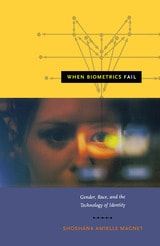
When Biometrics Fail
Gender, Race, and the Technology of IdentityShoshana Amielle Magnet
Duke University Press, 2011
From digital fingerprinting to iris and retina recognition, biometric identification systems are a multibillion dollar industry and an integral part of post-9/11 national security strategy. Yet these technologies often fail to work. The scientific literature on their accuracy and reliability documents widespread and frequent technical malfunction. Shoshana Amielle Magnet argues that these systems fail so often because rendering bodies in biometric code falsely assumes that people’s bodies are the same and that individual bodies are stable, or unchanging, over time. By focusing on the moments when biometrics fail, Magnet shows that the technologies work differently, and fail to function more often, on women, people of color, and people with disabilities. Her assessment emphasizes the state’s use of biometrics to control and classify vulnerable and marginalized populations—including prisoners, welfare recipients, immigrants, and refugees—and to track individuals beyond the nation’s territorial boundaries. When Biometrics Fail is a timely, important contribution to thinking about the security state, surveillance, identity, technology, and human rights.
[more]