Results by title

4 books match the query 'Black Music'
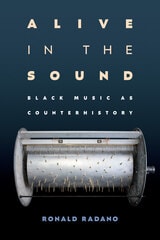
cover of Alive in the Sound: Black Music as Counterhistory

Alive in the Sound

Black Music as Counterhistory

Ronald Radano

Duke University Press, 2025
In Alive in the Sound, Ronald Radano proposes a new understanding of US Black music by focusing on the key matter of value, manifested musically in its seemingly embodied qualities—spirit, soul, and groove. While acknowledging these qualities are always embedded in Black music, Radano shows they developed not simply from performance but from musicians’ status as laborers inhabiting an enduring racial-economic contradiction: Black music originated publicly as an exchangeable property owned by people whose subhuman status granted them—as “natural” musicians—indelible properties of sound. As a contradiction of the rules of ownership, wherein enslaved property was forbidden the right to own, modern Black music emerges after emancipation as a primary possession, moving dialectically into commercial markets and counterhistorically back into Black worlds. Slavery’s seminal contests of ownership underlie modern musical sensations of aliveness, which become the chief measure of value in popular music. By reconceiving US Black music history as a history of value, Radano rethinks the music’s place in US and global culture.
[more]
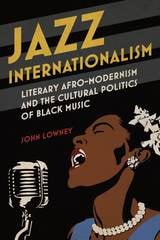
cover of Jazz Internationalism: Literary Afro-Modernism and the Cultural Politics of Black Music

Jazz Internationalism

Literary Afro-Modernism and the Cultural Politics of Black Music

John Lowney

University of Illinois Press, 2017

Jazz emerged during the political and social upheaval of world war, communist revolution, Red Scares, and the Black Migration. The tumult bred disagreements about the cultural significance of jazz that concerned both its African American roots and its international appeal. The questions about what was new or even radical about the music initiated debates that writers recapitulated for decades.

Jazz Internationalism offers a bold reconsideration of jazz's influence in Afro-modernist literature. Ranging from the New Negro Renaissance through the social movements of the 1960s, John Lowney articulates nothing less than a new history of Afro-modernist jazz writing. Jazz added immeasurably to the vocabulary for discussing radical internationalism and black modernism in leftist African American literature. Lowney examines how Claude McKay, Ann Petry, Langston Hughes, and many other writers employed jazz as both a critical social discourse and mode of artistic expression to explore the possibilities—and challenges—of black internationalism. The result is an expansive understanding of jazz writing sure to spur new debates.
[more]
cover of Lying up a Nation: Race and Black Music

Lying up a Nation

Race and Black Music

Ronald M. Radano

University of Chicago Press, 2003
What is black music? For some it is a unique expression of the African-American experience, its soulful vocals and stirring rhythms forged in the fires of black resistance in response to centuries of oppression. But as Ronald Radano argues in this bracing work, the whole idea of black music has a much longer and more complicated history-one that speaks as much of musical and racial integration as it does of separation.
[more]
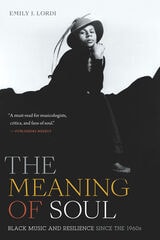
cover of The Meaning of Soul: Black Music and Resilience since the 1960s

The Meaning of Soul

Black Music and Resilience since the 1960s

Emily J. Lordi

Duke University Press, 2020

In The Meaning of Soul, Emily J. Lordi proposes a new understanding of this famously elusive concept. In the 1960s, Lordi argues, soul came to signify a cultural belief in black resilience, which was enacted through musical practices—inventive cover versions, falsetto vocals, ad-libs, and false endings. Through these soul techniques, artists such as Aretha Franklin, Donny Hathaway, Nina Simone, Marvin Gaye, Isaac Hayes, and Minnie Riperton performed virtuosic survivorship and thus helped to galvanize black communities in an era of peril and promise. Their soul legacies were later reanimated by such stars as Prince, Solange Knowles, and Flying Lotus. Breaking with prior understandings of soul as a vague masculinist political formation tethered to the Black Power movement, Lordi offers a vision of soul that foregrounds the intricacies of musical craft, the complex personal and social meanings of the music, the dynamic movement of soul across time, and the leading role played by black women in this musical-intellectual tradition.
[more]