Results by title
9 books match the query 'Black people in art'
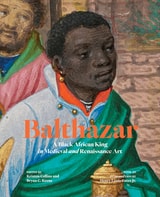
Balthazar
A Black African King in Medieval and Renaissance ArtKristen Collins
J. Paul Getty Trust, The, 0
According to the Gospel of Matthew, magi from the East, following a star, traveled to Jerusalem bearing precious gifts for the infant Jesus. The magi were revered as wise men and later as kings. Over time, one of the three came to be known as Balthazar and to be depicted as a Black man.
Balthazar was familiar to medieval Europeans, appearing in paintings, manuscript illuminations, mosaics, carved ivories, and jewelry. But the origin story of this fascinating character uncovers intricate ties between Europe and Africa, including trade and diplomacy as well as colonization and enslavement.
In this book, experts in the fields of Ethiopian, West African, Nubian, and Western European art explore the representation of Balthazar as a Black African king. They examine exceptional art that portrays the European fantasy of the Black magus while offering clues about the very real Africans who may have inspired these images. Along the way, the authors chronicle the Black presence in premodern Europe, where free and enslaved Black people moved through public spaces and courtly circles. The volume’s lavish illustrations include selected works by contemporary artists who creatively challenge traditional depictions of Black history.

Black Aliens
Kinship in the Cosmic DiasporaJoanna Davis-McElligatt
The Ohio State University Press, 2026
Analyzing prose, poetry, film, record albums, comic books, illustrations, art installations, and exhibition catalogues, Davis-McElligatt traces how Octavia E. Butler, Maisy Card, Sun Ra, and Dwayne McDuffie and M. D. Bright visualize aliens whose bodies and beings are subject to interpellation as Black on Earth. She argues that these creators intentionally locate the Black alien as a subject whose galactic bonds are constructed in and as narrative form itself, made manifest in plot, characterization, and narrativization. In recasting narrative spacetime, they reimagine Black entanglements, kinship systems, and histories as a cosmic diaspora.
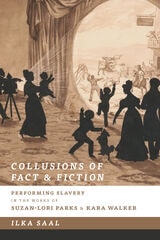
Collusions of Fact and Fiction
Performing Slavery in the Works of Suzan-Lori Parks and Kara WalkerSaal, Ilka
University of Iowa Press, 2021
Saal argues that the attempt to reconstruct or recuperate the experience of African Americans under slavery is no longer at stake in the works of artists growing up in the post–Civil Rights era. Instead, they lay bare the discursive dimension of our contemporary understanding of the past and address the continued impact of its various verbal and visual signs upon contemporary identities. In this manner, Parks and Walker stake out new possibilities for engaging the past and inhabiting the present and future.
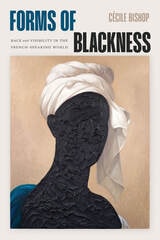
Forms of Blackness
Race and Visibility in the French-Speaking WorldCécile Bishop
Duke University Press, 2025
Considering race as form across literature, theory, painting, and photography, Cécile Bishop’s Forms of Blackness explores the formal devices that make blackness both visible and recognizable. In keeping with black Francophone theorists like Édouard Glissant and Frantz Fanon, Bishop uses the ambiguities these aesthetic forms carry to explore a range of identity concepts like opacity, formlessness, and doubleness. Bishop puts blackness-as-race and blackness-as-form in dialogue, showing how race disrupts the concept of artistic autonomy and how the aesthetic challenges race as a self-evident visual phenomenon. When thought together, form does not isolate blackness from race but rather calls attention to the material substrate that turns race into a phenomenon that can be experienced through sense perception. Moving between careful analysis and experimental modes of critique, Forms of Blackness offers a new way of thinking about the politics of visibility and offers a pressing invitation to question the ways we interpret what we see.
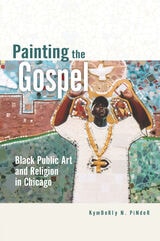
Painting the Gospel
Black Public Art and Religion in ChicagoKymberly Pinder
University of Illinois Press, 2016
Painting the Gospel includes maps and tour itineraries that allow readers to make conceptual, historical, and geographical connections among the works.
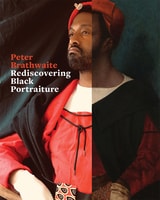
Rediscovering Black Portraiture
Peter Brathwaite
J. Paul Getty Trust, The, 0
“These mirror images with their uncanny resemblances traverse space and time, spotlighting the black lives that have been silenced by the canon of western art, while also inviting us to interrogate the present.” —Times (UK)
Since the beginning of the COVID-19 pandemic, Peter Brathwaite has thoughtfully researched and reimagined more than one hundred artworks featuring portraits of Black sitters—all posted to social media with the caption “Rediscovering #blackportraiture through #gettymuseumchallenge.”
Rediscovering Black Portraiture collects more than fifty of Brathwaite’s most intriguing re-creations. Introduced by the author and framed by contributions from experts in art history and visual culture, this fascinating book offers a nuanced look at the complexities and challenges of building identity within the African diaspora and how such forces have informed Black portraits over time. Artworks featured include The Adoration of the Magi by Georges Trubert, Portrait of an Unknown Man by Jan Mostaert, Rice n Peas by Sonia Boyce, Barack Obama by Kehinde Wiley, and many more. This volume also invites readers behind the scenes, offering a glimpse of the elegant artifice of Brathwaite’s props, setup, and process.
An urgent and compelling exploration of embodiment, representation, and agency, Rediscovering Black Portraiture serves to remind us that Black subjects have been portrayed in art for nearly a millennium and that their stories demand to be told.
An exhibition of Brathwaite’s re-creations is on view at the Bristol Museum & Art Gallery in Bristol, UK from April 14 to September 3, 2023.
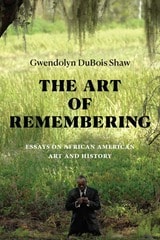
The Art of Remembering
Essays on African American Art and HistoryGwendolyn DuBois Shaw
Duke University Press, 2024

The World Before Racism
An Art StoryLisa E. Farrington
The Artist Book Foundation, 2025
Utilizing works of art as a primary source, Lisa Farrington's research in The World Before Racism conclusively answers the questions: Who invented racism? When? And why?
The term racism is understood to mean that race is the principal determinant of specific human traits and capacities and that due to racial differences, one race is inherently superior to all others. Over time, racism has commonly referenced the notion that the White race is superior to all others, fostering prejudice and discrimination. In The World Before Racism: An Art Story, author and art historian Lisa Farrington meticulously examines the intersection of art, history, and race, using original works of art as primary source materials to support her premise that racism is a construct, invented in the mid-1700s, to support the financial, political, and religious structures of European colonialism.
Using art from ancient Egypt, classical Greece, and the Roman Empire, through Medieval Europe and the colonization of the New World, to the art of the present day—sources that cannot be easily altered, edited, or selectively translated—Farrington expertly examines the intricate interplay between the Black and White races, how they saw and understood each other over the centuries. The artworks serve as powerful voices, precisely conveying the artist’s intended messages. The goal of The World Before Racism is to present irrefutable evidence that the ideology of racism is unfounded, unsupported, unjustified, and destined to fade away like so many other archaic and erroneous ideas.

Value in Art
Manet and the Slave TradeHenry M. Sayre
University of Chicago Press, 2022
How did art critics come to speak of light and dark as, respectively, “high in value” and “low in value”? Henry M. Sayre traces the origin of this usage to one of art history’s most famous and racially charged paintings, Édouard Manet’s Olympia.
Art critics once described light and dark in painting in terms of musical metaphor—higher and lower tones, notes, and scales. Sayre shows that it was Émile Zola who introduced the new “law of values” in an 1867 essay on Manet. Unpacking the intricate contexts of Zola’s essay and of several related paintings by Manet, Sayre argues that Zola’s usage of value was intentionally double coded—an economic metaphor for the political economy of slavery. In Manet’s painting, Olympia and her maid represent objects of exchange, a commentary on the French Empire’s complicity in the ongoing slave trade in the Americas.
Expertly researched and argued, this bold study reveals the extraordinary weight of history and politics that Manet’s painting bears. Locating the presence of slavery at modernism’s roots, Value in Art is a surprising and necessary intervention in our understanding of art history.