Results by title
3 books match the query 'Body Politics'
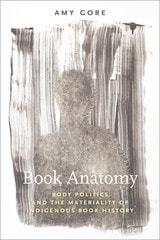
Book Anatomy
Body Politics and the Materiality of Indigenous Book HistoryAmy Gore
University of Massachusetts Press, 2023
Winner of the Beatrice Medicine Award for Scholarship in American Indian Studies
From the marginalia of their readers to the social and cultural means of their production, books bear the imprint of our humanity. Embodying the marks, traces, and scars of colonial survival, Indigenous books are contested spaces. A constellation of nontextual components surrounded Native American–authored publications of the long nineteenth century, shaping how these books were read and understood—including illustrations, typefaces, explanatory prefaces, appendices, copyright statements, author portraits, and more.
Centering Indigenous writers, Book Anatomy explores works from John Rollin Ridge, Sarah Winnemucca Hopkins, Pretty Shield, and D’Arcy McNickle published between 1854 and 1936. In examining critical moments of junction between Indigenous books and a mainstream literary marketplace, Amy Gore argues that the reprints, editions, and paratextual elements of Indigenous books matter: they embody a frontline of colonization in which Native authors battle the public perception and reception of Indigenous books, negotiate representations of Indigenous bodies, and fight for authority and ownership over their literary work.
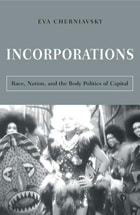
Incorporations
Race, Nation, and the Body Politics of CapitalEva Cherniavsky
University of Minnesota Press, 2006
An exploration of race, Hollywood, and the commodification of the body
Incorporations offers a new way of thinking about issues of race, bodies, and commodity culture. Moving beyond the study of identity and difference in media, Eva Cherniavsky asserts that race can be understood as a sign of the body’s relation to capital.
In Incorporations, Cherniavsky interrogates the interplay of nationalism, colonialism, and capitalism in the production of racial embodiment. Testing the links between race and capital, Incorporations examines how media culture transmutes white bodies into commodity-images in such films as Blonde Venus, A Touch of Evil, and Fargo, in the television series The Simpsons, and in the fiction of Octavia Butler and Leslie Marmon Silko. Cherniavsky posits an innovative approach to whiteness studies that does not focus on the emancipatory possibilities of cross-racial identification.Working with the tools of critical race theory as well as postcolonial and cultural studies, Cherniavsky demonstrates how representations of racial embodiment have evolved, and suggests that “race” is the condition of exchangeable bodies under capital.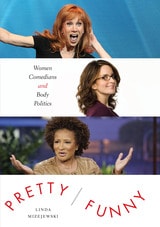
Pretty/Funny
Women Comedians and Body PoliticsBy Linda Mizejewski
University of Texas Press, 2014
Women in comedy have traditionally been pegged as either “pretty” or “funny.” Attractive actresses with good comic timing such as Katherine Hepburn, Lucille Ball, and Julia Roberts have always gotten plum roles as the heroines of romantic comedies and television sitcoms. But fewer women who write and perform their own comedy have become stars, and, most often, they’ve been successful because they were willing to be funny-looking, from Fanny Brice and Phyllis Diller to Lily Tomlin and Carol Burnett. In this pretty-versus-funny history, women writer-comedians—no matter what they look like—have ended up on the other side of “pretty,” enabling them to make it the topic and butt of the joke, the ideal that is exposed as funny.
Pretty/Funny focuses on Kathy Griffin, Tina Fey, Sarah Silverman, Margaret Cho, Wanda Sykes, and Ellen DeGeneres, the groundbreaking women comics who flout the pretty-versus-funny dynamic by targeting glamour, postfeminist girliness, the Hollywood A-list, and feminine whiteness with their wit and biting satire. Linda Mizejewski demonstrates that while these comics don’t all identify as feminists or take politically correct positions, their work on gender, sexuality, and race has a political impact. The first major study of women and humor in twenty years, Pretty/Funny makes a convincing case that women’s comedy has become a prime site for feminism to speak, talk back, and be contested in the twenty-first century.