Results by title

8 books match the query 'Bové, Paul A.'
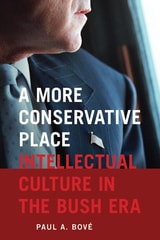
cover of A More Conservative Place: Intellectual Culture in the Bush Era

A More Conservative Place

Intellectual Culture in the Bush Era

Paul A. Bové

Dartmouth College Press, 2013
Identifying the historical antecedents of President George W. Bush’s imperial ambitions and the sources of the reactionary thought and politics that underlie them, Paul A. Bové shows how neoconservatism represents a singular danger to democracy. At the same time, he criticizes the equally disheartening inability of the academic Left to oppose neoconservatives and its tendency to mirror their views instead. Divorced from historical knowledge and intellectual rigor, the neocon mindset reflects a cultural and historical amnesia that feeds on ignorance and conformity. Exposing the threats to national survival inherent in the alliance of right-wing politics and academic tribalism, Bové emphasizes the need to reconnect with the powers of imagination and the complexity of human historical experience. With urgency and passion, Bové shows how the neocons have succeeded in cowing or coopting academic intellectuals and how language has been used and abused for the maintenance and extension of an undemocratic regime.
[more]
cover of Critique and Cosmos: After Misao Miyoshi

Critique and Cosmos

After Misao Miyoshi

Rob Wilson and Paul A. Bové, special issue editors

Duke University Press, 0

This special issue aims to channel the energies, tactics, critical forces, and comparative poetics Masao Miyoshi (1928–2009) carried out in his work from the 1970s on: coming to terms with his concept of aftering (the act of prolonging and transforming impacts across cultural, political, and disciplinary borders) and its temporal, border-crossing, translational, field-reframing, and revisionary effects. Contributors do not assess his scholarship and photography in any memorial, critical, or honorific sense. Instead, they seek to renew the critical visions that he distributed across various fields, from Asian to Asian American studies and beyond. Each takes seriously the mandate inside Miyoshi's work that cultural criticism envision its work broadly and courageously. Essays address the state of Japan studies; China's role in twentieth-century geopolitics, particularly involving Tibet; the critical ethos of "the planetary" in the Anthropocene; and the Korean film Snowpiercer, whose plot represents an embodiment of killer capitalism.

Contributors. Tsering Wangmo Dhompa, Arif Dirlik, Harry Harootunian, Reginald Jackson, Mary Layoun, Christine L. Marran, George Solt, Keijiro Suga, Stefan Tanaka, Chih-ming Wang, Rob Wilson
[more]
cover of Early Postmodernism: Foundational Essays

Early Postmodernism

Foundational Essays

Paul A. Bové

Duke University Press, 1995

In the decade that followed 1972, the journal boundary 2 consistently published many of the most distinguished and most influential statements of an emerging literary postmodernism. Recognizing postmodernism as a dominant force in culture, particularly in the literary and narrative imagination, the journal appeared when literary critical study in the United States was in a period of theory-induced ferment. The fundamental relations between postmodernism and poststructuralism were being initially examined and the effort to formulate a critical sense of the postmodern was underway. In this volume, Paul A. Bové, the current editor of boundary 2, has gathered many of those foundational essays and, as such, has assembled a basic text in the history of postmodernism.
Essays by noted cultural and literary theorists join with Bové’s contemporary preface to represent the important and unique moment in recent intellectual history when postmodernism was no longer seen primarily as an architectural term, had not yet come to describe the wide range of culture it does now, but was finding power and place in the literary realm. These essays show that the history of postmodernism and its attendant critical theories are both more complex and more deeply bound with literary criticism than often is acknowledged today. Early Postmodernism demonstrates not only the significance of these literary studies, but also the role played by literary critical postmodernism in making possible newer forms of critical and cultural studies.

Contributors. Barry Alpert, Charles Altieri, David Antin, Harold Bloom, Paul A. Bové, Hélène Cixous, Gerald Gillespie, Ihab Hassan, Joseph N. Riddel, William, V. Spanos, Catharine R. Stimpson, Cornel West
[more]
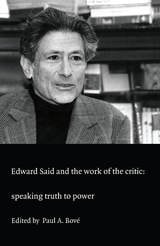
cover of Edward Said and the Work of the Critic: Speaking Truth to Power

Edward Said and the Work of the Critic

Speaking Truth to Power

Paul A. Bové, ed.

Duke University Press, 2000

For at least two decades the career of Edward Said has defined what it means to be a public intellectual today. Although attacked as a terrorist and derided as a fraud for his work on behalf of his fellow Palestinians, Said’s importance extends far beyond his political activism. In this volume a distinguished group of scholars assesses nearly every aspect of Said’s work—his contributions to postcolonial theory, his work on racism and ethnicity, his aesthetics and his resistance to the aestheticization of politics, his concepts of figuration, his assessment of the role of the exile in a metropolitan culture, and his work on music and the visual arts.

In two separate interviews, Said himself comments on a variety of topics, among them the response of the American Jewish community to his political efforts in the Middle East. Yet even as the Palestinian struggle finds a central place in his work, it is essential—as the contributors demonstrate—to see that this struggle rests on and gives power to his general "critique of colonizers" and is not simply the outgrowth of a local nationalism. Perhaps more than any other person in the United States, Said has changed how the U.S. media and American intellectuals must think about and represent Palestinians, Islam, and the Middle East. Most importantly, this change arises not as a result of political action but out of a potent humanism—a breadth of knowledge and insight that has nourished many fields of inquiry. Originally a special issue of boundary 2, the book includes new articles on minority culture and on orientalism in music, as well as an interview with Said by Jacqueline Rose.

Supporting the claim that the last third of the twentieth century can be called the "Age of Said," this collection will enlighten and engage students in virtually any field of humanistic study.


Contributors. Jonathan Arac, Paul A. Bové, Terry Cochran, Barbara Harlow, Kojin Karatani, Rashid I. Khalidi, Sabu Kohsu, Ralph Locke, Mustapha Marrouchi, Jim Merod, W. J. T. Mitchell, Aamir R. Mufti, Jacqueline Rose, Edward W. Said, Gayatri Chakravorty Spivak, Lindsay Waters
[more]
cover of Edward W. Said, Volume 25

Edward W. Said, Volume 25

Paul Bové

Duke University Press, 0

This volume begins to show why the current period in humanistic studies could be known as "The Age of Edward Said." The collection brings together outstanding intellectuals from the wide variety of fields to which Edward Said, the most important humanist of his generation, has made contributions: literary criticism, postcolonial studies, musicology, Middle Eastern Studies, anthropology, and journalism.

Featured is a new interview with Said, conducted by W. J. T. Mitchell, in which Said discusses the importance of the visual to his thinking, specifically the works of Goya and Caravaggio, which in turn made possible Said's valuable contributions to our understanding of photography and painting. Other contributions reflect on Said's influences on the American public sphere; the subtle personal politics that inform the relationship between music and emotion; Said's importance to a thinking about "race before racism" and the disappearance of the American; and jazz man Jim Merod reflects on Said's "sublime lyrical abstractions."

Covering with insight the many debates Said so deftly entered and formed, the distinguished contributors to this volume reflect upon his oeuvre to create an atmosphere of thoughtfulness, questioning, and interactivity.
[more]
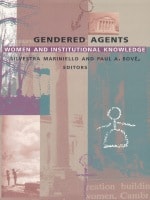
cover of Gendered Agents: Women and Institutional Knowledge

Gendered Agents

Women and Institutional Knowledge

Silvestra Mariniello and Paul A. Bové, eds.

Duke University Press, 1998

Gendered Agents, edited by Silvestra Mariniello andPaul A. Bové, presents essays by influential feminist theorists who challenge traditional Western epistemology and suggest new directions for feminism. By examining both literary and historical discourses, such critics as Gayatri Spivak, Hortense Spillers, and Lauren Berlant assess questions of sexuality, ethics, race, psychoanalysis, subjectivity, and identity.
Gathered from various issues of the journal boundary 2, the essays in Gendered Agents seek to transform the model of Western academic knowledge by restructuring its priorities and values. In the introduction, Mariniello urges feminists to begin anew but take as their starting place the achievements of feminism and feminist theory: an understanding of language that considers the implications of silence, the motivation to decompartmentalize experience, and the acknowledgement that everything is political. Challenging both a canonical organization of knowledge and the persistently self-referential "ghettoization" of feminism, contributors subsequently tackle subjects as diverse as pre-Marxist France, the American fetus, black intellectuals, queer nationality, and the art of literary interpretation.

Contributors. Lauren Berlant, Karen Brennan, Margaret Cohen, Nancy Fraser, Elizabeth Freeman, Carol Jacobs, Silvestra Mariniello, Larysa Mykyta, Laura Rice, Ivy Schweitzer, Doris Sommer, Hortense J. Spillers, Gayatri Chakravorty Spivak, Judith Wilt

[more]
cover of Mastering Discourse: The Politics of Intellectual Culture

Mastering Discourse

The Politics of Intellectual Culture

Paul A. Bové

Duke University Press, 1992

Mastering Discourse gathers and elaborates more than a decade of thought on the problems of the intellectual in contemporary society, by one of the most distinguished critics writing on these issues today. From Derrida and Foucault to Kristeva and Irigaray, Paul A. Bové looks at the practices of literary and cultural theory, and discusses the way theorists have produced their institutional positions and politics. Examining some of the major theories developed out of and in relation to the problems of discourse, Bové analyzes the limited successes and failures of these efforts.
Mastering Discourses offers an account of why "theory" fails to deal adequately with the politics of discursive cultures and warns that unless critics take much more seriously their own disciplinary inscriptions they will always reproduce structures of power and knowledge that they claim to oppose. Moreover, Bové argues, they will not fulfill the main role of the post-enlightenment intellectual, namely: to respond effectively to the present, through new theoretical and historical formulations that address the changing world of transnational capitalism and its neoliberal ideologies.
[more]
cover of The University, Volume 27

The University, Volume 27

Paul A. Bové, ed.

Duke University Press, 0

The essays collected in this issue of boundary 2 were written in response to a call for papers that would treat the contemporary university, in various regions and stages of formation around the world, in light of the interaction between local and global realities. Underlying this project is the assumption that profound changes in economy and world organization transform the function and value of universities in tension not only with the regional histories and forces in which particular universities function but also with what used to be called "the idea of the university." The authors of these essays approach this topic in two ways: some present the history and current situation of the university in a given place and politics, and some write of the new university’s political economy as the state withdraws support for higher education and hands the institutions over to entrepreneurial and transnational corporate culture. None of these essays defends the idea that the university pursues knowledge for its own sake. Yet there is a tinge of nostalgia for this idea, or at least for the idea that the university’s task is to educate, to destroy bias, to cultivate. Of course, such an idea remains the public justification for the existence of the university, especially in the advanced capitalist societies, whose higher classes benefit the most from the globalization of economic production.
[more]