Results by title
7 books match the query 'Brazilians'

Communicating with Brazilians
When "Yes" Means "No"By Tracy Novinger
University of Texas Press, 2004
Brazilians are gracious, friendly, fun-loving people, which makes their country a very inviting place to visit for pleasure or business. So great is their cordiality that Brazilians will say "yes" to almost any request—even when they actually mean "no"—which can be quite confusing for U.S. visitors who are used to a more direct style of communication. In fact, as Americans spend time in Brazil, they discover a number of cultural differences that can hamper their communication with Brazilians. To overcome these barriers, this book analyzes Brazilian culture and modes of communication and compares them with their American counterparts to help Americans learn to communicate successfully with Brazilians and vice versa.
To aid Americans in understanding the Brazilian perspective, Tracy Novinger presents a portrait of Brazil's history, racial fusion, economy, and contemporary lifestyles. She focuses in on many aspects of Brazilian culture, such as social organization and ranking systems; preconceptions, worldviews, and values; sexual behaviors and eating customs; thought patterns; nonverbal communication such as the use of time, space, gestures, touch, eye contact, rituals, etc.; and differences in Brazilian and American point-making styles when negotiating, persuading, and conversing. For quick reference, she concludes the book with a summary and checklist of the leading Brazilian cultural characteristics, as well as eight recommendations for enhancing intercultural communication.

Goodbye, Brazil
Émigrés from the Land of Soccer and SambaMaxine L. Margolis
University of Wisconsin Press, 2013
Goodbye, Brazil is the first book to provide a global perspective on Brazilian emigration. Drawing and synthesizing data from a host of sociological and anthropological studies, preeminent Brazilian immigration scholar Maxine L. Margolis surveys and analyzes this greatly expanded Brazilian diaspora, asking who these immigrants are, why they left home, how they traveled abroad, how the Brazilian government responded to their exodus, and how their host countries received them. Margolis shows how Brazilian immigrants, largely from the middle rungs of Brazilian society, have negotiated their ethnic identity abroad. She argues that Brazilian society abroad is characterized by the absence of well-developed, community-based institutions—with the exception of thriving, largely evangelical Brazilian churches.
Margolis looks to the future as well, asking what prospects at home and abroad await the new generation, children of Brazilian immigrants with little or no familiarity with their parents' country of origin. Do Brazilian immigrants develop such deep roots in their host societies that they hesitate to return home despite Brazil's recent economic boom—or have they become true transnationals, traveling between Brazil and their adopted lands but feeling not quite at home in either one?
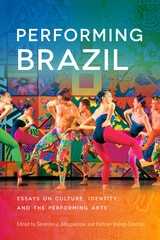
Performing Brazil
Essays on Culture, Identity, and the Performing ArtsEdited by Severino J. Albuquerque and Kathryn Bishop-Sanchez
University of Wisconsin Press, 2015
The contributors to the volume are Maria José Somerlate Barbosa, Eric A. Galm, Annie McNeill Gibson, Ana Paula Höfling, Benjamin Legg, Bryan McCann, Simone Osthoff, Fernando de Sousa Rocha, Cristina F. Rosa, Alessandra Santos, and Lidia Santos.

Searching for Home Abroad
Japanese Brazilians and TransnationalismJeffrey Lesser, ed.
Duke University Press, 2003
The concepts of home and diaspora are engaged and debated throughout the volume. Drawing on numerous sources—oral histories, interviews, private papers, films, myths, and music—the contributors highlight the role ethnic minorities have played in constructing Brazilian and Japanese national identities. The essayists consider the economic and emotional motivations for migration as well as a range of fascinating cultural outgrowths such as Japanese secret societies in Brazil. They explore intriguing paradoxes, including the feeling among many Japanese-Brazilians who have migrated to Japan that they are more "Brazilian" there than they were in Brazil. Searching for Home Abroad will be of great interest to scholars of immigration and ethnicity in the Americas and Asia.
Contributors. Shuhei Hosokawa, Angelo Ishi, Jeffrey Lesser, Daniel T. Linger, Koichi Mori, Joshua Hotaka Roth, Takeyuki (Gaku) Tsuda, Keiko Yamanaka, Karen Tei Yamashita

Stella Manhattan
Silviano Santiago
Duke University Press, 1994
After being forced from his native country by an unforgiving father who embodies the authoritarian temper of the Brazilian dictatorship and is embarrassed by his son’s homosexuality and transvestism, Stella Manhattan, alter ego of Eduardo da Costa e Silva, lands a job in the Brazilian consulate with the help of his father’s friend, Colonel Valdevinos Vianna. Eduardo is also recruited by Vianna to help him bring his own alter ego, the sadomasochist Black Widow, out of the closet. Transformed by black leather, the Black Widow cruises the streets and bars of New York in search of American flesh. Surrounding the relationship between these two men is a group of Brazilian guerrillas who attempt to press Eduardo into their service in order to entrap the colonel. The guerrillas are at the center of a network of revolutionaries, from the Cubans to the Black Panthers and the Young Lords. Virtually apolitical, Eduardo/Stella is drawn by desire into the conflict between the Brazilian government and its communist opposition.
Eduardo also gets caught in the designs of other memorable characters of various sexual and political persuasions: the reactionary professor Aníbal, confined to a wheelchair, who enjoys watching his wife Leila make love with men she picks up on the street; and Paco, alias La Cucaracha, a flamboyant queen, a rabid anti-Castro Cuban exile, and the most sympathetic of this gallery of outcasts.
Working through two complex themes—politics and sex—Santiago sets the action in New York to emphasize the interaction of the seemingly contradictory impulses of liberation and Americanization that Brazil underwent in the late 1960s. As in Manuel Puig’s Kiss of the Spider Woman, political and sexual liberation cut two ways—neither one necessarily compatible with the other. Exploring the complexities of repression that affect all forms of identity, Santiago mingles tragedy and farce as international intrigues are played out in New York’s Latino and black neighborhoods, and the genteel world of international diplomacy is thrust into the milieu of urban gay street life.

The Brazilians
Their Character and AspirationsBy José Honório Rodrigues
University of Texas Press, 1967
Brazil has long been a country in search of its own meaning and mission. Early in their history Brazilians began to puzzle over their surroundings and their relation to them. The eighteenth century produced an entire school of nativistic writers who, with the advent of independence, became fiery nationalists, still pursuing introspective studies of their homeland. Throughout the nineteenth century, the intellectuals of Brazil determined to define their nation, its character, and its aspirations.
In this now well-established tradition, José Honório Rodrigues confronts the questions of who and what the Brazilian is, what Brazil stands for, where it has been, and where it is going. This study, originally published in Portuguese as Aspirações nacionais, was especially timely at a period when strong feelings of nationalism led Brazilians to seek to define their own image, and when the revolution of rising expectations disposed them to determine what goals they were seeking and how far they were on the road to achieving them.
In order to understand and explain his nation, Rodrigues poses two questions: what are the national characteristics, and what are the national aspirations? Both questions are complex, but the reader will find well-reasoned answers, with a wealth of information on growth and development and abundant statistics to substantiate these answers.

Transnational Desires
Brazilian Erotic Dancers in New YorkSuzana Maia
Vanderbilt University Press, 2012
Their motivation to migrate and to work as erotic dancers can also be understood in the context of a representational system, inaugurated in colonial times, that emphasizes the exoticism of Brazilian womentheir bodies, their skin tone, their sexuality. These stereotypes are the props that Brazilian women use to construct their performances in Manhattan and Queens gentlemen's bars and the language through which they negotiate their relationships to society at large.
Transnational Desires focuses on the lives of nine Brazilian dancers with whom the author, herself a middleclass Brazilian, developed close relationships over the years. Maia examines their social relations both in the bar scene and with family, friends, and lovers outside. She shows that for these women erotic dancing is part of a life trajectory that involves negotiating their social position and life prospects in a fundamentally transnational social universe.