Results by title
16 books match the query 'Breaking'

Breaking the Banks
Representations and Realities in New England Fisheries, 1866-1966Matthew McKenzie
University of Massachusetts Press, 2018
Books, films, and the media have long portrayed the Yankee fisherman's hard-scrabble existence, as he faced brutal weather on the open seas and unnecessary governmental restrictions. As McKenzie contends, this simplistic view has long betrayed commercial fisheries' sophisticated legislative campaigns in Washington, DC, as they sought federal subsidies and relief and, eventually, fewer constricting regulations. This clash between fisheries' representation and their reality still grips fishing communities today as they struggle to navigate age-old trends of fleet consolidation, stock decline, and intense competition.

Breaking the Barnyard Barrier
A Woman Veterinarian Paves the WayLinda Rhodes
University of Nevada Press, 2026
In Breaking the Barnyard Barrier, Linda Rhodes tells the story of how a woman, through grit and tears, made her way in a man’s world and blazed a path that prevailed against career stereotypes.

Breaking the Chains
Gender, Context, and the Politics of Writing in Modern ChinaDong Limin
Seagull Books, 2025
How has literature shaped gender politics in modern China? How has the concept of “woman” evolved within the shifting sociopolitical landscape? Old Chains and New delves into these questions by examining the dynamic interplay between literature, gender, and historical change. Drawing from literary studies, history, and sociology, this book reveals how women’s writing has not only reflected but also actively shaped cultural and national transformations.
From the late Qing era, when the “woman question” emerged as part of China’s response to imperialist pressures, to the ongoing evolution of feminist literary scholarship, this study argues that gender and literature are deeply interwoven. Women’s liberation in modern China was never solely about gender equality—it became a driving force for broader social change and national identity formation. Engaging with the complexities of women’s literature through a cultural-political lens, this book challenges static definitions and calls for a reevaluation of women’s literature not just as a literary category but as a key component in shaping China’s modern intellectual and cultural history.
By adopting the framework of “China as method,” Old Chains and New reimagines the role of literature in ideological and cultural shifts. It highlights women’s writing as a unique form of aesthetic politics—one with the power to intervene in and transform reality.
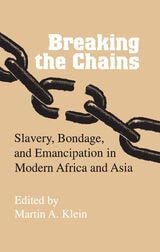
Breaking the Chains
Slavery, Bondage, and Emancipation in Modern Africa and AsiaMartin A. Klein
University of Wisconsin Press, 1993
“Martin Klein has brought together recent work on the abolition of slavery, from Ottoman Turkey to Thailand and from South India to West Africa. This anthology builds on the recent scholarship on both slavery in Asia and Africa and the end of slavery as a world-wide historical phenomenon. Whereas other anthologies have tended to focus on either Africa or Asia, this project brings together in one volume case studies and methodological approaches concerning both regions. Breaking the Chains will be an important part of the relatively sparse literature on emancipation in comparative and global context.”—Richard Roberts, Stanford University
Because the American history of slavery and emancipation tends to be foremost in Western minds, few realize that traditional forms of servitude still exist in a variety of places around the world: children are sold on the streets of Bangkok, bondage persists in India despite official efforts to abolish it, and until 1980 slavery was legal in Mauritania.
Breaking the Chains deals with emancipation in African and Asian societies which were either colonized or came under the domination of European powers in the nineteenth century. In these societies, emancipation involved the imposition on non-European societies of an explicitly European discourse on slavery, and, in most cases, a free labor ideology. Most of the slave masters described in these essays were not European and found European ideas on emancipation difficult to accept.
Against this backdrop, the essayists (many of whom contribute their own non-Western perspective) focus on the transition from slavery (or other forms of bondage) to emancipation. They show that in each case the process involved pressure from European abolition movements, the extension of capitalist relations of production, the concerns and perceptions of the colonial state, and the efforts of non-Western elites to modernize their cultures.
Martin A. Klein argues that the Asian and African experience has much in common with the American experience, particularly in efforts to control labor and family life. The struggle to control the labor of former slaves has often been intense and, he suggests, has had a continuing impact on the social order in former slave societies.

Breaking the Circle
Death and the Afterlife in BuddhismCarl B. Becker
Southern Illinois University Press, 1993
In this much-needed examination of Buddhist views of death and the afterlife, Carl B. Becker bridges the gap between books on death in the West and books on Buddhism in the East.
Other Western writers have addressed the mysteries surrounding death and the afterlife, but few have approached the topic from a Buddhist perspective. Here, Becker resolves questions that have troubled scholars since the beginning of Buddhism: How can Buddhism reconcile its belief in karma and rebirth with its denial of a permanent soul? What is reborn? And when, exactly, is the moment of death?
By systematically tracing Buddhism’s migration from India through China, Japan, and Tibet, Becker demonstrates how culture and environment affect Buddhist religious tradition.
In addition to discussing historical Buddhism, Becker shows how Buddhism resolves controversial current issues as well. In the face of modern medicine’s trend toward depersonalization, traditional Buddhist practices imbue the dying process with respect and dignity. At the same time, Buddhist tradition offers documented precedents for decision making in cases of suicide and euthanasia.
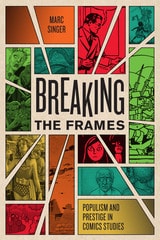
Breaking the Frames
Populism and Prestige in Comics StudiesBy Marc Singer
University of Texas Press, 2018
A CHOICE Outstanding Academic Title, 2019
Comics studies has reached a crossroads. Graphic novels have never received more attention and legitimation from scholars, but new canons and new critical discourses have created tensions within a field built on the populist rhetoric of cultural studies. As a result, comics studies has begun to cleave into distinct camps—based primarily in cultural or literary studies—that attempt to dictate the boundaries of the discipline or else resist disciplinarity itself. The consequence is a growing disconnect in the ways that comics scholars talk to each other—or, more frequently, do not talk to each other or even acknowledge each other’s work.
Breaking the Frames: Populism and Prestige in Comics Studies surveys the current state of comics scholarship, interrogating its dominant schools, questioning their mutual estrangement, and challenging their propensity to champion the comics they study. Marc Singer advocates for greater disciplinary diversity and methodological rigor in comics studies, making the case for a field that can embrace more critical and oppositional perspectives. Working through extended readings of some of the most acclaimed comics creators—including Marjane Satrapi, Alan Moore, Kyle Baker, and Chris Ware—Singer demonstrates how comics studies can break out of the celebratory frameworks and restrictive canons that currently define the field to produce new scholarship that expands our understanding of comics and their critics.
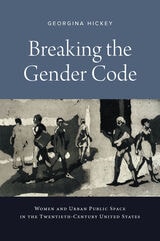
Breaking the Gender Code
Women and Urban Public Space in the Twentieth-Century United StatesGeorgina Hickey
University of Texas Press, 2023
A history of the activism that made public spaces in American cities more accessible to women.
From the closing years of the nineteenth century, women received subtle—and not so subtle—messages that they shouldn’t be in public. Or, if they were, that they were not safe. Breaking the Gender Code tells the story of both this danger narrative and the resistance to it.
Historian Georgina Hickey investigates challenges to the code of urban gender segregation in the twentieth century, focusing on organized advocacy to make the public spaces of American cities accessible to women. She traces waves of activism from the Progressive Era, with its calls for public restrooms, safe and accessible transportation, and public accommodations, through and beyond second-wave feminism, and its focus on the creation of alternative, women-only spaces and extensive anti-violence efforts. In doing so, Hickey explores how gender segregation intertwined with other systems of social control, as well as how class, race, and sexuality shaped activists' agendas and women's experiences of urban space. Drawing connections between the vulnerability of women in public spaces, real and presumed, and contemporary debates surrounding rape culture, bathroom bills, and domestic violence, Hickey unveils both the strikingly successful and the incomplete initiatives of activists who worked to open up public space to women.

Breaking the Jaws of Silence
Sixty American Poets Speak to the WorldSholeh Wolpé
University of Arkansas Press, 2013

Breaking the Land
The Transformation of Cotton, Tobacco, and Rice Cultures since 1880Pete Daniel
University of Illinois Press, 1985
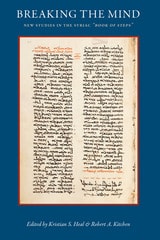
Breaking the Mind
Kristian S. Heal
Catholic University of America Press, 2014

Breaking the Silence
The German Who Exposed the Final Solution.Walter Laqueur and Richard Breitman
Brandeis University Press, 1994
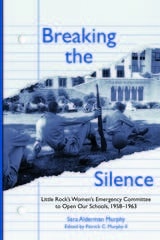
Breaking the Silence
The Little Rock Women's Emergency Committee to Open Our Schools, 1958–1963Sara Murphy
University of Arkansas Press, 1997
The Little Rock Central High School integration crisis did not end in1957 when President Eisenhower sent a portion of the first Airborne Division to protect nine black students. The turmoil was entering its second year in 1958 when Arkansas governor Orval Faubus invoked a hastily passed state law to close the high schools rather than obey the federal court orders that would integrate them.
A group of respectable, middle-class white women, faced with the prospect of no schools as well as the further loss of their city’s good name, turned militant. Led by Adolphine Fletcher Terry, a prominent, “old family” civic leader in her seventies, the women quickly put together the Women’s Emergency Committee to Open Our Schools (WEC), a highly effective organization that bombarded the city with ads, fliers, and statements challenging Faubus’s action. At peak membership, the WEC mustered two thousand to their cause. Largely inexperienced in politics when they joined the WEC, these women became articulate, confident promoters of public schools and helped others to understand that those schools must be fully integrated.
Forty years later, Sara Murphy, a key member of the WEC, recounts the rarely told sto1y of these courageous women who formed a resistance movement. With passion and sensitivity, she reconstructs the challenges and triumphs of that battle, which issued from the mutual link Southern white women shared with disfranchised African Americans in their common goal for full citizenship.

Breaking the South Slav Dream
The Rise and Fall of YugoslaviaKate Hudson
Pluto Press, 2003

Breaking the World
Black Insecurity and the Horizons of Speculative FictionJustin L. Mann
Duke University Press, 2026
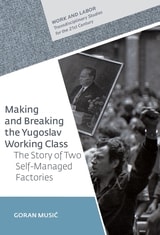
Making and Breaking the Yugoslav Working Class
The Story of Two Self-Managed FactoriesGoran Music
Central European University Press, 2021
Workers' self-management was one of the unique features of communist Yugoslavia. Goran Musić has investigated the changing ways in which blue-collar workers perceived the recurring crises of the regime. Two self-managed metal enterprises, one in Serbia another in Slovenia, provide the frame of the analysis in the time span between 1945 and 1989. These two factories became famous for strikes in 1988 that evoked echoes in popular discourses in former Yugoslavia. Drawing on interviews, factory publications and other media, local archives, and secondary literature, Musić analyzes the two cases, going beyond the clichés of political manipulation from the top and workers' intrinsic attraction to nationalism.
The author explains how, in the later phase of communist Yugoslavia, growing social inequalities among the workers and undemocratic practices inside the self-managed enterprises facilitated the spread of a nationalist and pro-market ideology on the shop floors. Yet rather than being a mass taken advantage of by populist leaders, the working class Musić presents is one with agency and voice, a force that played an important role in shaping the fate of the country. The book thus seeks to open a debate on the social processes leading up to the dissolution of Yugoslavia.

Softly, With Feeling
Joe Wilder and the Breaking of Barriers in American MusicEdward Berger
Temple University Press, 2014
"Joe Wilder set the table. His struggles made it easier for me and many others."--From the Foreword by Wynton Marsalis
Trumpeter Joe Wilder is distinguished for his achievements in both the jazz and classical worlds. He was a founding member of the Symphony of the New World, where he played first trumpet, and he performed as lead trumpet and soloist with Lionel Hampton, Jimmy Lunceford, Dizzy Gillespie, and Count Basie. Yet Wilder is also known as a pioneer who broke down racial barriers, the first African American to hold a principal chair in a Broadway show orchestra, and one of the first African Americans to join a network studio orchestra.
In Softly, with Feeling, Edward Berger tells Wilder's remarkable story-from his growing up in working-class Philadelphia to becoming one of the first 1,000 black Marines during World War II-with tremendous feeling and extensive reminiscences by Wilder and his colleagues, including renowned Philadelphia-area musicians Jimmy Heath and Buddy DeFranco. Berger also places Wilder's experiences within a broader context of American musical and social history.
Wilder's modesty and ability to perform in many musical genres may have prevented him from achieving popular recognition, but in Softly, with Feeling, his legacy and contributions to music and culture are assured.